

Sliding Gate Motor Singapore: Match Capacity to Weight
Three numbers decide which sliding gate motor you need in Singapore: the gate’s weight, its length and how many times it opens a day. Ignore any one of them and the motor fails early. A motor rated for a 600-kilogram gate will not last on a 1,000-kilogram steel gate. Here is how to match motor capacity to your gate and your traffic before you commit to an automatic gate installation.
What is a sliding gate motor, and how does it work?
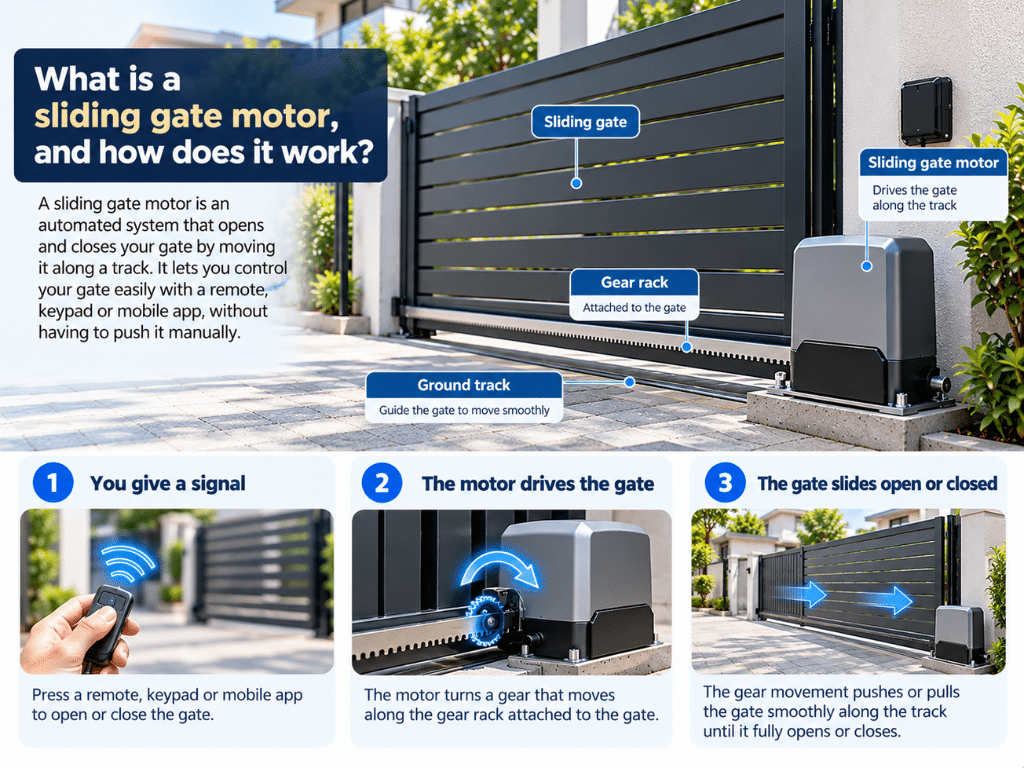
A sliding gate motor is a rack-and-pinion operator that moves a gate sideways along its track. A toothed rack runs along the length of the gate, and a pinion gear on the motor meshes with it to push the gate open and pull it closed.
Rack-and-pinion is the standard drive because it copes with heavy gates and constant use better than anything else. The drive force spreads along the gate instead of loading a single hinge, so a sliding gate can carry a heavier leaf than a swing gate on a motor of the same class. Residential sliding motors handle gates of 400 to 600 kilograms. Heavy-duty units go much further: the Dormer DE2 reaches 1,600 kilograms and the DEA Gulliver 2,500 kilograms. Power draw stays modest, with a Comunello FORT 400 using about 70 watts at its rated 400-kilogram load. Before you pick a motor, settle the gate itself, starting with whether a sliding or a swing gate suits your driveway.
How do you match motor capacity to gate weight?
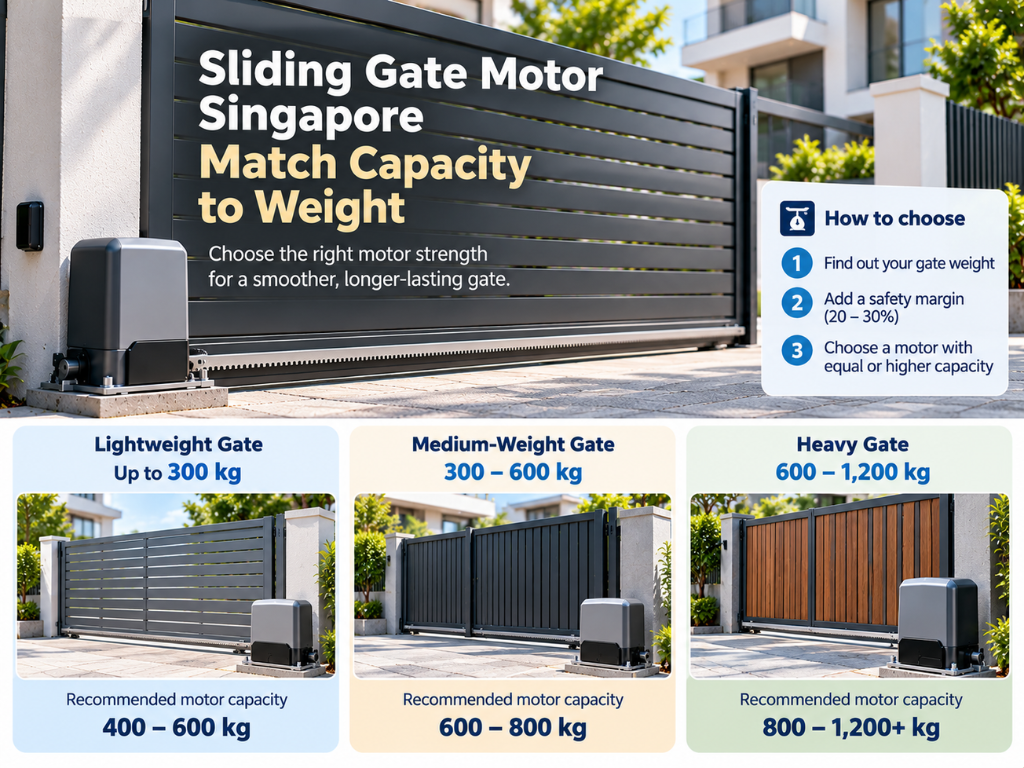
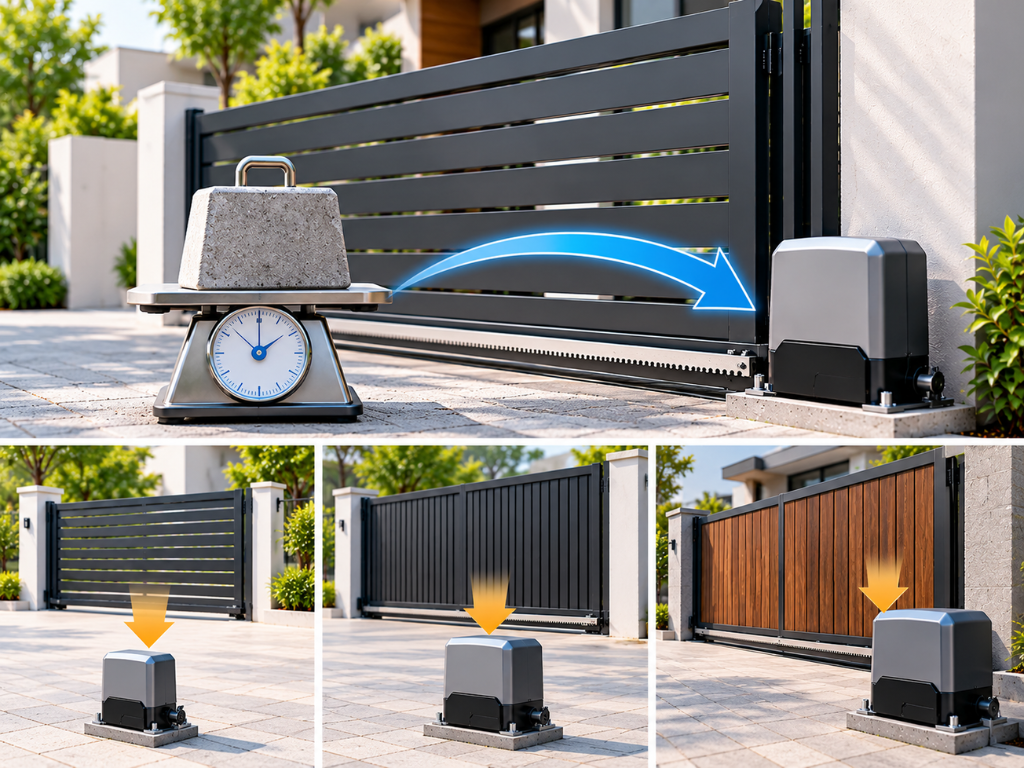
Pick a motor rated 20 to 30 percent above the actual gate weight. A motor rated at exactly the gate’s weight works at its limit on every cycle and wears out fast.
Weight starts with the material. A residential aluminium sliding gate often weighs 150 to 300 kilograms. A steel or wrought-iron gate of the same size can weigh 400 to 800 kilograms or more. That aluminium versus steel weight difference moves the motor rating more than anything else, so decide on the material before you choose the motor. Weigh the gate or calculate it from its size and material. Guessing is risky: a motor sized for aluminium will burn out under steel. A safe rule is to go one rating tier above the measured weight. The extra headroom covers wind load and the slow stiffening of the rollers as they age.
Does gate length matter as much as weight?
Yes. A longer gate carries more inertia and needs more force to start and stop, so a motor that matches the weight but falls short on length will strain on every cycle, even with a light gate.
Most buyers overlook length. Take an 8-metre sliding gate. It has more mass in motion and a longer rack to drive, so the motor works harder speeding it up and slowing it down than it would on a shorter gate of the same weight. Manufacturers rate sliding motors on maximum weight and maximum length, and a residential unit commonly covers gates up to 8 metres and 800 kilograms. Go past the length rating and the drive is overloaded every time the gate starts moving, even when the weight is within spec. Check the length against the motor’s spec as well as the weight. That check is often the difference between a motor that lasts a decade and one that struggles from the start.
How do daily cycles affect the motor you need?
Daily cycles set the duty cycle rating you need, meaning the share of time the motor can run before it has to rest. A gate that opens a few times a day runs fine on a residential motor. A gate that opens hundreds of times a day needs a high duty-cycle unit.
This is where condos and factories part ways with landed homes. A landed driveway gate opening ten times a day sits comfortably on a standard-duty motor. A condo side gate or factory gate cycling hundreds of times a day needs an intensive S1 duty-cycle motor, built to run continuously. Push a motor past its duty cycle and it overheats and wears its internal parts, which is the main reason commercial and residential motors are built differently. Put a residential motor on a high-traffic gate and expect it to fail within a couple of years when it should have lasted ten. Count the real number of daily openings. Gate size tells you nothing about duty cycle.
Single-phase or three-phase sliding motor?
Use a single-phase motor for gates up to about 1,500 kilograms and a three-phase motor for heavier industrial gates. Single-phase runs off the standard Singapore home supply. Three-phase needs an industrial feed, and in return it gives a heavy gate the torque it needs.
A single-phase 230-volt motor runs straight off a landed home’s supply and handles gates up to about 1,500 kilograms at moderate use. That covers most landed homes and small commercial sites. A three-phase motor handles gates from 1,500 to 4,000 kilograms. It starts with more torque, accelerates more smoothly and builds up less heat over repeated cycles, so it lasts longer on a busy industrial gate. Put a heavy industrial sliding gate on a single-phase motor and it is undersized from the first day. Choose the phase from the gate’s weight first, then confirm the site has the supply to match.
Magnetic or mechanical limit switch: which is better?
A magnetic limit switch is the better choice for a sliding gate motor. It has no moving parts to wear out, and it holds the open and closed positions accurately. A mechanical limit uses a lever or cam that wears and slowly drifts out of adjustment.
The limit switch tells the motor where to stop, and the difference between the two types shows up over years. A magnetic limit pairs a magnet on the gate with a sensor on the motor. Nothing touches, so it keeps its calibration, and modern 24-volt controllers tend to use it. A mechanical limit relies on a cam hitting a switch. Each impact shifts the stopping point slightly, until the gate overruns or stops short and someone has to readjust it. Specify a magnetic limit and you avoid that repeat service call. If your gate creeps a little further past its closed position every month, the cause is a worn mechanical limit. The motor itself is usually fine.
Why does the manual release key matter in Singapore?
The manual release key disengages the motor so you can push the gate by hand during a power cut. In Singapore, storms and lightning knock out power often enough that this matters. Without an accessible manual release, a power failure can trap your car behind the gate.
Every sliding gate motor comes with a key-operated release that unlocks the drive and lets the gate slide freely. It is a small part that matters at the worst possible moment. The Meteorological Service Singapore records some of the highest lightning activity in the world, and the power cuts that follow mean owners here use the release for real. A 24-volt DC motor with battery backup avoids the problem for as long as the battery lasts, because it keeps opening the gate through a blackout. Know where your release key is and check that it turns freely. A release that has rusted solid is as useless as having none.
How do track debris and standing water affect a sliding motor?
Debris and standing water in the track make the gate drag, so the motor has to push against extra resistance on every cycle and wears out sooner. Singapore’s heavy rain washes grit and leaves into the floor track and leaves puddles behind.
In this climate, the track is the weak point of a sliding gate. Leaves, sand and grit collect in the ground track and jam the rollers. Water left standing after a downpour corrodes the track and the bottom edge of the gate. Either way, the motor ends up straining against a gate that no longer rolls freely. Keeping the track clean and well drained is basic maintenance, and it is where heavy-duty sliding gate upkeep begins. A cantilever sliding gate avoids the issue altogether. It runs on cantilever rollers with no ground track, though the hardware costs more. When a motor struggles with a dragging gate, check the track first. That is usually where the problem is.
How do you choose and install a sliding gate motor in Singapore?
Choose a sliding gate motor on weight, length and daily cycles, then match the phase, the limit type and the safety devices. A proper specification lists the rated weight and length, the duty cycle and the control features.
Measure the gate before you look at motors. Weigh it or calculate the weight from its material and size, measure the length, and count how many times it really opens each day. Then pick a motor rated above all three. Specify a magnetic limit, make sure the manual release is easy to reach, and fit the safety devices needed for power-operated gate safety under EN 12453. Plan proper drainage for the track, or go with a cantilever gate if water is a problem on your site. When you are ready, book a gate assessment and the motor will be matched to your measured gate and actual traffic.
Sizing a sliding gate motor that lasts
Match a sliding gate motor on weight, length and daily cycles together, with headroom on each and a 20 to 30 percent margin on weight. Set the phase to the load, and choose a magnetic limit over a mechanical one. Keep the manual release free, and clear the debris and water that Singapore’s rain leaves in the track. Size the motor to all three numbers and it should run for a decade. Size it to one and it can burn out in two years.
Enforce Automatic Global supplies, installs and maintains sliding gate motors for landed homes, condos and industrial sites across Singapore. Book a gate assessment with Enforce to have your gate weighed and measured and your daily cycles counted, then get a motor matched to all three, with the right limit switch, manual release and safety devices.
Frequently asked questions
What size sliding gate motor do I need for my gate?
Size the motor to your gate’s weight, length and daily cycles, with a 20 to 30 percent margin. A residential motor handles gates up to around 600 kilograms and 8 metres. A heavy gate over 1,500 kilograms needs a three-phase unit. Work out the weight from the gate’s material first, because an aluminium gate and a steel gate of the same size weigh very different amounts.
How much does a sliding gate motor cost in Singapore?
The price depends on the rated capacity, the voltage and phase, the duty cycle and the brand. The range runs from a residential single-phase unit to a three-phase industrial operator. A 24-volt DC motor with battery backup and a magnetic limit costs more than a basic 230-volt unit. A site assessment fixes the specification for your gate before pricing.
Can a sliding gate motor handle a steel gate?
Yes, as long as the motor is rated for the steel gate’s weight. Steel and wrought-iron gates weigh 400 to 800 kilograms or more, far heavier than aluminium, so they need a higher-rated motor. Above 1,500 kilograms, that means a three-phase unit. A motor sized for an aluminium gate and fitted to a steel one will fail early.
How many cycles a day can a sliding gate motor handle?
That depends on the motor’s duty cycle rating. A residential motor suits a landed gate opening tens of times a day. An intensive S1 duty-cycle motor is built to run continuously, for a condo or factory gate that cycles hundreds of times a day. Run a motor past its duty cycle and it overheats and fails early, just as an undersized one would.