

Aluminium vs Steel Gate Singapore: Which Lasts?
The aluminium vs steel gate question in Singapore comes down to one factor most quotes skip: how each metal handles salt air. Coastal estates near East Coast and Sentosa sit in an atmosphere that international corrosion standards rate among the most aggressive on the scale. This blog walks you through which material lasts longer by the coast, across fabricated gate options, weight, motor load and lifetime cost.
Aluminium or steel: which is better for a Singapore gate?
For most Singapore homes, aluminium is the better default; steel earns its place only where structural load or budget overrides corrosion risk. Aluminium weighs about a third of mild steel, roughly 2.7 grams per cubic centimetre against 7.85, and it forms its own protective oxide layer that resists salt air without coating.
Mild steel still wins on raw strength per dollar, which is why it appears on wide cantilever spans, industrial gates and high-security barriers. The trade-off is permanent. Steel must be galvanised or kept under an intact paint film for its whole life, while aluminium defends itself. The honest split, before any coast factor enters: aluminium for daily-use residential driveway gates, steel where the load or the price tag rules.
Which gate material actually lasts longer by the coast?
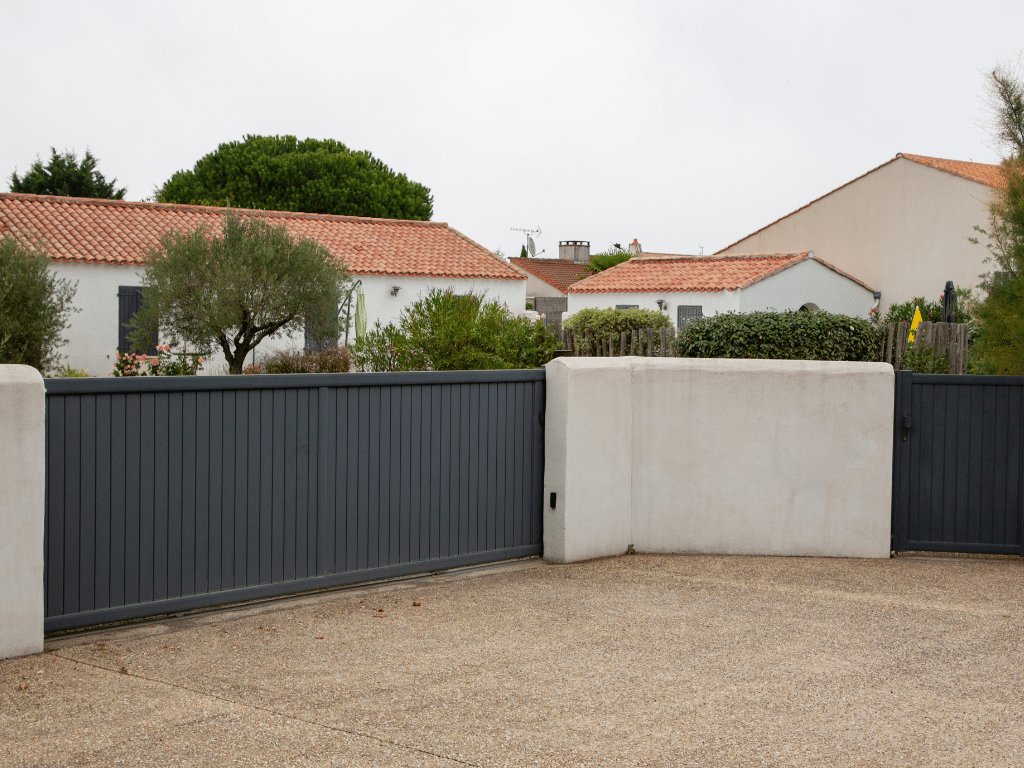
By the coast, aluminium lasts significantly longer than uncoated or coating-breached steel, and the gap is measurable. Under the ISO 9223 atmospheric corrosivity standard, a marine atmosphere classifies as corrosivity class C4 to C5, with first-year carbon steel loss of 50 to 80 micrometres per year. An inland urban site sits at class C2, between 1.3 and 25 micrometres per year.
That is a multiple, not a rounding error. An atmospheric corrosion study measuring carbon steel, galvanised steel and stainless across urban and marine exposure found marine sites pushed both carbon and galvanised steel into the C4-C5 bracket, while stainless showed only superficial staining after the same exposure. Aluminium’s passive oxide behaves closer to the stainless end of that spectrum. For a gate that lives 50 metres from the sea, the material decision is a corrosion decision first and an aesthetic decision second.
Why does steel corrode faster in salt air?
Steel corrodes faster by the coast because airborne chloride from sea spray is hygroscopic: it holds moisture against the metal surface and keeps it electrochemically active. Salt does not just sit there. It maintains a continuously damp film that drives rust even on days without rain.
Aluminium sidesteps this. It reacts with oxygen to form a thin, stable aluminium oxide layer that seals the surface and self-repairs when scratched. Steel’s iron oxide does the opposite, flaking off to expose fresh metal underneath. Published coastal chloride corrosion data shows chloride deposition is the single most detrimental factor for steel near the coast, with corrosion risk rising sharply the closer a structure sits to the shoreline. This is the mechanism behind every rusted seafront gate in Singapore, and it does not slow down with age.
Does galvanising or powder coating solve steel’s corrosion problem?
Galvanising and powder coating delay steel corrosion; they do not end it. Hot-dip galvanising adds a sacrificial zinc layer that buys years, and powder coating adds a colour film on top, but both are barriers with a finite life in a C4-C5 marine atmosphere.
The weakness is the breach. A scratch, a drilled hole for a hinge, or a coating chip exposes bare steel, and chloride attacks that point preferentially. Once rust starts under a coat, it spreads beneath the film where you cannot see it until it bubbles. Worth noting: a coated steel gate that looks fine can be corroding underneath, while bare aluminium has no coat to fail. The cleaner approach by the coast is to remove the failure point entirely rather than maintain a barrier against it, which is the structural case for aluminium over coated steel in salt air.
How does gate weight change the motor and the running cost?
Gate weight directly sets the motor size, and a heavier steel gate forces a higher-rated operator that draws more power and wears faster. A sliding steel gate at three times the mass of an aluminium equivalent loads the motor, the rollers and the rack on every cycle.
That load compounds over a gate’s life. A motor pushing a heavier leaf runs hotter, and heat is what kills gate operators. The geometry of the opening matters here too, which we cover in our comparison of sliding versus swing layouts. Most of the common gate motor failures we see trace back to an operator working harder than it should, often because the gate is heavier than the motor was sized for. A lighter aluminium leaf lets you specify a smaller operator, which costs less to buy and less to run across a decade of daily cycles.
Is aluminium strong enough, or do you actually need steel?
For standard residential driveway gates, aluminium alloy 6063-T5 is strong enough; you need steel only for exceptional spans or security loads. The alloy handles normal gate widths while staying light enough for a modest motor, which is why it dominates landed-home automatic gate work.
Steel becomes the right answer at the extremes: very wide cantilever gates with no ground track, industrial perimeters expecting impact, or sites where a security specification demands the mass. For those, the strength per dollar of mild steel justifies the corrosion maintenance that follows. The reason aluminium fits most automatic gate systems on Singapore landed homes is that residential spans rarely reach the point where steel’s strength advantage outweighs its weight and corrosion penalties.
Which gate needs more maintenance over its life?
Steel needs materially more maintenance than aluminium, and the gap widens near the coast. A coated steel gate requires periodic inspection for coat breaches, touch-up painting and eventual recoating, because the barrier protecting it has a finite service life in salt air.
Aluminium’s maintenance is mostly cosmetic: wash off salt deposits, keep the powder coat clean, and the metal underneath defends itself. There is no sacrificial layer to renew. For a coastal landed home, that difference shows up as a steel gate needing attention every few years against an aluminium gate that mostly needs washing. The lifetime cost of ownership, not the purchase price, is where aluminium pulls ahead on the coast.
Which is the right call for your property type?
Match the metal to the site. For a coastal landed home within sight of the sea, aluminium is the clear choice, because the C4-C5 corrosivity there punishes steel and its coatings hardest. For an inland landed home, both work, and the decision shifts to weight, motor cost and looks rather than corrosion.
For an industrial or high-security site, steel’s strength and lower material cost often justify the maintenance burden, especially where gates are very wide or built to take impact. Budget and span drive that call. The cost variables behind either choice, including motor and installation, are broken down in our guide to what drives autogate cost. The single worst outcome is a coated steel gate on a seafront driveway, chosen on purchase price, that corrodes through its coat within a few years.
Conclusion
By the coast, the aluminium vs steel decision is settled by chemistry, not preference. Salt air rates as a C4-C5 corrosivity environment that attacks steel and its coatings far faster than the inland average, while aluminium’s self-healing oxide and lighter weight win on lifespan, motor load and maintenance. Steel keeps its place inland and on heavy industrial spans, where strength and price lead.
Choosing a gate for a coastal or landed property? Send your driveway dimensions and location to Enforce for a material recommendation and fabrication quote matched to your site’s corrosion exposure.
Frequently asked questions
Is an aluminium or steel gate cheaper in Singapore?
Steel is usually cheaper to buy per kilogram, but aluminium is often cheaper to own over a decade once coastal maintenance and recoating are counted. For a seafront property in a C4-C5 corrosivity zone, aluminium’s freedom from coating upkeep typically offsets its higher purchase price.
How long does a powder-coated aluminium gate last in Singapore?
A correctly powder-coated aluminium gate of around 60 to 80 microns holds 10 to 15 years before noticeable fade, and the aluminium structure beneath lasts far longer because it self-protects. Coastal salt exposure ages the coat faster, but the metal itself does not rust like steel.
Can a rusted steel gate be repaired, or does it need replacing?
Surface rust on a steel gate can be treated and recoated, but corrosion that has eaten through the section or spread under the coating usually means replacement. In a marine atmosphere classed C4-C5 by ISO 9223, repairs buy time rather than solve the problem, since the chloride exposure continues.