

Telescopic Gate Singapore: Fix for Tight Driveways
A telescopic gate in Singapore solves the one problem a single sliding gate cannot: a driveway with too little side space for the gate to retract into. On narrow landed plots where the opening is 3.5 metres but the fence run beside it is shorter, the maths simply does not work for a single leaf. This blog walks you through how telescopic gates fix that, across automatic sliding gate systems and their leaf, motor and cost trade-offs.
What is a telescopic gate and how does it work?
A telescopic gate is a sliding gate split into two or more leaves that overlap and stack behind one another as they open, so the gate needs far less side space than a single sliding leaf. The leaves run on parallel ground tracks, linked by a cable-pulling kit that drives them in sync from a single motor.
The mechanism is the clever part. The motor pulls the main leaf, and a cable system drags the second and third leaves along at the same time, so they all finish open together. Because the outer leaf has further to travel in the same time, it moves faster than the inner one. A two-leaf gate stacks into roughly half the run of a single slider, and a three-leaf gate packs tighter still. The result is a wide clear opening achieved in a fraction of the lateral space a conventional sliding gate demands.
Why is a telescopic gate the fix for short driveways and tight side space?
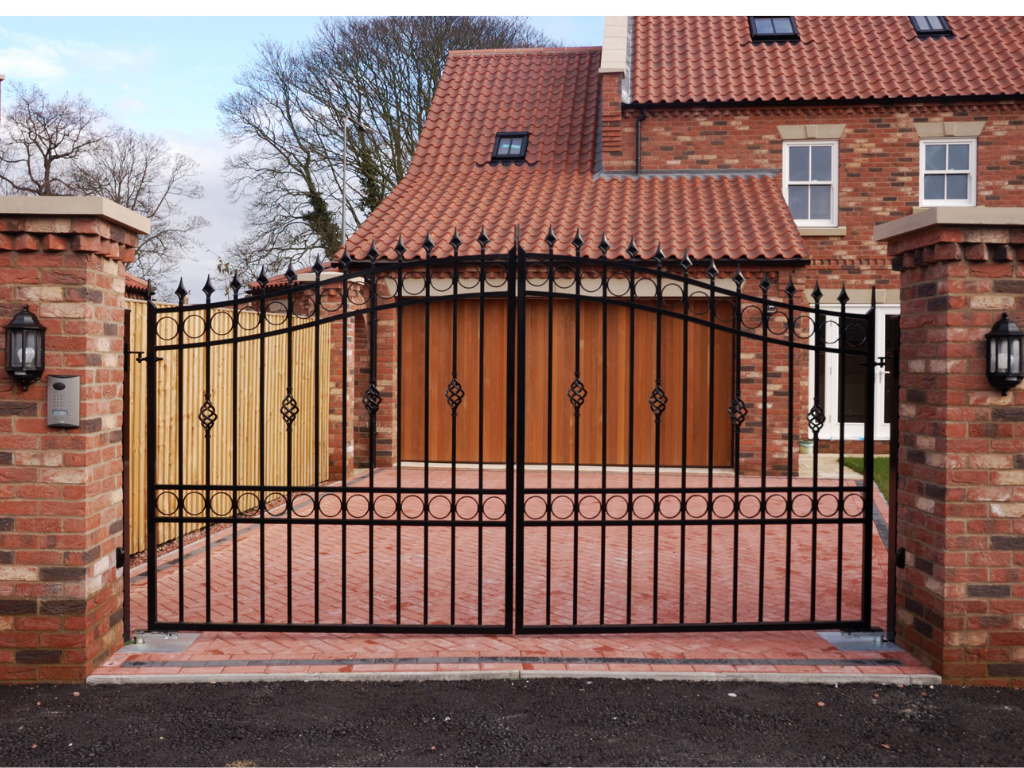
A telescopic gate works because it removes the single sliding gate’s fatal constraint: runback. A single sliding leaf must travel its full width clear of the opening, so a 3.5 metre gate needs at least 3.5 metres of clear fence beside it, plus margin for end stops. Many Singapore landed plots do not have that.
Tight frontages are common here. Terrace and semi-detached homes often have a boundary wall, a planter or the neighbour’s structure right where a single slider would need to retract. Splitting the gate into overlapping leaves cuts the required runback roughly in half for two leaves, which is frequently the difference between a sliding solution fitting and not fitting. Where a single slider has nowhere to go, a telescopic gate gives the same drive-through width while stacking into the short space available. That is the entire reason the product exists.
How much runback and side clearance does a telescopic gate actually save?
A two-leaf telescopic gate needs roughly half the runback of a single sliding gate for the same opening; a three-leaf design reduces the stacking length further again. For a 4 metre opening, a single slider needs over 4 metres of clear side run, while a two-leaf telescopic needs closer to 2 metres.
The savings scale with leaf count. Published telescopic runback engineering from gate manufacturers shows a three-leaf configuration reducing the required run back by up to 30% compared with arrangements that use fewer leaves, while still reaching clear openings of up to 18 metres on industrial systems. For a Singapore landed driveway, the practical takeaway is simpler: if your usable side space is shorter than your gate is wide, leaf count is the lever that makes a sliding gate possible at all.
Telescopic, single sliding, or swing: which suits a narrow frontage?
For a narrow frontage with limited side space, telescopic beats both single sliding and swing in most cases. A single slider is ruled out when runback is shorter than the gate width. A swing gate needs clear arc space in front, which a short driveway with parked cars rarely has.
Swing gates do tolerate uneven ground better, since they pivot off hinges rather than running on a track, a trade-off covered in our comparison of sliding versus swing clearance. The cleaner approach on a tight, flat landed driveway is telescopic: it gives the full opening width, needs no swing arc, and stacks into space a single slider cannot use. Where this breaks down is on very rough or sloping ground, where a trackless folding gate becomes the better answer. For the standard short Singapore driveway, telescopic is the default fix.
Two leaves or three: how do you choose?
Choose two leaves when you need to roughly halve runback, and three when side space is extremely tight or the opening is very wide. A two-leaf telescopic gate handles most Singapore landed driveways with a 3 to 5 metre opening. A three-leaf gate is for openings beyond that, or plots where the stacking space is severely limited.
More leaves mean more compactness but more cost and complexity, since each added leaf needs its own track and synchronisation. A multi-leaf gate configuration is worth specifying only when two leaves cannot stack into the available space. Worth noting: most residential sites are solved with two leaves, and jumping to three without a space reason adds cost for no benefit. Match the leaf count to the runback you actually have, measured on site, not to a spec-sheet maximum.
How does the multi-leaf mechanism affect the motor and speed?
The multi-leaf design raises effective motor load, because the outer leaf travels at a multiple of the inner leaf’s speed. On a two-leaf gate the front leaf moves at twice the inner leaf’s pace; on a three-leaf gate the leading leaf can move at four times the speed of the rear one.
That speed difference matters for sizing. The motor sees a higher effective mass than a single equivalent gate, so a properly rated operator with electronic speed control is not optional, it is the difference between a gate that lasts and one that fails early. Published multi-leaf synchronisation mechanics recommend a low-voltage geared motor with modern electronics that slow the stroke at each end to protect the faster-moving leaf. Most of the common gate motor failures we see on multi-leaf gates trace back to an undersized operator fighting that compounded load. Specify the motor for the real load, not the headline gate width.
What does a telescopic gate cost in Singapore?
A telescopic gate costs more than a single sliding gate of the same opening, because it carries multiple leaves, multiple tracks, a synchronisation kit and a higher-rated motor. The price is driven by leaf count, material, finish and the operator specification rather than by the opening width alone.
Material choice sits underneath that. Aluminium alloy 6063 keeps each leaf light, which lets you specify a smaller motor and reduces long-term wear, while steel adds mass and cost to the operator. The full set of cost variables, including motor and installation, is broken down in our guide to what drives autogate cost. The reason a telescopic quote sits above a single-slider quote is the extra leaf, track and synchronisation hardware, not a premium on the same gate. You are paying for the space-saving mechanism, and on a tight site that mechanism is what makes a sliding gate possible.
What maintenance and safety does a telescopic gate need?
A telescopic gate needs clean, aligned tracks and active safety devices on every moving leaf. The overlapping leaves create shearing points where one leaf passes another, so sensitive safety edges and photocell sensors are required, not optional extras.
Track discipline is the maintenance core. Multiple parallel tracks mean more surface to keep free of debris and standing water, both of which raise friction and trigger false sensor stops. Keep the tracks clear, check the cable-pulling kit tension, and the gate runs for years. The shearing-edge risk is the safety item that separates a telescopic gate from a single slider: every leaf gap needs a sensitive edge so the gate reverses on contact. Skipping that protection to save cost is the one shortcut no installer should accept on a multi-leaf gate.
Conclusion
A telescopic gate exists for one job: giving a full drive-through opening on a site that cannot spare the side space a single sliding gate demands. Two overlapping leaves roughly halve the runback, three cut it further, and the only real costs are the extra hardware and a properly sized motor to handle the faster outer leaf. On a short Singapore driveway, it is usually the fix.
Not sure your driveway has the runback for a single slider? Send your gate opening width and a photo of the side space to Enforce for a telescopic gate assessment and quote matched to your frontage.
Frequently asked questions
Is a telescopic gate good for a landed home or only for industrial sites?
Telescopic gates suit both. On Singapore landed homes they solve short driveways where a single sliding gate has no runback, typically with a two-leaf design for a 3 to 5 metre opening. Industrial sites use three or more leaves to cover openings up to around 18 metres where side space is still limited.
How wide an opening can a telescopic gate cover?
Telescopic gates cover openings from about 4 metres on a two-leaf residential setup to roughly 18 metres on three-leaf industrial systems, according to gate manufacturer engineering data. The wider the opening and the tighter the stacking space, the more leaves the configuration needs.
Can an existing single sliding gate be converted to telescopic?
Converting is rarely worth it. A telescopic gate needs multiple parallel ground tracks, a synchronisation kit and usually a different motor, so most conversions amount to a new installation. Enforce assesses the driveway runback on site to confirm whether two or three leaves fit before quoting.