

Switchable Privacy Glass Singapore: Where It Works
Switchable privacy glass turns a clear panel opaque at the flick of a switch, and in Singapore it shows up most in meeting rooms, clinics and bathrooms. Buildings here run air-conditioning all day, and the sector draws close to 38% of national electricity, so every glazing choice carries weight. This blog walks you through where switchable smart glass earns its place, and where it does not.
What is switchable privacy glass, and how does it actually work?
Switchable privacy glass is glass with a polymer-dispersed liquid crystal (PDLC) layer that flips between clear and opaque when you apply or cut electrical power. With the power off, the liquid crystals scatter light at random and the glass reads as a frosted, milky white. Switch the power on, the crystals line up, and the panel turns clear in milliseconds.
The film is the engine. PDLC is laminated between two panes of tempered glass to form a sealed unit, or supplied as a self-adhesive smart film that bonds to existing glass. Both behave the same optically. The key working fact people miss: privacy is the unpowered, resting state, and transparency is what costs electricity. That single behaviour shapes nearly every good and bad use case in this article.
Where does switchable privacy glass actually work in Singapore?
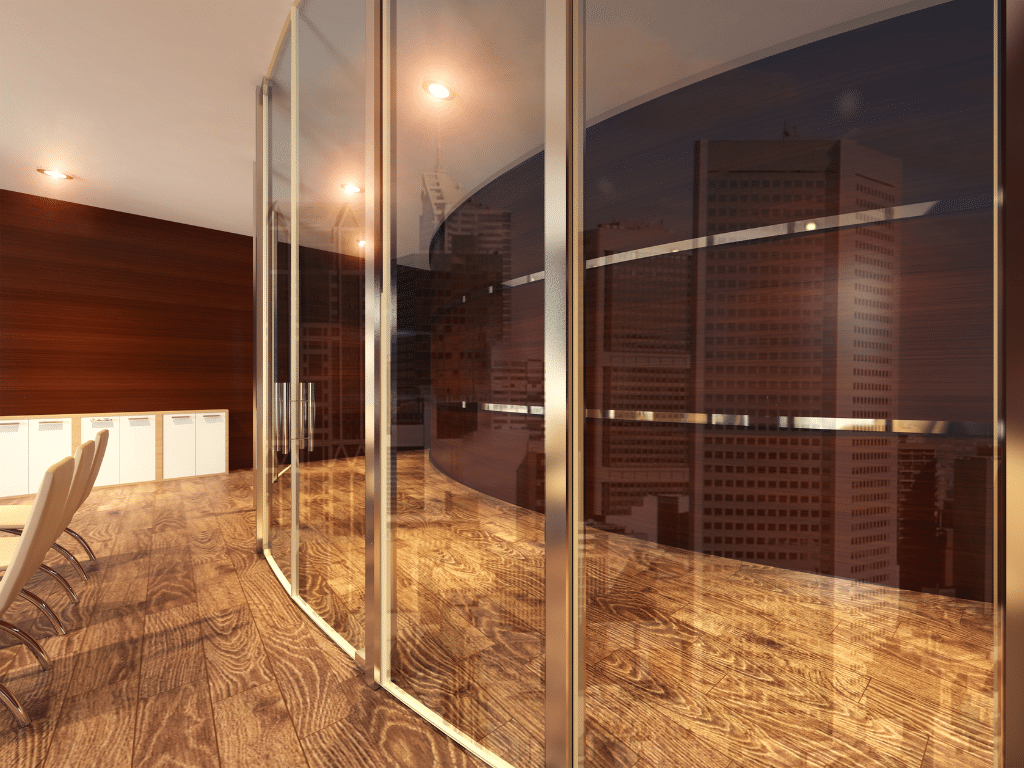
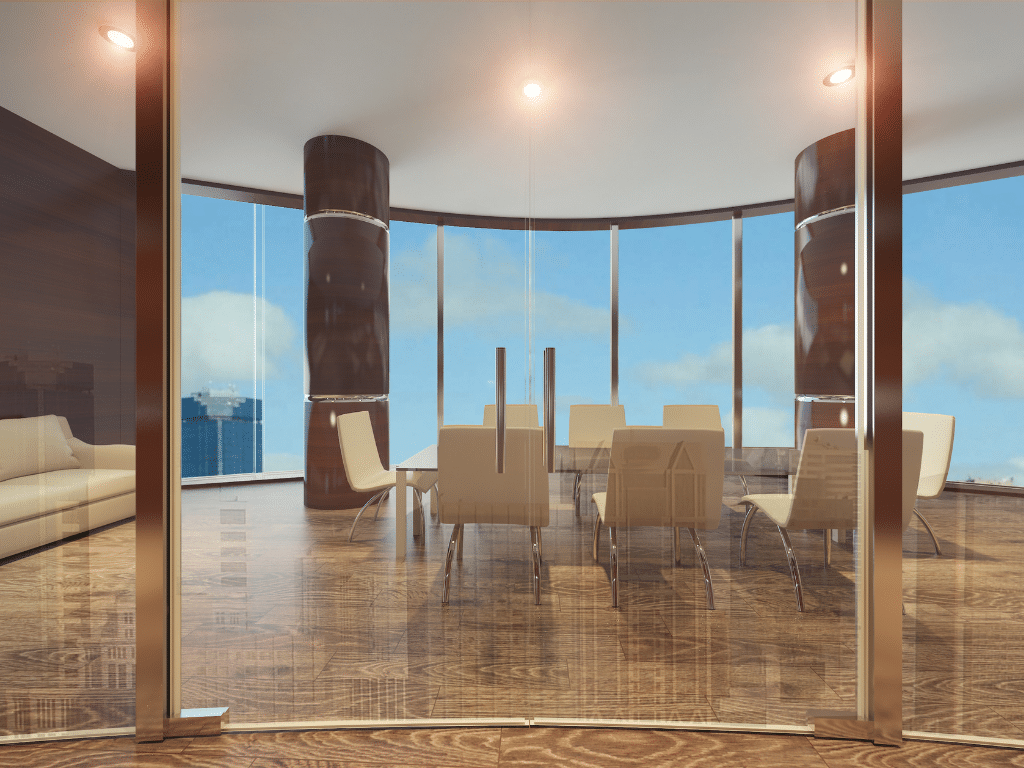
Switchable privacy glass works best on interior partitions where privacy needs to switch on and off: boardrooms, doctors’ consultation rooms, clinic recovery bays and ensuite bathrooms. These are spaces that want daylight and openness most of the time, then instant privacy for a meeting or examination.
Meeting rooms are the clearest fit. A glass-walled boardroom stays open and bright, then turns opaque for a confidential session without anyone hanging blinds. Clinics use it for the same reason, with the bonus that a sealed glass surface wipes down cleanly. For bathrooms in landed homes and hotel suites, a single switched panel replaces a curtain that grows mould in Singapore’s humidity. This is where it sits alongside framed glazing work and movable wall partitions in a fit-out, not in place of them. The common thread is interior use, switched on demand, at human scale rather than full façade height.
Where does smart glass fall short, and when should you skip it?
Skip switchable privacy glass on west-facing external façades and anywhere you need true blackout. In its opaque state PDLC is translucent, not black. It blurs shapes and stops you from reading detail, but it still passes diffuse light, so a lit room glows visibly from outside at night.
That rules out bedrooms expecting cinema-grade darkness and any brief that treats privacy as full visual blackout. Cost is the second filter. At several times the price of a frosted panel plus a blind, the glass only earns its premium where switching genuinely matters. The honest position: for a fixed-privacy bathroom window that never needs to be clear, frosted or laminated glass does the job for less, and a sliding glass layout like bi-parting glass entrances solves a different problem entirely. Specify smart glass for the switching, or do not specify it at all.
Smart glass or retrofit smart film: which should you choose?
Choose laminated smart glass for new builds and full panel replacements; choose retrofit smart film when you cannot shut the space down. Laminated glass seals the PDLC layer between two tempered panes, so the film edges are protected and the unit lasts longer in a humid climate.
Retrofit film is the pragmatic option for an occupied office. It bonds to the room side of existing glazing in hours, with no glass removal and no downtime, which matters when the alternative is closing a working clinic or boardroom. The trade-off is exposure: a surface-applied film has open edges that age faster than a hermetically sealed laminate. The cleaner approach for permanent installs is laminated glass; reserve film for upgrades to spaces like ultra-slim glass doors and partitions already in daily use. Match the method to whether the glass is going in fresh or going onto something that already exists.
How much power does switchable privacy glass use, and how is it wired?
Switchable privacy glass runs on low-voltage alternating current, typically 48 to 60 volts AC, stepped down from mains by a small transformer. It draws only when clear. In the powered, transparent state the film consumes roughly 3 to 5 watts per square metre, and in the opaque state it draws zero.
Direct current degrades the liquid crystals, so the system must run on AC, with a driver delivering around 100 milliamps per square metre according to published PDLC driver specifications. To put the draw in perspective, ten square metres of switched glass uses less power than a single old incandescent bulb. The wiring detail that matters on site: the transformer needs a home, usually above the ceiling or in a nearby riser, and the switch line has to be planned before the partition goes up. Retrofitting power into a finished wall is the avoidable cost most clients hit.
Does switchable glass actually cut heat and energy in Singapore’s climate?
For interior partitions, the energy story is mostly about lighting and comfort, not air-conditioning load, because indoor glass sees no direct sun. The real envelope number in Singapore is ETTV, the Envelope Thermal Transfer Value, capped by BCA at 50 watts per square metre for air-conditioned buildings. Interior smart glass does not touch that figure.
On external glazing the picture changes. Solar-control PDLC rejects a meaningful share of ultraviolet and near-infrared radiation in its translucent state, which peer-reviewed PDLC testing measures across film thickness and area. That helps on a façade, yet standard privacy PDLC is not primarily a solar-control product, and treating it as one oversells it. Worth noting: in the tropics, the durable energy win from interior smart glass is replacing blinds and reducing the need for artificial light in glass-walled rooms, not slashing the cooling bill.
Is the glass private when the power goes off?
Yes, and this is the most useful design feature of PDLC. With power removed, the glass returns to its opaque, frosted state, so a power cut leaves a meeting room or consultation room private rather than suddenly exposed. The default is privacy, not transparency.
Spec the glass to fail private, not exposed, and the failure mode works in your favour. The flip side is that holding the glass clear during a long meeting means keeping it powered the whole time, which is the 3 to 5 watts per square metre noted earlier. For a clinic or boardroom, defaulting to private on any outage is exactly the behaviour you want, and it is one reason switchable glass beats motorised blinds for sensitive rooms. A blind stuck half-open during a power failure offers neither privacy nor a clean look.
What drives the cost of switchable privacy glass in Singapore?
Switchable privacy glass is priced on four variables: panel area, glass build, film grade and electrical work. The film and lamination sit well above plain tempered glass per square metre, so total panel size is the biggest single driver.
Laminated smart glass costs more than retrofit film because it includes two tempered panes and factory lamination, while film saves on glass but adds edge-exposure risk over time. Control complexity adds up next: a single wall switch is cheap, while dimming, app control or zoning each add hardware and wiring. The transformer, busbar connections and concealed cabling are real line items that a frosted-glass-plus-blind quote does not carry. The reason a smart glass quote dwarfs a frosted one is the switching: you are paying for the PDLC layer, the driver and the install, not just the glass.
Conclusion
Switchable privacy glass is a precise tool, not a universal upgrade. It is built for interior partitions that need privacy on demand, it stays private when the power drops, and it costs what it costs because you are buying the switching, not the glass. Use it where switching matters, and reach for frosted glass or a blind where it does not.
Planning a meeting room, clinic or bathroom fit-out? Send your panel dimensions and a site photo to Enforce for a switchable glass assessment and quote on switchable smart glass.
Frequently asked questions
Can you retrofit smart film onto existing glass?
Yes. PDLC smart film is a self-adhesive layer that bonds to the room side of existing glazing without removing the glass, which makes it the common choice for occupied Singapore offices. Laminated smart glass is the more durable option for new builds, since the PDLC sits sealed between two tempered panes.
Is switchable privacy glass see-through at night?
No, but it is not blackout either. In its opaque state PDLC is translucent: it blocks clear sightlines and detail, yet a lit room still glows through it after dark. For true darkness, smart glass is the wrong product, and a blackout blind or solid panel is the correct one.
How is smart glass different from electrochromic or SPD glass?
PDLC switches between clear and opaque for privacy in milliseconds. Electrochromic glass tints gradually for solar control over several minutes, and suspended particle device (SPD) glass darkens to block glare. For on-demand interior privacy in Singapore, PDLC is the practical and most widely installed choice.
How long does switchable privacy glass last?
A correctly installed laminated PDLC unit running on the right 48 to 60 volt AC supply typically performs for over a decade, since the film draws zero power in its resting opaque state. Running the film on DC instead of AC is the fastest way to fail it early.