

Industrial Sliding Gate Motor Singapore: Duty & Weight
An industrial sliding gate motor in Singapore has to run continuously and move a gate many times heavier than anything on a landed home. A landed driveway might see a handful of cycles a day. A factory gate sees hundreds. If the motor fails at a shift change, the lorries stop, and soon after, so does the plant. Here is how duty cycle, gate weight and shift patterns shape the motor in an automatic gate system built for a worksite.
What is an industrial sliding gate motor, and how does it differ?
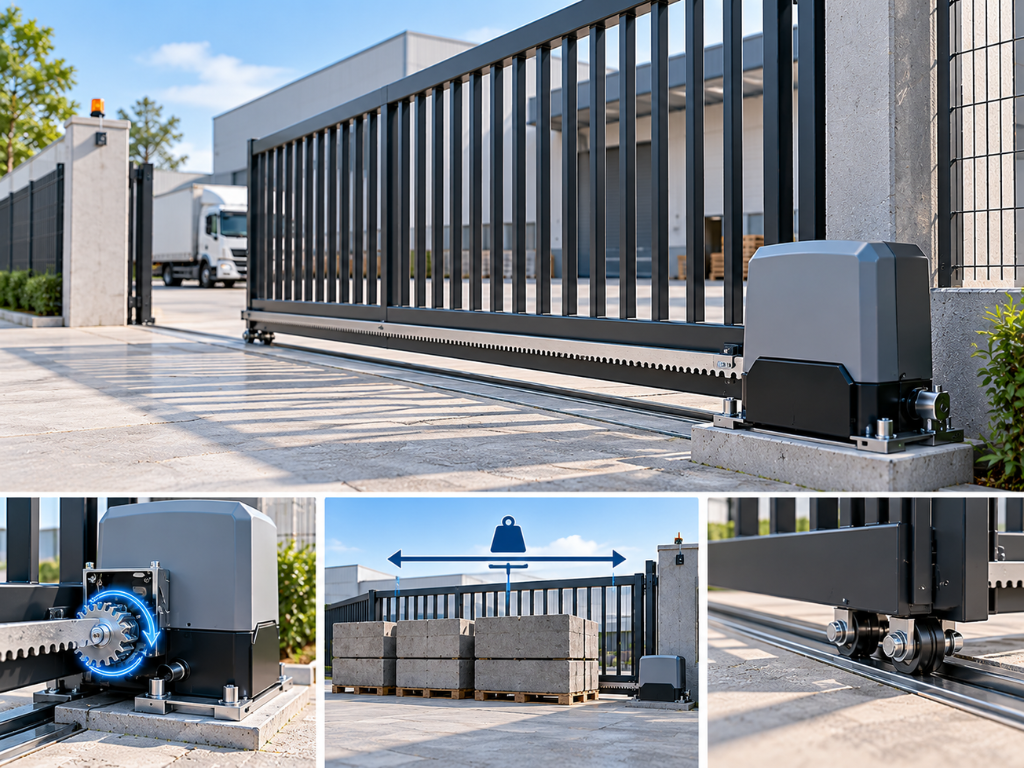
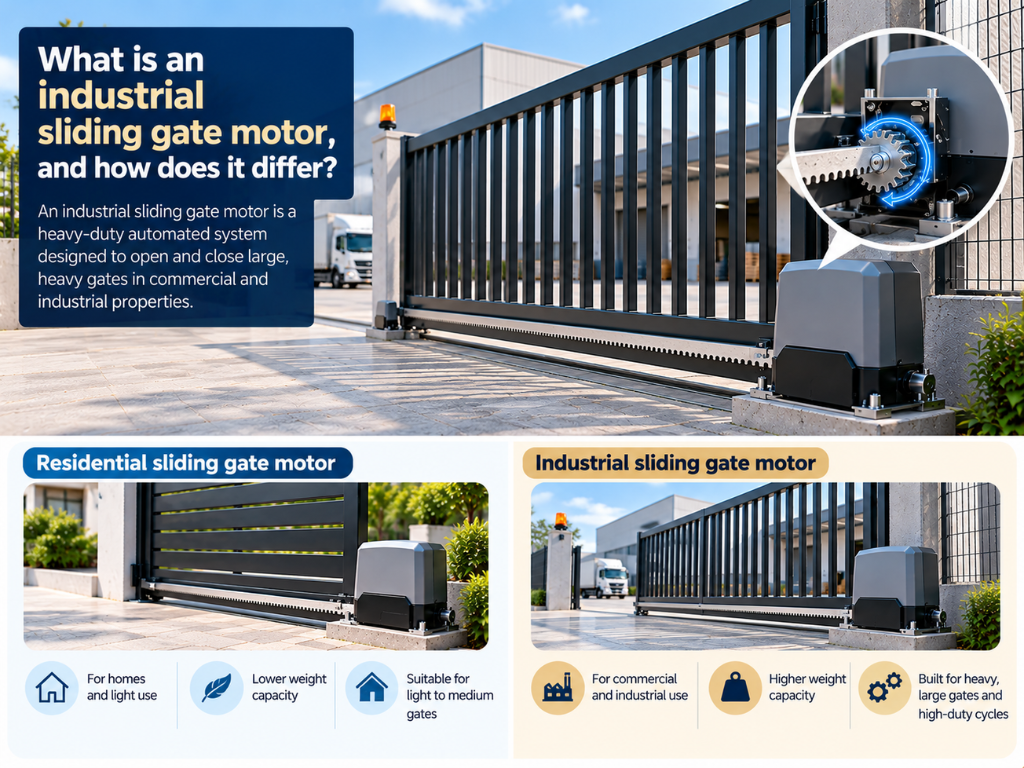
An industrial sliding gate motor is a heavy-duty operator built to drive gates far heavier than any residential unit can, and to run all day without overheating. It has a high-torque motor, built-in overload protection and an oil-bath gearbox, none of which a light-duty operator carries.
Weight capacity is one difference. Run time is the bigger one. A residential motor handles a gate up to around 600 kilograms and is rated for a limited number of cycles per hour. An industrial operator such as the Quiko TITANO drives gates of 3,000 to 6,000 kilograms on a continuous-duty motor. Industrial units run on three-phase power and use high-temperature Class H insulation, so they can run hot without damage. They also use a self-ventilated gearmotor, where a residential unit is sealed. These are the motors behind heavy-duty sliding gate installations at warehouses and factories, where the gate cycles on every delivery. A residential motor on a factory gate saves money at purchase and then fails within months.
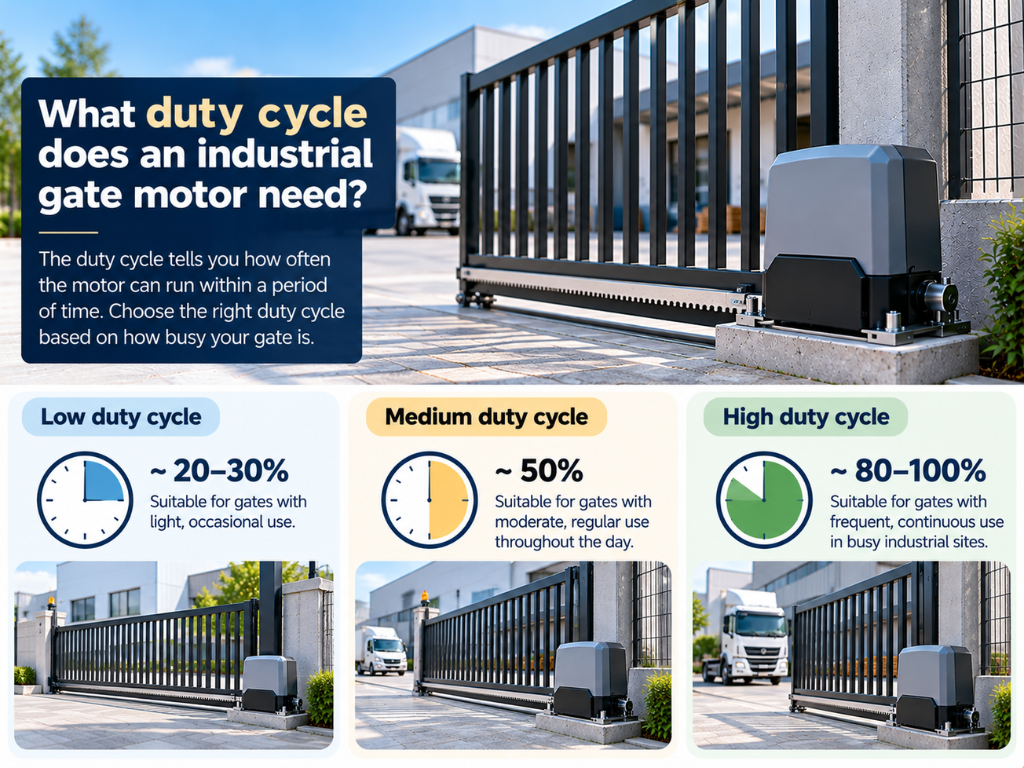
What duty cycle does an industrial gate motor need?
An industrial gate motor needs a 100 percent continuous duty cycle, so it can keep running with no forced rest. A residential motor rated for around 45 cycles per hour overheats and cuts out under factory traffic.
Duty cycle is the number that separates an industrial motor from a domestic one. It is the share of time a motor can run before it has to cool down. The motor rating standard IEC 60034-1 classifies it, with S1 meaning continuous duty. An industrial operator is built to S1, so it drives the gate through a full shift without stopping. A residential motor pushed past its cycles-per-hour limit trips its thermal protection and stalls. This mismatch is the main reason a domestic motor burns out on a commercial gate, as our piece on commercial versus residential motors explains. Choose a motor on gate weight alone, without checking duty cycle, and a factory gate can fail in its first busy week.
How does gate weight set the industrial motor?
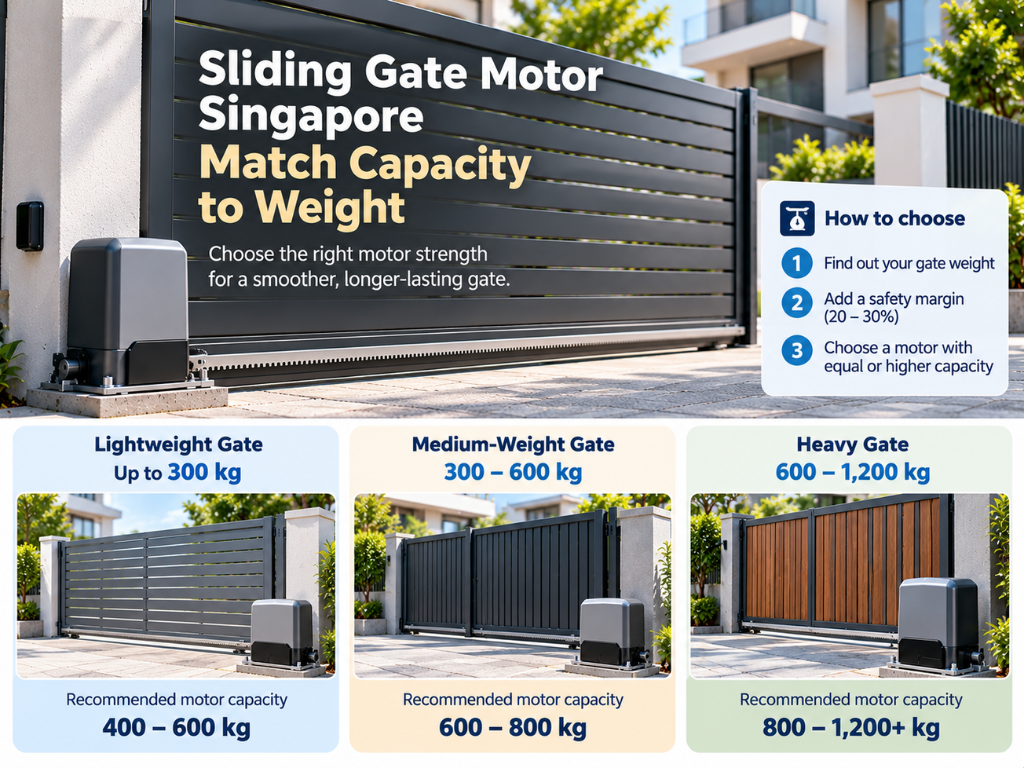
Gate weight sets the motor rating directly. Industrial gates start where residential ones stop, at around 1,500 kilograms, and go up to 6,000 kilograms or more. The heavier and longer the gate, the higher the operator rating, and the more likely you need three-phase power.
These weights are a different scale from residential. The SEA Big 4000 drives a gate up to 4,000 kilograms with a 14-metre leaf. The Quiko TITANO range goes up to 6,000 and even 10,000 kilograms for the largest industrial gates. A steel or galvanised gate spanning a lorry entrance is heavy by design, often several times the weight of a residential aluminium gate. Rate the motor above the real gate weight, with margin. A long cantilever gate that loads the operator right to its limit wears the gearbox fast. Weigh the gate or calculate it from the steel section and span before you choose the operator. Underestimate the weight of an industrial gate and you will overload the motor.
Why do factory shift patterns matter more than the daily total?
Factory traffic comes in bursts around shift changes. A gate that averages 80 cycles a day can still face dozens of cycles in the hour around each changeover, and the motor has to survive that hour.
Motors fail at the peak. A factory running three shifts sees a rush of lorries and workers at every changeover. The gate opens and closes almost nonstop for an hour around 7am, again mid-afternoon and again late at night, then sits idle in between. A motor sized to the daily average overheats during the rush, trips its thermal cut-out and leaves trucks queuing at the gate. Size the motor to the cycle count in the busiest hour. That is why the shift pattern is the first question to ask about an industrial gate. If your gate cuts out at the 3pm changeover, it was sized for the wrong number.
What is a thermal cut-out, and why does it trip mid-shift?
A thermal cut-out is built-in protection that shuts the motor down when it overheats. It trips mid-shift when an underrated motor has run past its duty cycle. The gate then freezes until the motor cools, which often takes fifteen to thirty minutes.
The cut-out is working as designed. The real fault lies in the specification. A motor driving a heavy gate through a shift-change rush heats up. If it is a residential or light-commercial unit pushed past its duty rating, the thermal protector opens the circuit to stop the windings burning out. The gate stops wherever it happens to be, and nothing moves until the motor cools. Industrial motors avoid this with a continuous-duty rating and Class H insulation that copes with sustained heat. A gate that works all morning and dies every afternoon is tripping its thermal cut-out, which usually means the motor is one duty class too small for the traffic.
Single-phase or three-phase for a factory gate?
Use three-phase power for any factory gate above roughly 1,500 kilograms. It gives a heavy, high-cycle gate the starting torque it needs and runs cooler. Single-phase suits lighter gates, and three-phase is the industrial standard.
Take the F.H. Brundle BY3500. It drives a 3,500-kilogram gate on a 400-volt three-phase supply at 750 watts, with high starting torque, smoother acceleration and less heat build-up over repeated cycles than a single-phase unit. Most Singapore factories and warehouses already have a three-phase supply, so the motor simply matches it. A heavy single-phase operator with an inverter can reach 4,000 kilograms, but for a gate cycling all day, three-phase is the more reliable choice. Run a 3,000-kilogram gate on a single-phase motor and both the supply and the operator strain on every start.
How does continuous use wear the gearbox, and how is it managed?
Continuous use wears the gearbox faster than any other part. Industrial operators deal with this through an oil-bath gearbox and a soft-start inverter that spreads the load. A sealed grease gearbox, fine on a residential gate, overheats and wears out under factory cycling.
An industrial operator uses worm-gear reduction, commonly 30 to 1 or 40 to 1, running in an oil bath that cools and lubricates the gears through continuous operation. Quiko, for example, builds its industrial drive around a self-ventilated gearmotor with an oil-bath gearbox designed for intensive use. An inverter control adds acceleration and deceleration ramps, so the heavy gate starts and stops gently and the gears and rack take less shock. Regular servicing then keeps the gears and rack within tolerance, and that is the core of heavy-duty gate maintenance that avoids downtime. Let the gearbox run dry on a continuous-duty gate and it will fail.
What does an hour of gate downtime cost a factory?
An hour of gate downtime costs a factory far more than the motor does. A stuck gate holds up the lorries and deliveries, and the production that depends on them. That cost is the real reason to pay for a properly specified industrial motor.
Picture a jammed gate at a logistics hub. Containers wait at the entrance, the forklifts meant to unload them sit idle, and the loading dock stalls. The loss per hour quickly outweighs the price gap between a residential and an industrial operator. A manual override lets staff crank a heavy gate open during a blackout, but it is a stopgap and does nothing about an undersized motor that trips every day. Specify the motor to the gate weight, the duty cycle and the shift peak, and the recurring stoppages go away. An autogate repair callout can only patch them. Over the life of the gate, the cheapest motor is the one that never stops the site.
How do you specify an industrial sliding gate motor in Singapore?
Specify an industrial sliding gate motor on four things: gate weight, continuous duty cycle, the cycle count at shift peak and the three-phase supply. Then confirm the gearbox and the safety devices. A proper specification names the rated weight, the duty class and the power supply.
Start with the gate and the traffic pattern. Weigh the gate, count the cycles in the busiest shift-change hour and confirm the three-phase supply. Then select a continuous-duty operator rated above the gate weight. Ask for an oil-bath gearbox and a soft-start inverter on a long or heavy leaf. Check the gate has the safety devices required for power-operated gate safety under EN 12453, and confirm the manual override will move the loaded gate in a power cut. When you are ready, book a site assessment and the motor will be matched to your gate, your shifts and your supply.
Sizing a factory gate motor for the busiest hour
Four numbers set an industrial sliding gate motor: the gate weight, the continuous duty cycle, the cycle count at shift peak and the three-phase supply. Size the motor to the busiest hour of the day. Insist on continuous duty and an oil-bath gearbox, and check that the manual override can move the loaded gate. Get these right and the gate runs through every shift. Get them wrong and the thermal cut-out stops the lorries exactly when the plant is busiest.
Enforce Automatic Global supplies, installs and maintains industrial sliding gate motors for factories, warehouses and logistics sites across Singapore. Book a site assessment with Enforce to have your gate weighed and your shift peaks counted, and get a continuous-duty motor matched to the traffic that keeps your site moving.
Frequently asked questions
What size motor do I need for a factory or warehouse gate?
A factory or warehouse gate needs a continuous-duty industrial operator rated for the gate’s weight, typically from 1,500 kilograms up to 4,000 or 6,000 kilograms, on a three-phase supply. A unit like the SEA Big 4000 covers a 4,000-kilogram, 14-metre gate. Rate it above the real gate weight and size it to the busiest shift-change hour.
Why does my factory gate motor keep cutting out?
It is tripping its thermal cut-out because it has run past its duty cycle. A residential or light motor rated for around 45 cycles per hour overheats under shift-change traffic, then stops until it cools. The fix is a continuous-duty industrial motor with Class H insulation, sized to the cycle count in the peak hour.
Do industrial sliding gates need three-phase power?
Industrial sliding gates above roughly 1,500 kilograms need three-phase power for the starting torque and lower heat that a heavy, high-cycle gate demands. A three-phase operator such as the F.H. Brundle BY3500 drives a 3,500-kilogram gate on 400 volts. Most Singapore factories already have three-phase, so the motor is matched to the existing supply.
How often should an industrial gate motor be serviced?
More often than a residential one. A gate cycling hundreds of times a day wears its gearbox, rack and pinion with every cycle. Put a high-cycle factory gate on a tighter service schedule that covers the oil-bath gearbox, the rack tension and clearing the track, so it doesn’t seize at a shift change.