

Automatic Swing Door Singapore: Types, Fire Code & Cost
An automatic swing door in Singapore is a hinged door opened and closed by a motorised operator. Two things decide which operator you need: how heavy the leaf is and where the door sits in your building.
It matters this season because the Code on Accessibility 2025 took effect on 1 November 2025. At Enforce Automatics Global in Singapore, we supply and install the operators on our automatic swing door range, from surface arms to concealed units.
How does an automatic swing door system work?
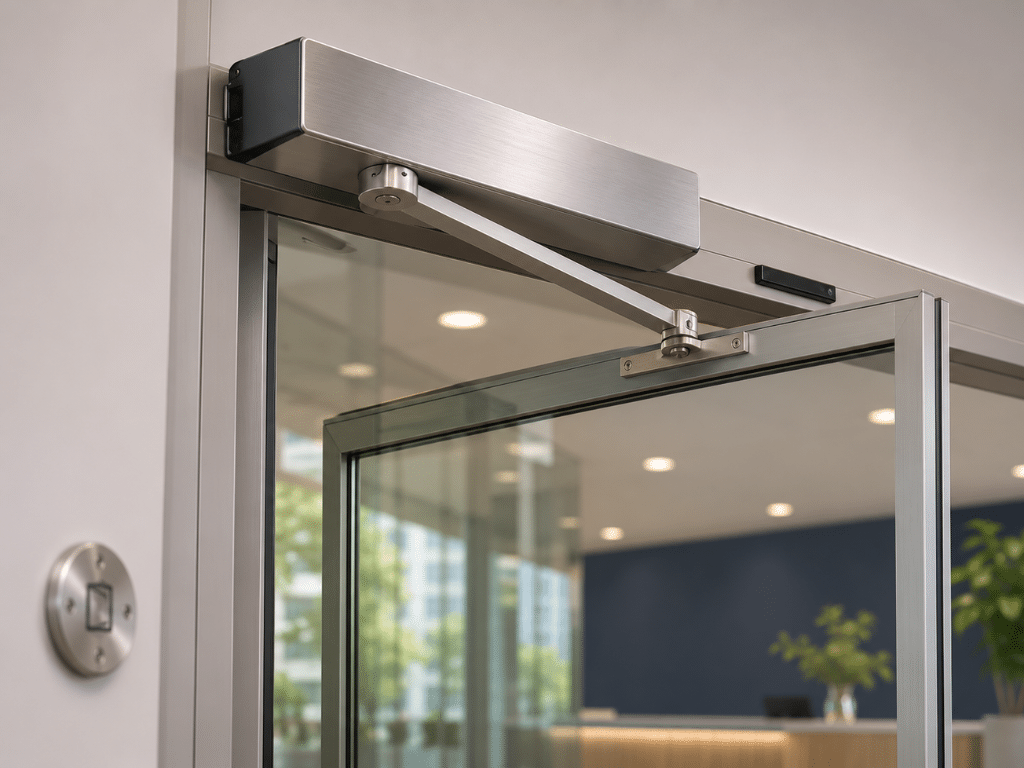
An automatic swing door system has four working parts. The operator drives an arm or spindle that moves the leaf. A sensor or button calls the door open, and a safety sensor watches the swing path. Check that your quote includes the last one, because it’s the part a cheap quote leaves off.
When someone walks up, the activation sensor, push button or card reader signals the operator. Its motor drives the arm through a gearbox, the door swings to its set angle, waits for the hold-open time, then closes more slowly. If someone steps into the swing path, the safety sensor stops or slows the door. Nobody takes a glass door to the shoulder.
How the automatic swing door mechanism closes the door matters more than people expect. Some operators close on a built-in spring, so the door shuts even without power; others stop where they are. Both suit the right door, but the choice changes how hard the door is to push by hand, which is where the fire code comes in.
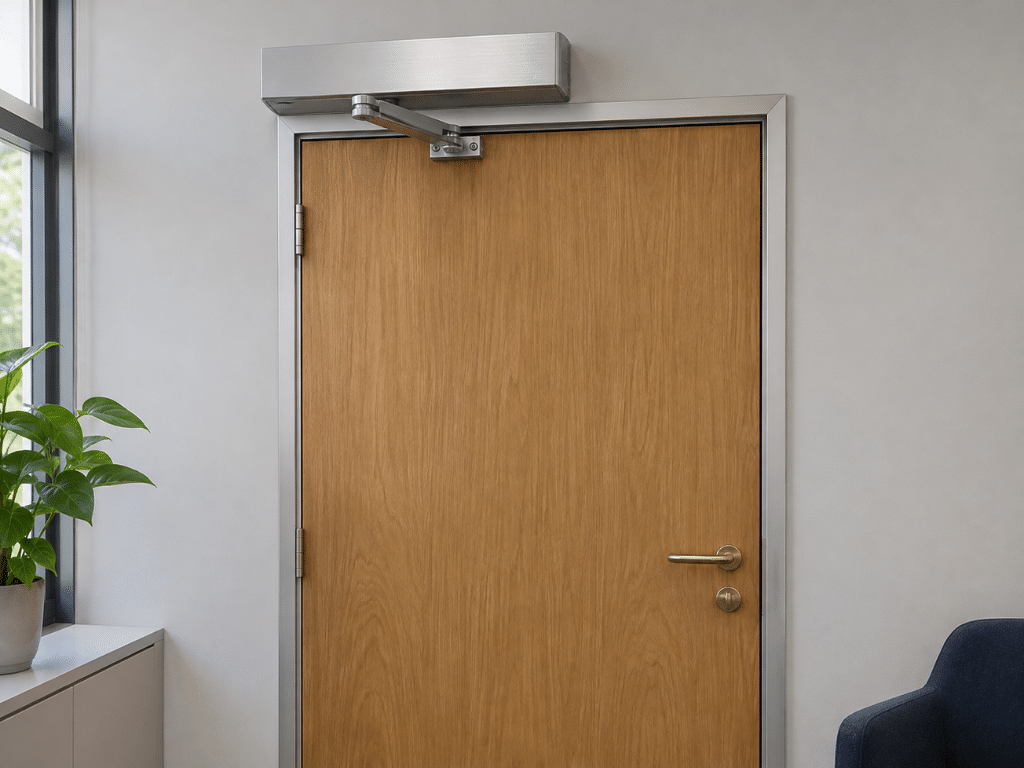
Surface arm, top concealed or floor concealed: which automatic swing door operator should you choose?
Choose a surface arm for a door that’s already in place and top concealed for a new entrance with a header. Keep floor concealed for frameless glass, where the clean look is worth the extra site work.
|
Operator type |
Where the motor sits |
Suits |
Think about |
On our range |
|
Surface arm |
In a slim box on the frame or wall above the door, with a visible arm |
Existing timber, aluminium or glass doors in offices, clinics and toilets |
The box and arm stay visible; push arm or pull arm depends on which side it mounts |
Ditec DAB105 (doors up to 200 kg), DAB205 (up to 400 kg), DAB305 (up to 450 kg) |
|
Top concealed |
Hidden inside the transom or header |
New fit-outs and shopfronts where the frame is being made anyway |
The header must be deep enough to take the unit, so plan it before fabrication |
EF T200W |
|
Floor concealed |
Set into the floor under the door’s pivot |
Frameless glass entrances with nothing above the door |
Needs slab depth and a dry threshold, and it’s harder to reach for servicing |
EF U200A |
If you’re a tenant automating an existing office or clinic door, go surface arm. It fixes onto your current frame with no hacking and comes off when the lease ends. The real decision is weight. Match the operator to the leaf with some headroom, because an undersized operator strains and wears out early.
Our Ditec DAB105 surface arm operator handles doors up to 200 kg. Send us the leaf size and a photo of the frame, and we’ll tell you whether it or a heavier model fits.
If you’re building a new entrance and want only the door on show, ask for top concealed at design stage. The EF T200W top concealed operator sits inside the header. The catch is timing: once the aluminium frame is fabricated without room for it, you’re back to a surface arm.
Floor concealed looks the cleanest but needs a cut-out in the slab and a threshold that won’t collect water. On an external door facing the rain, we’d steer you to top concealed instead.
Which automatic swing door suits an office, clinic or condo lobby in Singapore?
For an office or clinic, a single-leaf swing operator sized to the door is usually right. An exposed, busy lobby is often better served by a sliding door.
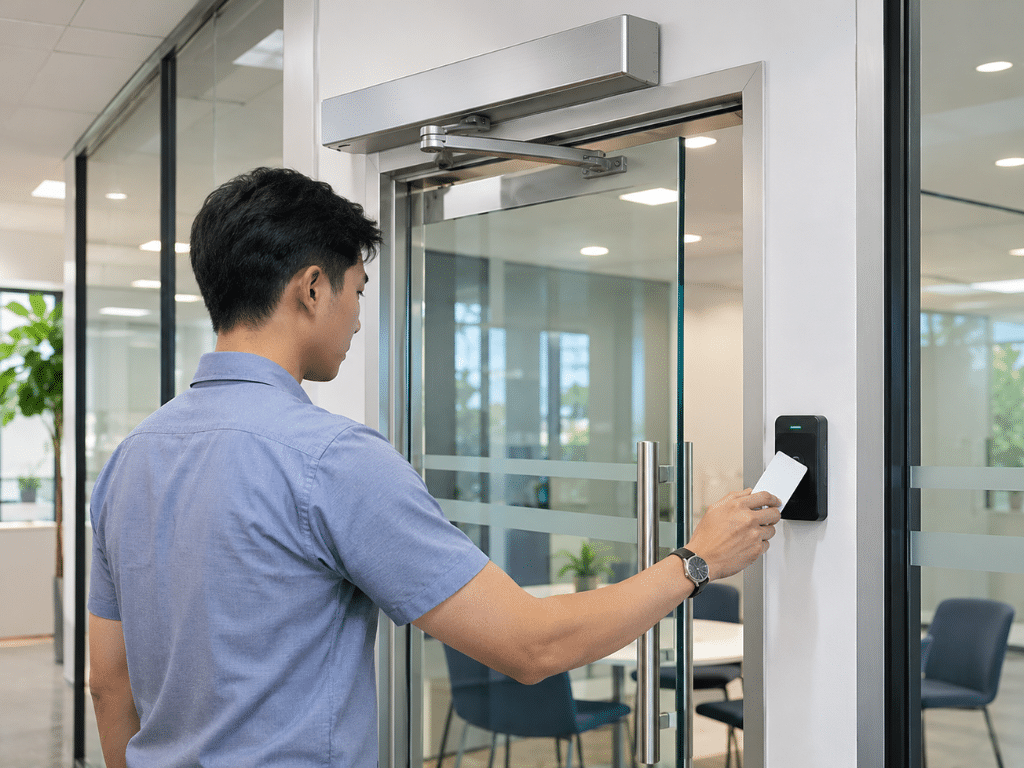
An automatic swing door for office use earns its keep. Meeting rooms, pantries and the glass door behind reception see one-at-a-time traffic, which a swing operator handles well. Link the main door to your card reader so it opens when staff badge in. Put internal doors on a push button so they don’t open every time someone walks past.
In a clinic, plan for the slowest person through the door: a patient on crutches or a parent with a pram. Set a longer hold-open time and make sure the door gives at least 850 mm of clear opening. If one leaf can’t give that width without getting too heavy, go double leaf.
For a condo lobby or any exterior door facing open ground, wind is the problem. A swing leaf catches gusts like a sail, and when the Northeast Monsoon arrives in December, an exposed door can stall half-open or slam. If the entrance is exposed and busy, an automatic sliding door is often the better buy. Our comparison of sliding and swing doors sets out when each one wins.
What does SCDF Fire Code 2023 require for an automatic swing door?
If your door sits on an escape route, SCDF wants a swing door. It must also open by hand without a key or much effort, operator or not.
Under Clause 2.3.9 of the SCDF Fire Code 2023, any door in a path of travel must be side-hinged or pivoted swing type. Sliding doors on an escape route carry extra conditions, such as opening on fire alarm, so we suggest a swing door first for exit routes.
The same clause caps the push needed at 30 N to start an exit door moving and 20 N once it’s open 30 degrees. In plain terms, one hand should push it open. A heavy leaf with a strong closing spring can need far more with the power off. Ask your supplier to measure the manual opening force, operator unpowered, before handover.
The door must open from inside without a key, tool or special knowledge. Fit a thumb-turn or push bar inside, not a keyed cylinder alone. And if you add a magnetic lock for access control, it must be wired to release directly from the building’s fire alarm.
The swing-direction rule skips landed houses (PG I) and individual flats (residential units under PG II). Offices, shops, clinics and condo common areas fall under it. Your Qualified Person signs off the door schedule, so show them the operator spec before you order.
What does the Code on Accessibility 2025 mean for an automatic swing door?
The Code on Accessibility 2025 sets two numbers to check: at least 5 seconds of hold-open time and at least 850 mm of clear opening.
Under the Code on Accessibility in the Built Environment, a power-operated door must stay open at least 5 seconds after the sensor or button is released. Installers call this the closing delay, and it should run longer where someone needs more time. Treat 5 seconds as the floor; for a clinic or eldercare centre, we’d set it longer.
Clear opening is measured from the door face to the doorstop with the door at 90 degrees, and it must be at least 850 mm. A 900 mm leaf can fall short once the hinge, stop and arm take their share. It’s the first thing we check on any drawing.
The Code covers new buildings and addition and alteration works, so a renovation that touches your entrance brings the door into scope.
What happens to an automatic swing door when the power trips?
In a power trip, an automatic swing door either closes on its spring or stays where it stopped. Either way, someone must be able to push it open by hand.
On a main entrance or exit route, ask for a battery backup unit. It runs the operator for a limited number of cycles after the mains drop. A short trip then doesn’t turn it into a heavy manual door.
A magnetic lock releases when the power drops. That’s right for escape but leaves the door unsecured, so agree with building management how it’s watched until power returns. Then cycle the door once. Some operators run one slow cycle to relearn the door’s position, so a door that crawls once isn’t faulty.
How much does an automatic swing door cost in Singapore?
Start from about SGD 4,000 to 6,500 installed for a simpler commercial entrance, the opening range in our automatic door installation cost guide. A single-leaf swing operator added to a sound existing door usually sits toward the lower end, because the door and frame are already there.
The price climbs with leaf weight, since a heavier door needs a bigger operator. It climbs again for a concealed unit, which needs a suitable header or a cut slab. A double leaf means two operators. New glass doors, a new power point, card access, a magnetic lock and a fire alarm link each add a line.
Pay for a correctly rated operator and a swing-side safety sensor. Skip the concealed unit on a back-of-house door nobody looks at; a surface arm does the same job for less.
Signs a cheap quote will cost you later:
- No operator model or weight rating named
- No safety sensor on the swing side of the door
- Wiring and the power point left out or marked “by others”
- Nothing about fire alarm release when a magnetic lock is involved
- No mention of hold-open time or manual opening force
After installation, budget about SGD 400 to 800 a year for servicing, the range we publish for automatic doors.
For a straight number, we need the door’s size and material and whether it’s on an escape route. Add a photo of the frame and the space above it.
What we’d fit on your door
For an existing office or clinic door, we’d fit a surface arm operator rated above your leaf weight. Add a swing-side safety sensor, and a battery on any main or exit door. Go concealed only when the frame is being built new.
To confirm the operator and the price, we need to see the door, its frame and where it sits on your escape route. Book a free site survey and we’ll measure it on site.
FAQs About Automatic Swing Door Singapore
Can you automate my existing manual swing door?
Usually, yes. Enforce fits surface arm operators to existing timber, aluminium and glass doors, as long as the hinges, frame fixings and leaf weight can take the load. We check the hinges and any existing door closer on site, because a worn hinge or a closer left in place will fight the operator.
Can an automatic swing door work with card access or a magnetic lock?
Yes. The card reader or exit button releases the lock first, then the operator opens the door. On an exit route, the SCDF Fire Code requires the magnetic lock to release directly from the fire alarm. Make sure that link is in the scope and tested before handover. Enforce also supplies access control systems.
How much does it cost to maintain an automatic swing door?
Enforce’s published range for automatic door servicing is about SGD 400 to 800 a year, covering sensor recalibration and safety testing. A busy main entrance needs more attention than a meeting room door, because wear on the arm and hinges builds with every cycle.
Do I need approval to install an automatic swing door?
If the door is on an escape route or part of addition and alteration works, your Qualified Person includes it in the plans. They check it against the SCDF Fire Code and the Code on Accessibility. For an internal door off the escape route, confirm with your building management and QP before installation.