

Automatic Sliding Door vs Swing Door Singapore
The choice between an automatic sliding door and a swing door in Singapore comes down to traffic volume and the space around the opening, not looks. A sliding door clears a full opening for two-way flow; a swing door needs an arc most busy entrances cannot spare. This blog walks you through which suits your entrance, drawing on automatic sliding door systems and where each type wins.
What is the core difference between an automatic sliding and swing door?
The core difference is the direction of movement: a sliding door moves laterally along a track parallel to the wall, while a swing door pivots on hinges through an arc into or out of the space. That single mechanical fact drives every downstream decision about traffic, space and safety.
A sliding door parts to the side and needs pocket space beside the opening for the leaf to travel. A swing door rotates on a motorised hinge and needs a clear arc, typically up to around one metre of unobstructed floor, for the leaf to sweep. Enforce supplies both as automated systems: sliding for lateral flow and automatic swing door units where a hinged leaf fits the opening. The movement pattern, lateral versus rotational, is the root of the entire comparison.
Which handles high pedestrian traffic better?
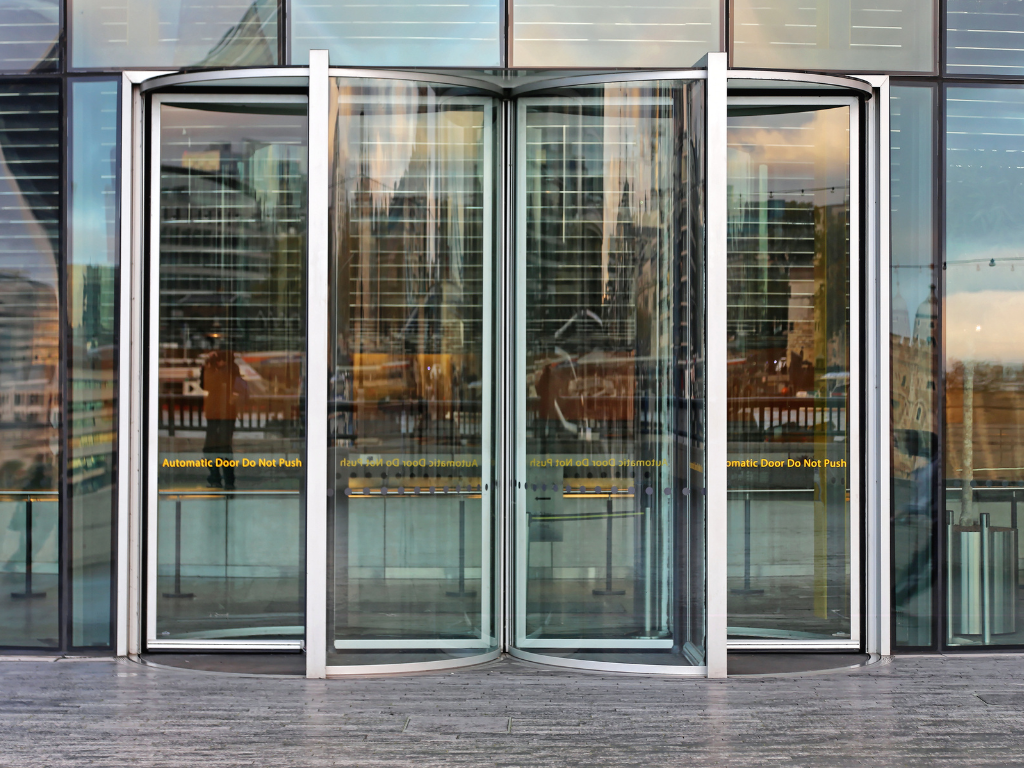
For high pedestrian traffic, the automatic sliding door is the clear winner, because it supports continuous two-way flow through a single wide opening. Sliding doors are the default in supermarkets, malls, transit hubs and hospital entrances precisely because crowds move both directions at once without colliding with a moving leaf.
Swing doors suit modest or one-way traffic. A swing leaf sweeping into a stream of people forces a pause and creates a pinch point, which is why busy entrances avoid them. A sliding door rated for a high duty cycle handles thousands of openings a day on a motor sized for that load, while a swing operator is better matched to a clinic side door or an office that sees lighter, intermittent use. For a Singapore mall or supermarket entrance running constant footfall through every trading hour, sliding is not a preference, it is the throughput requirement.

Which needs less space: side pocket or swing arc?
Each saves space differently, so the answer depends on where you have room. A sliding door needs clear pocket space beside the opening equal to its leaf width; a swing door needs a clear arc in front of or behind it but no side pocket.
The deciding question is what surrounds the opening. If a return wall, counter, display or column sits beside the doorway, the sliding pocket has nowhere to go, and a swing door fits better. If the floor in front must stay clear for queuing or circulation, the swing arc is the problem, and sliding wins. For interior settings where the door doubles as a flexible room divider, the trade-offs shift toward zoning and sightlines, which our comparison of slim-framed interior door zoning covers in depth. For an entrance specifically, map the obstruction first: side blockage points to swing, front blockage points to sliding.
Which gives the wider clear opening for accessibility?
The sliding door gives the wider usable clear opening, which makes it the stronger choice for accessibility and for moving trolleys, strollers and luggage. A sliding leaf retracts fully to one side, so the entire opening is passable, while a swing leaf’s arc can intrude on the effective passage.
Accessibility is where this matters most. A sliding door’s full clear width lets a wheelchair, a delivery trolley or a parent with a pram pass without negotiating a moving panel, which aligns with Singapore’s BCA Code on Accessibility for barrier-free entrances. A swing door can meet accessibility too, but it has to be sized and positioned so the arc does not reduce the clear path or strike an approaching user. For a clinic, a hospital or any entrance with high accessibility demand, the sliding door’s unobstructed clear opening is the safer specification.
How does wind and exterior exposure affect the choice?
Wind is the swing door’s weakness, and on exposed Singapore exteriors it tilts the decision toward sliding. A swing leaf presents a large surface to gusts, so wind can fight the operator, slam the leaf, or force the motor to work against pressure it was not sized for.
Exterior podium levels, high-rise lobbies and seafront-facing entrances see real wind load. A sliding door takes wind better because the leaf moves laterally within a guided track rather than swinging as a sail, so gusts do not wrench it on its hinge. A swing door on a windy exterior threshold wears its operator faster and risks erratic closing. For an exposed entrance in Singapore’s storm season, the sliding door is the more robust answer, while swing doors are better kept to sheltered or interior thresholds where wind is not a factor.
Which is safer, and which loses less air-conditioning?
Both can be made safe to the same standard, but they fail differently, and sliding doors generally control air-conditioning loss better at busy entrances. Working to the ANSI A156.10 safety standard, both door types use motion and safety-beam sensors that stop the leaf on detecting a person.
The safety difference is collision geometry. A swing leaf moves toward the user and can strike someone who steps into its arc, which is why swing doors need guarding sensors on the swing path; a sliding leaf moves away across the opening, reducing head-on collision risk. On energy, a measured door infiltration study found an open entrance raised air infiltration about 21.3 times versus closed, so a door that opens only as wide and as long as needed protects the cooling. A sliding door tuned to open partially for single users, and a deeper treatment in our sliding-door breakdown, limits that loss better than a fully swinging leaf at a high-traffic threshold.
Which costs less to run and maintain over time?
Sliding doors generally cost less to run at high traffic, while swing doors can be cheaper to install on an existing hinged opening. A sliding operator runs efficiently across high cycle counts, and its lateral motion puts less shock load on the mechanism than a swinging leaf reversing direction.
Maintenance tracks usage. A high-traffic sliding door needs its track kept clear and its belt and sensors checked, while a swing door’s hinge, arm and arc sensors are the wear points. A swing door retrofitted onto an existing frame can be the lower upfront cost, since it reuses the opening, whereas a sliding door may need pocket space created. Over a busy entrance’s life, the sliding door’s smoother duty cycle usually wins on running cost, while the swing door’s edge is a cheaper conversion of a doorway that already swings.
Which should you pick for your specific entrance type?
Match the door to the entrance. A mall, supermarket or hospital entrance with heavy two-way traffic takes a sliding door; a clinic side entrance, an office with moderate flow, or a narrow retrofit opening can take a swing door.
The pattern is consistent across commercial entrance automation: pick sliding when traffic is high, the opening is wide, or the threshold is exposed to wind, and pick swing when traffic is modest, side pocket space is blocked, or you are automating an existing hinged door. Where the opening is wide but side space is tight, a telescopic sliding variant bridges the gap. The single worst mismatch is a swing door on a high-traffic exposed entrance, where it fights both the crowd and the wind. Specify against traffic and surroundings first, and the door type usually picks itself.
Conclusion
The sliding-versus-swing decision for an entrance is settled by traffic and space, not aesthetics. Sliding doors own high-traffic, wide, wind-exposed entrances with their full clear opening and smooth duty cycle, while swing doors fit modest-traffic, narrow or retrofit openings where side pocket space is unavailable. Read the traffic volume and the obstruction around the opening first, and the correct door type becomes obvious.
Specifying an entrance and unsure which way to go? Send your opening width, daily traffic estimate and a photo of the surrounding wall to Enforce for a sliding-versus-swing recommendation matched to your entrance.
Frequently asked questions
Can a swing door be converted to an automatic sliding door?
Conversion is possible but rarely a simple swap, because a sliding door needs side pocket space and a track that a hinged opening does not have. Enforce assesses the opening width and the wall beside it before advising whether sliding conversion or an automated swing operator on the existing frame is the better route.
Is a sliding door always better than a swing door?
No. A sliding door wins on high traffic, wide clear openings and wind resistance, but a swing door is the better fit for narrow openings, blocked side space, or automating an existing hinged door. The right choice follows the entrance’s traffic and surroundings, not a blanket rule.
Which suits a narrow HDB or small shop unit entrance?
For a narrow shop unit with blocked side space, an automatic swing door often fits where a sliding pocket will not. Where the opening is wide but side space is tight, a telescopic sliding door is the alternative. Enforce specifies the type against the unit’s clear opening width and adjacent obstructions.