

Automatic Swing Door Power Failure: How to Open It
In an automatic swing door power failure, the door springs shut, stops where it is or springs open. Which one you get depends on the operator, and someone must still be able to push it by hand. That matters now, because November is Singapore’s peak month for lightning and power trips. At Enforce Automatics Global in Singapore, we supply and install the operators on our automatic swing door range.
What happens to an automatic swing door in a power failure?
Your automatic swing door does one of three things when the power goes, and the operator’s closing mechanism decides which. If your door is on an escape route, our advice on what the SCDF Fire Code requires covers the rules behind each one.
A spring-close operator stores energy in a spring as the motor opens the door, so the spring pulls it shut when the power drops. The Ditec DAB105 and DAB205 on our range close on a spring and motor. That keeps the entrance shut and secure, and it’s what fire doors need, but the spring makes the door heavier to push by hand.
A motor-close operator relies on the motor to shut the door, so in a power cut the door stays wherever it stopped. It’s lighter to push, but a door left half-open lets out the aircon and leaves the shop unsecured.
The Ditec DAB305 can also run the other way round, in what Ditec calls INVERSE mode. A spring opens the door when the power goes, which suits doors that must clear for escape or smoke extraction. If you don’t know which type you have, the model name on the operator cover will tell you.

How do you open an automatic swing door manually in a power failure?
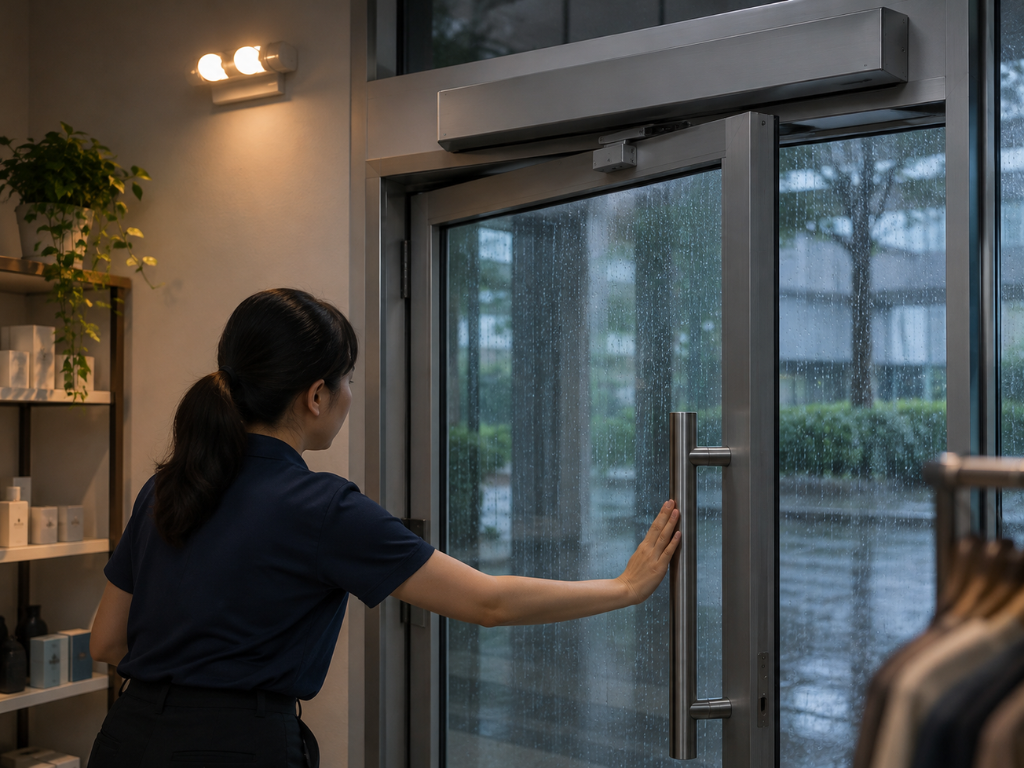
To open an automatic door manually in a power failure, push or pull it steadily with one hand at the handle side, away from the hinges. Don’t yank the arm or force the operator cover, because the arm is the part that bends.
On a spring-close door, the push should feel firm but easy. On an exit route, Clause 2.3.9 of the SCDF Fire Code 2023 caps manual opening force at 30 N to start the door and 20 N once it’s open 30 degrees. That’s a light one-handed push.
If you need your shoulder to move it, the closing spring is set too strong for the leaf, or the operator is too small for the door. That’s a fire safety problem as well as a nuisance, so get it measured and reset.
If the door won’t move at all, the lock is holding it, not the operator. Look for a green break-glass unit or exit button beside the door before you push harder.
Does an automatic door battery backup keep it working, and for how long?
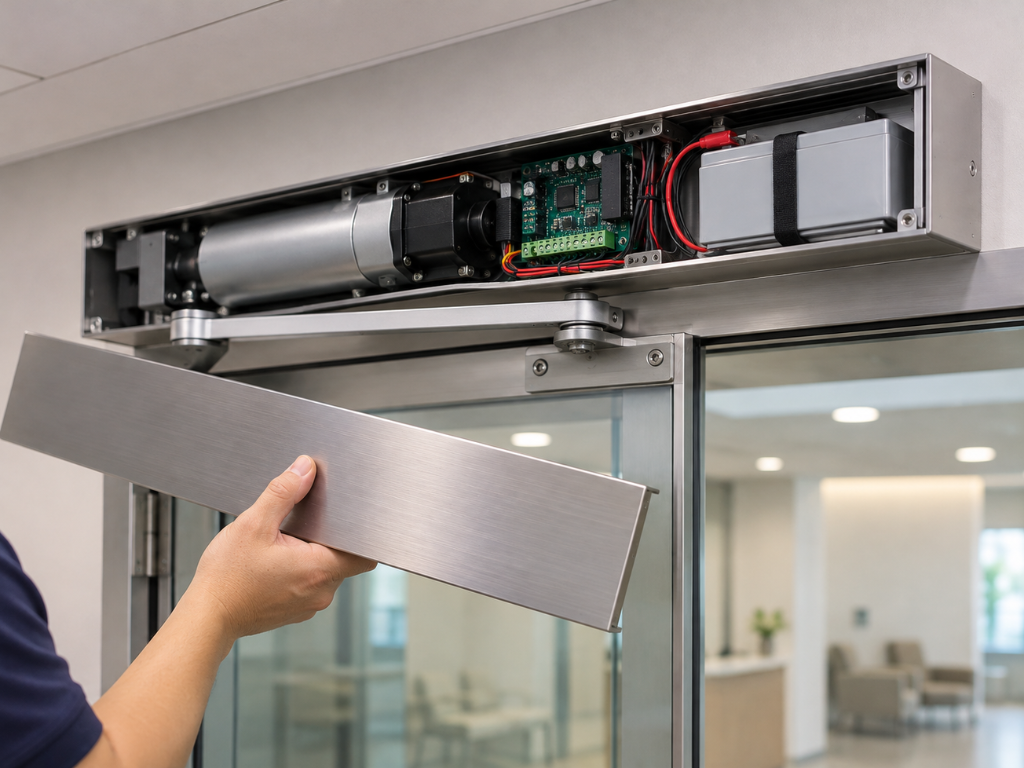
An automatic door battery backup keeps the operator running through a power trip. The door works as normal until the mains return or the battery runs down.
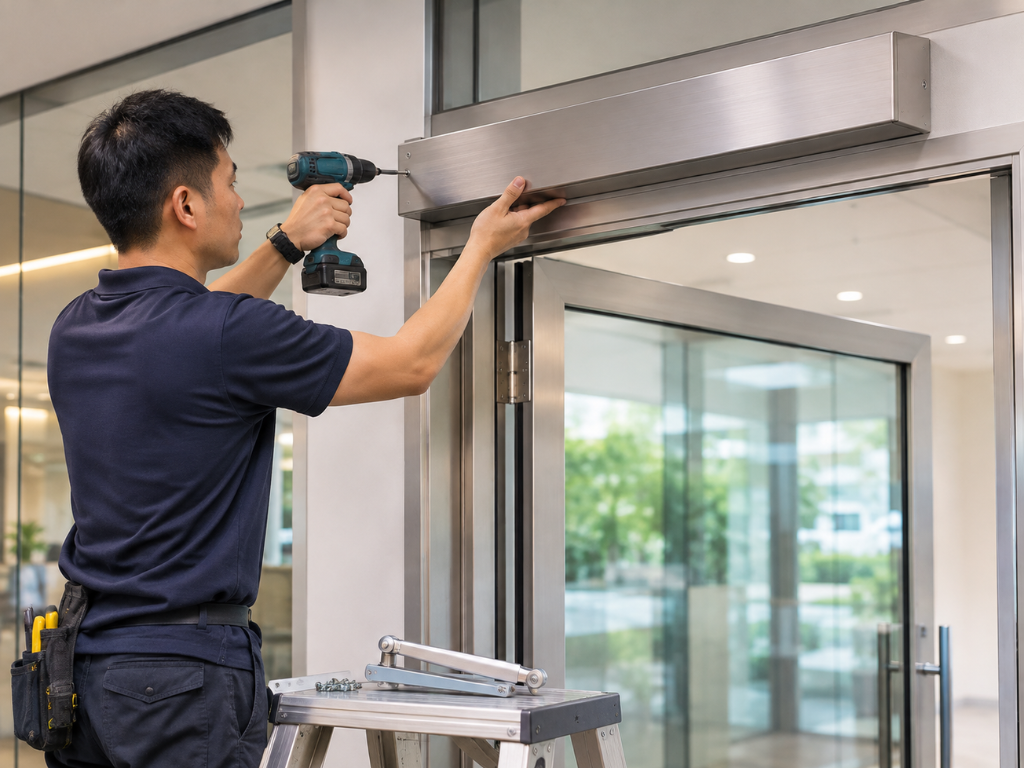
All three Ditec operators on our Auto Swing Arm range take an optional battery kit. Battery backup duration is set by the battery’s size and how often the door cycles. A busy clinic entrance drains it far faster than a meeting room door. Ask for the rated run time in writing before you rely on it.
We’d fit a battery on a main entrance, a clinic door or any door where people with walking aids or wheelchairs depend on it. For an internal door with light traffic, a spring-close operator without a battery is fine, because people can push it by hand.
Batteries age, and you won’t know yours has died until the next trip. Test it every few months by switching off the operator’s supply at its isolator and running the door.
What happens to the maglock and fire alarm link when the power trips?
A magnetic lock, or maglock, holds the door with an electromagnet, so it releases the moment it loses power. That’s right for escape, but anyone can walk in until the power returns.
On an exit route, the Fire Code requires the maglock to be wired directly to the building fire alarm so it releases when the alarm activates. Routing that release through the access control system or building management system isn’t allowed. A power trip often sets off the fire panel’s fault signals too, so expect building management to check the system afterwards.
Plan for those hours. Agree with building management who watches the entrance during a long outage, and make sure your access control set-up locks again on its own when power returns. Some electric strikes stay locked without power, which is wrong for an escape route, so check which type is on your door.
Why does the door operator power trip in a thunderstorm, and do you need surge protection?
A door operator power trip in a thunderstorm comes from lightning surging through the electrical supply, which trips the breaker or damages the controller board.
Singapore gets about 176 lightning days a year, and Meteorological Service Singapore’s records put November at the top, ahead of April and May. If your door goes dead after storms, look at the supply first.
Ask your licensed electrician about surge protection on the distribution board that feeds the door. It costs far less than a burnt controller, and it protects the access control and CCTV on the same circuit. If the door sits on a shared circuit with heavy equipment, a dedicated supply helps too.
What should you do when the power comes back?
When the power comes back, check the door is closed and clear, and switch the operator on at its selector if it was off. Then walk through it once before customers do.
Some operators run one slow cycle after a power cut to relearn the door’s open and closed positions, so a door that crawls once isn’t faulty. If it keeps crawling, stops short or bangs shut, the settings or the arm need attention.
Check the lock relocked and the card reader works. If the fire alarm went off during the trip, the panel may need resetting before the maglock and door return to normal.
For a straight answer on your door, send us photos of the operator cover showing the model name and of the lock. Tell us whether the door is on an escape route.
What should owners check, and how often?
An owner check routine takes a few minutes and catches the faults that only show up in a power cut.
|
How often |
Check |
What a pass looks like |
|
Monthly |
Switch the operator off and push the door by hand |
One-hand push, no shoulder needed |
|
Monthly |
Walk through slowly |
Door stays open while you’re in the doorway |
|
Every 3 months |
Turn off the supply at the isolator |
Battery runs the door; if not, replace it |
|
At each fire alarm test |
Watch the door during the building’s test |
Maglock releases straight away |
|
After every power trip |
Run the door once and check the lock |
Normal speed after one cycle, lock relocks |
Book the yearly service alongside these. Our automatic door cost guide puts servicing at about SGD 400 to 800 a year.
What we’d fit on your door
For a main entrance or a door people depend on, we’d fit a spring-close operator sized to the leaf. Add a battery kit and a maglock wired to release from the fire alarm. Where the door must clear itself for escape or smoke, look at a spring-open operator instead.
To confirm which suits your door, we need the operator model, the lock type and whether it’s on an escape route. Book a free site survey and we’ll check it on site.
FAQs About Automatic Swing Door Power Failure
Can an automatic swing door close on someone when the power comes back?
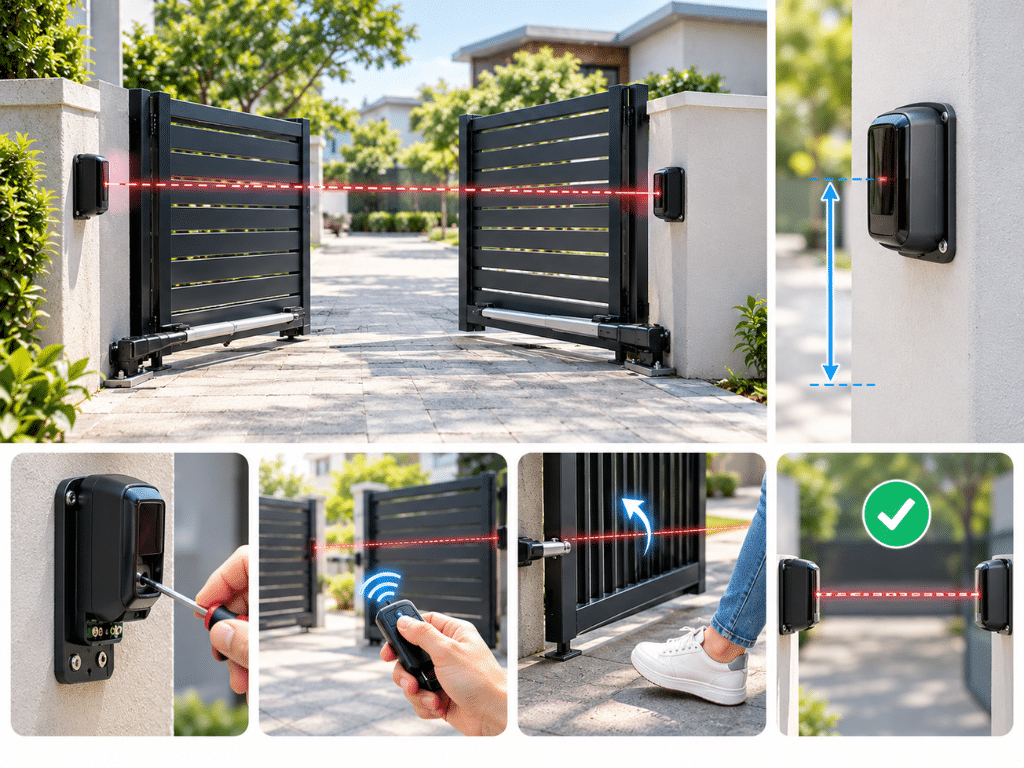
It shouldn’t, if the safety sensor on the door is working. The operator checks the sensors as it restarts and stops or slows if someone is in the swing path. If your door ever closes on a person after a power trip, stop using it and have the sensors checked. Enforce can survey the door and its sensor coverage.
Should I turn off an automatic door before a planned power shutdown?
Yes. Set the selector to off before a building’s planned electrical shutdown, and tell staff the door will be manual. Spring-close doors will shut themselves when the power drops, so don’t wedge a fire door open to get around that. Switch the operator back on once the power is stable.
Does a power cut damage an automatic door operator?
A clean power cut does little harm, because the operator stops and restarts. The risk is the surge when power returns or when lightning strikes nearby, which can damage the controller board. Surge protection on the supply is the cheapest insurance. If the door won’t restart, check the breaker and isolator first, then have the operator inspected.