

Photocell Sensor for Gate Singapore: Height & Testing
A photocell sensor for a gate in Singapore is the safety device that stops a closing gate from hitting a child, a pet or a car. It is also the part most owners forget about. An autogate with no working photocell is a serious hazard. Here is where to mount photocells, how many beam pairs you need, and a monthly test routine that keeps an automatic gate installation safe.
What is a photocell sensor for a gate, and how does it work?
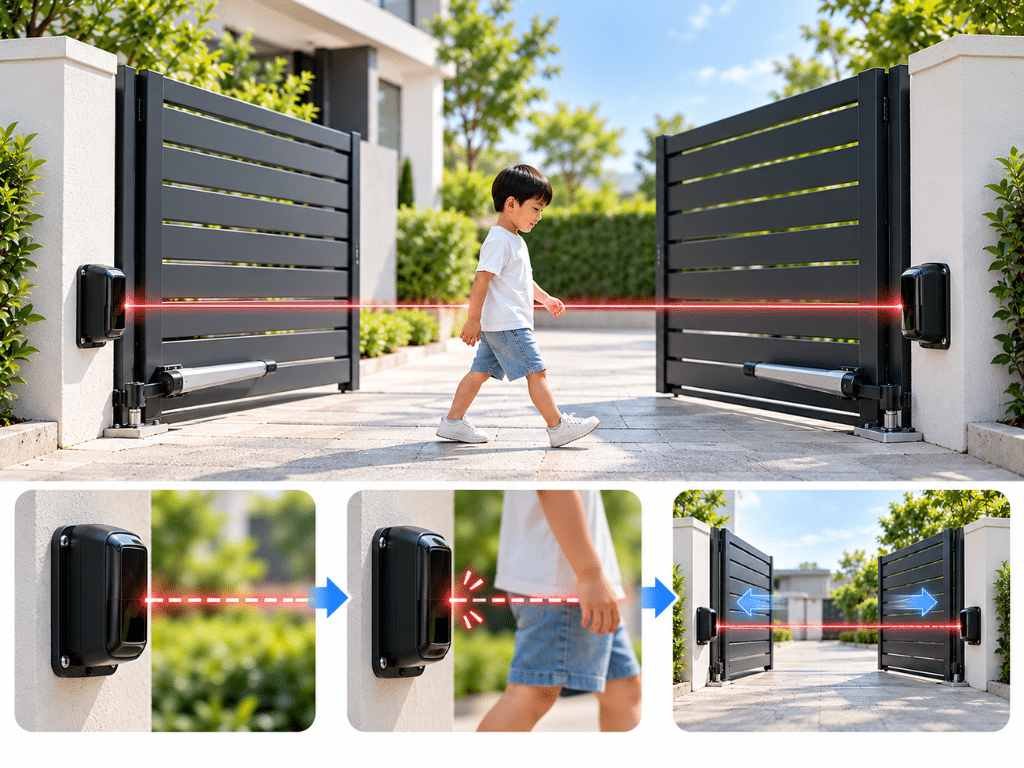
A photocell sensor is a pair of infrared devices, a transmitter and a receiver, that sends an invisible beam across the gate opening. When anything breaks the beam, the control board stops the gate or opens it again.
The transmitter emits a modulated infrared beam, commonly at a wavelength of 890 nanometres. The moment the beam is cut, the receiver sends a voltage-free switching signal to the board. A good sensor picks up the obstacle and signals the gate in about 10 milliseconds, so the gate reverses before it makes contact. Modulation lets the receiver ignore sunlight and headlights. The pair runs on a low 12 to 24 volt supply from the gate control board. Because it reacts before anything is touched, the photocell is the non-contact safety layer, and it sits next to the motor in every compliant gate automation setup.
Where should you mount gate photocells, and at what height?
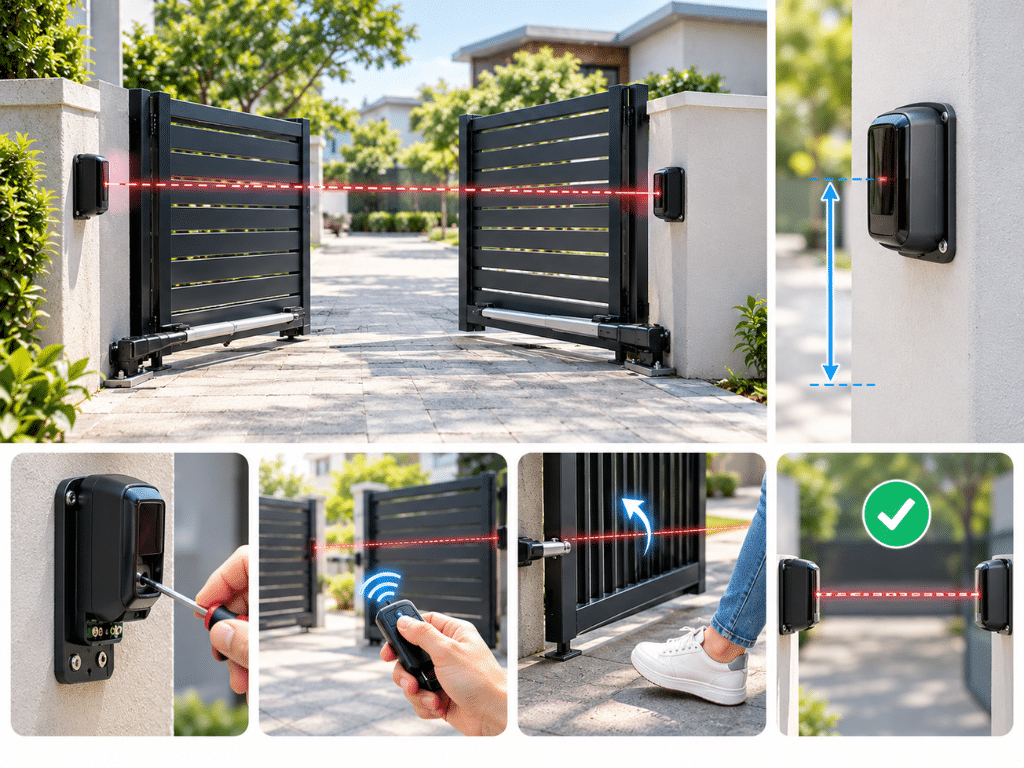
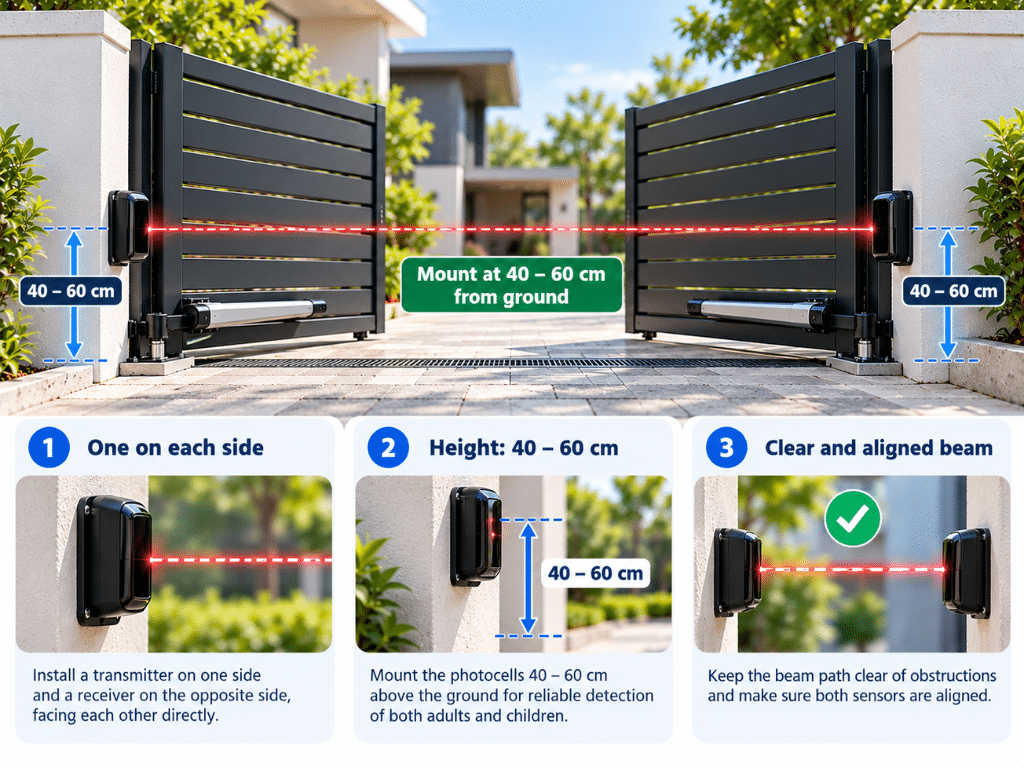
Mount gate photocells low, at least 200 millimetres above the ground, so the beam catches a child, a pet or a vehicle in the gate’s path. The height you choose decides what the sensor can protect.
Treat 200 millimetres as the minimum. Manufacturers set it as the lowest mounting height, and installers place the beam low enough to catch a crawling child or a small pet. A beam at chest height passes straight over both. One low pair covers the most common and most serious entrapment: a child or animal under a closing gate. On a driveway you also have to think about the car, so the beam needs to sit where it will pick up a bonnet or bumper stopped in the opening. The transmitter and receiver face each other across the opening, at least 500 millimetres apart, lined up so the receiver gets a clean beam. Mount the photocell too high and the small child it was installed to protect is left completely exposed.
How many beam pairs do you need?
Most gates need at least two beam pairs. An inner pair protects the gate’s closing path, and an outer pair picks up anyone approaching before the gate starts to close. One pair is the bare minimum. Two is standard on a driveway used by both cars and people.
The opening and the traffic decide how many you fit. The inner pair sits on the gate line and reverses the gate if anything is in the closing path. The outer pair sits a little beyond it and holds the gate open while a car or person is still crossing. With only one pair there’s a gap: the gate can start closing behind a slow pedestrian who has already passed the inner beam. Wider openings and commercial gates with heavy foot and vehicle traffic add more pairs to cover the remaining blind spots. A busy condo or factory gate running on one beam pair is a shortcut the first near-miss will expose.
What beam range, response time, and IP rating matter?
Three specs matter: beam range, obstacle detection time and IP weather rating. For a residential gate, look for 10 to 20 metres of range, a detection time of around 10 milliseconds and at least IP54. In Singapore, IP65 is the safer choice.
A through-beam photocell reaches 10 to 20 metres on a residential driveway and up to 30 metres on a wide commercial gate. The beam is strongest within the first metre. Detection time ranges from 10 milliseconds on a quality FAAC unit to 300 milliseconds on slower sensors, and on a heavy gate, faster is safer. The IP rating decides how long the sensor lasts outdoors. IP54 is the minimum, and an IP65 sunlight-resistant unit copes with Singapore’s rain and glare far better. A cheap IP44 sensor on an exposed driveway saves a little money, then fails in its first monsoon season.
Why do photocells false-trigger in the rain, and how do you stop it?
Photocells false-trigger in heavy rain when water scatters or blocks the infrared beam, or when a poorly sealed sensor lets moisture reach the lens. The gate then reverses for no reason or won’t close at all. With Singapore’s downpours, owners here run into this often.
Two things stop it: a good sensor and accurate alignment. A modulated infrared beam holds up against sunlight, rain and dust as long as the optics are properly tuned. An IP65 housing with an egg-shaped cover keeps rain off the lens. Correct alignment, confirmed by the receiver’s status LED, ends the intermittent dropouts that misalignment causes. Cheap sensors struggle in rain, sun and dust, so the specification matters more here than almost anywhere else on the gate. If your gate reverses every time it drizzles, check the photocell first. It is usually a cheap unit or out of alignment, and common autogate faults of this kind nearly always trace back to the sensor rather than the motor.
How do photocells and force detection work together?
Photocells and force detection are two safety layers that back each other up. The photocell reverses the gate before contact. Force detection reverses it on contact if something gets past the beam. A compliant gate uses both.
A photocell stops the gate before it touches a child or a car, but a thin object can slip between beams. That’s where the motor’s force detection comes in. It senses the rise in current when the gate meets resistance, then reverses. Gate safety standards treat both layers as required: power-operated gate safety falls under EN 12453, and the safety devices themselves under EN 12978. With force detection alone, the gate has to hit something before it reacts, and with a child in the way that is unacceptable. The photocell is the first line of defence and force detection is the backstop.
How do you test gate photocells each month?
Once a month, break the beam while the gate is closing and check that the gate stops and reverses. The test takes under a minute, and it is the most important safety check an owner can do.
Start the gate closing, then pass something through the lower beam, such as a broom handle or your foot. The gate should stop straight away and reverse. Do the same for each beam pair, and check that the receiver’s alignment LED shows a steady signal. Then test force detection: let the gate meet light resistance and watch it reverse. Write down the date and the result. If there’s ever an incident, a record of monthly tests is what proves the gate was safe. Nobody can trust a photocell that has never been tested, which is why this check belongs in every gate maintenance routine.
What happens if the photocell fails or is bypassed?
If a photocell fails or is bypassed, the gate loses its non-contact safety and will close on whatever is in its path. A gate rewired to ignore a faulty sensor is an accident waiting to happen.
The two cases play out differently. A faulty or misaligned photocell usually stops the gate from closing at all, which is the system failing safe. The danger starts when someone bypasses the sensor to stop the nuisance. Once it’s disconnected, the gate will close on a child or a car. The right response to a photocell fault is to realign or replace the sensor, never to disconnect it. A qualified technician puts the safety function back in place. Any gate that closes without a working photocell is a liability, and the owner is the one who carries it.
How do you choose and install gate photocells in Singapore?
Choose gate photocells by range, IP rating and number of beam pairs, then mount them at the right height and align them precisely. A proper specification lists the pair count, the range in metres and the IP rating.
Start with the gate and its traffic. Count the beam pairs the opening needs, check the range covers the full width, and specify at least IP54 (IP65 is better) for Singapore’s weather. Mount the pairs low enough to catch a child or pet, adjust the transmitter and receiver until the receiver LED holds steady, and wire them into the safety input on the control board. Check that the photocells and the motor’s force detection are both active, because the gate is only compliant with both. To have your gate’s safety checked or upgraded, arrange a gate safety check and the photocells, alignment and force detection will be tested against a closing gate.
Keeping a gate photocell doing its job
The photocell decides whether a closing gate reverses or crushes, so it deserves the attention most owners give the motor. Mount it low enough to catch a child. Fit inner and outer beam pairs, specify IP65 for the rain, and never let anyone bypass it. Then test it every month with a thirty-second beam check. Do that, and the gate stays safe for everyone who walks or drives through it.
Enforce Automatic Global supplies, installs and maintains gate photocell safety sensors across Singapore, aligned and tested against a live closing gate. Arrange a gate safety check with Enforce to have your photocells, beam pairs and force detection verified, so the gate reverses every time something crosses its path.
Frequently asked questions
How much does a gate photocell sensor cost in Singapore?
Photocell cost depends on the number of beam pairs, the range, the IP rating and the brand. Options run from a basic IP54 pair to a premium IP65 sunlight-resistant unit. The sensor is a small part of the total gate cost, and a second pair adds little. A site check confirms how many pairs your opening needs before pricing.
What height should gate safety sensors be mounted at?
Mount gate safety photocells at least 200 millimetres above the ground, low enough to catch a child, a pet or a vehicle in the gate’s path. A beam at chest height misses the most common entrapment hazards. Many installations add a second pair, one inner and one outer, for full coverage.
Why does my gate keep reversing or not closing?
It is usually a photocell fault: a misaligned beam, a dirty or rain-soaked lens, or a failing sensor. The gate fails safe by refusing to close. Realign the transmitter and receiver until the receiver LED is steady, and clean the lenses. If the sensor still faults, replace it. Never bypass it.
Can you add photocells to an existing automatic gate?
Yes. Photocells can be added to almost any existing automatic gate. They wire into the safety input on the control board and run off its 12 to 24 volt supply. If an older gate was installed without photocells, or with only one pair, add them. A gate without working safety beams is a hazard and does not comply with gate safety standards.