

Swing Gate Motor Singapore: Arm or Underground?
Your gate decides which swing gate motor you need in Singapore. Three things set it: the leaf width, the leaf weight and the wind load on the panel. In a monsoon squall, a solid privacy leaf puts far more strain on the operator than an open grille. Here is how arm-mounted and underground operators compare and how to size each one for an automatic gate installation that holds up.
What is a swing gate motor, and what are the types?
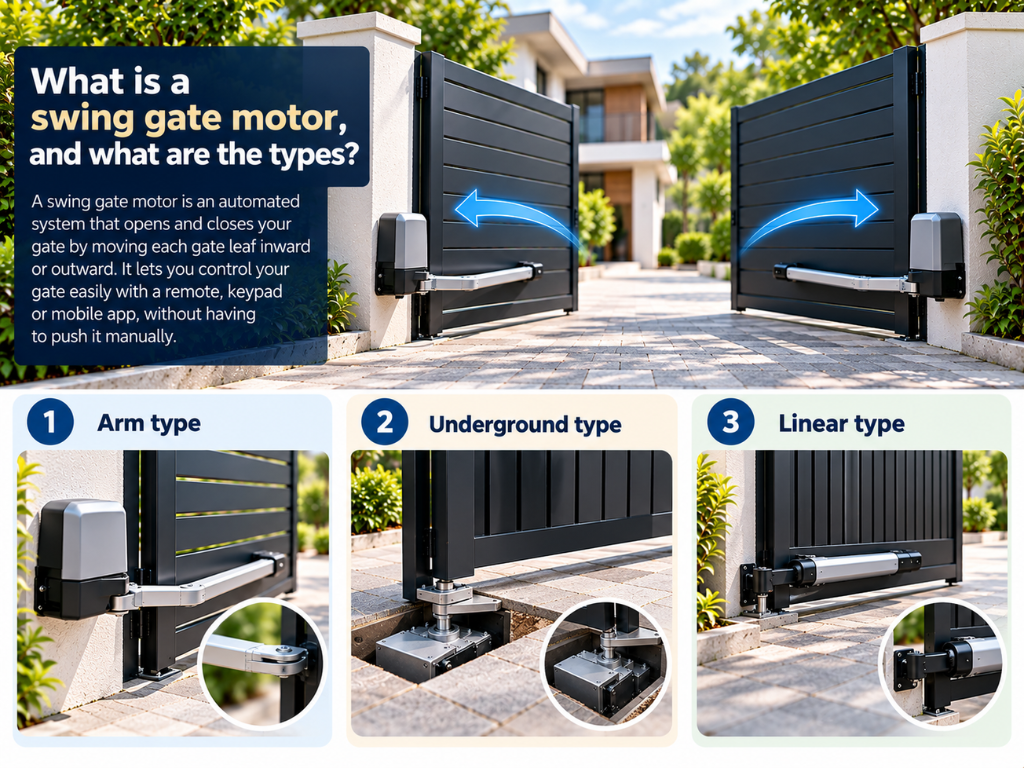
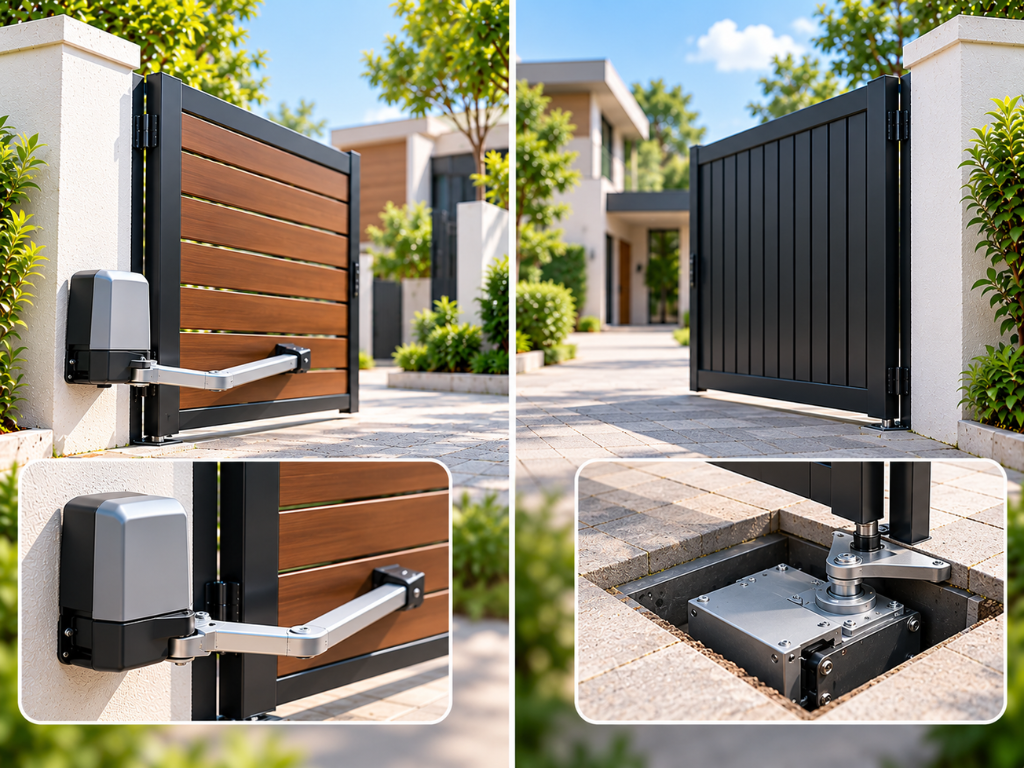
A swing gate motor is an operator that drives a hinged gate leaf through its arc. There are three types: a linear ram, an articulated arm and an underground operator. The first two mount above ground on the pillar and the leaf. The third sits hidden in a box at the hinge.
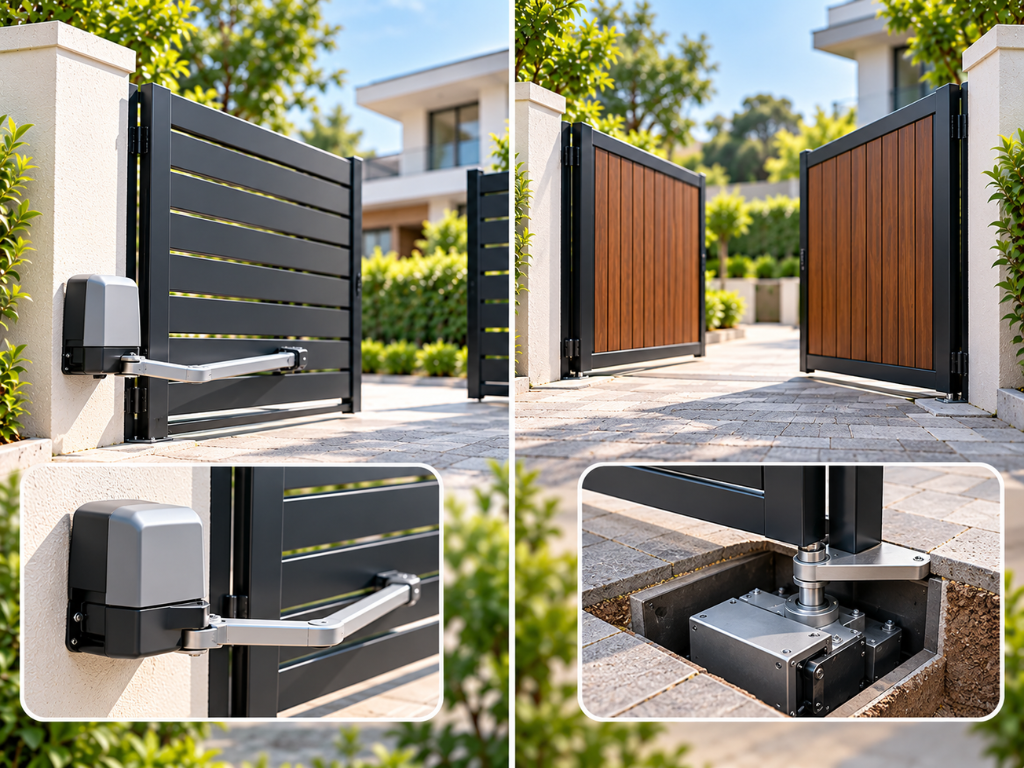
A linear ram, also called a worm-screw operator, extends and retracts like a piston. It is compact and the usual choice for a standard residential leaf. An articulated arm uses a jointed arm that works like a human arm pushing a door open, so it handles awkward hinge positions and deep pillars. An underground operator puts a hydraulic or electromechanical drive in a foundation box at the pivot, with nothing on show. Premium homes pick it for the clean look. On a double swing gate, each leaf gets its own operator, and both run off a shared control board, so you need two motors.
Arm-mounted or underground: which should you choose?
Go for an arm-mounted operator if cost, easy servicing and a simple retrofit matter most. Go underground if you want a clean look and the widest opening, and can accept the civil works. Both drive the leaf reliably, so the decision comes down to looks and budget.
An arm or ram operator mounts on the pillar and leaf. It costs less, goes in within a day, and is easy to service because every part is within reach. An underground operator hides the drive in a foundation box, so the gate looks as if it has no motor at all. Architect-designed landed homes pay for that look. The price is digging the box, waterproofing it and draining it. In Singapore, drainage is essential: one downpour can flood an underground box and kill the operator. For a standard driveway, an arm operator is the sensible pick. The underground option earns its premium only where the look really matters, such as the modern driveway gate designs that keep the hardware out of sight.
How do leaf width and weight set the motor?
Every swing operator has a rating for leaf width and another for leaf weight, and your gate has to fall within both. A long, light leaf loads the operator through its length. A short, heavy leaf loads it through its mass. Either can overload the motor.
Ratings vary by model. The CAME FERNI articulated arm handles a leaf up to 4 metres and 800 kilograms. The lighter CAME STYLO is rated for 1.8 metres and 150 kilograms. The FAAC S800H underground operator drives a leaf up to 4 metres and 800 kilograms. Most of a leaf’s weight comes from its material, so the aluminium versus steel difference decides which rating tier you land in. A steel leaf weighs far more than an aluminium leaf of the same size. Pick an operator rated above both the measured width and the weight, with some margin. A motor rated for exactly your leaf runs at its limit every cycle.
How does pillar depth decide ram versus articulated arm?
Pillar depth makes the call. A ram needs the hinge close to the pillar face. An articulated arm can work with a hinge set well back on a deep or wide pillar. Choose wrong and the operator hits the pillar.
Every arm or ram operator has a maximum distance it can sit from hinge to pillar. For a straight arm, that is around 60 to 200 millimetres. For an articulated arm, it is 200 to 380 millimetres. Go beyond it and the motor body catches the corner of the pillar and stops the gate from opening. So a gate hinged on a deep or wide pillar needs an articulated arm, or an underground operator, which has no pillar clearance limit at all. Measure the hinge-to-pillar distance before you choose the operator. Fit a ram to a deep pillar and you can expect a return visit.
What opening angle can each type reach?
It depends on the type. A ram or arm opens to around 90 to 125 degrees, and an underground operator can open to 180 degrees, the widest of the three.
Angle matters when the gate has to open fully against a wall or into a tight forecourt. A linear ram usually opens to about 90 to 100 degrees. An articulated arm reaches 110 to 125 degrees, giving more clearance. Underground operators such as the FAAC S800H come in 100-degree and 180-degree versions. At 180 degrees, the leaf folds back flat against the boundary wall, which a ram can’t do. Choose the operator for the opening angle your driveway needs as well as the leaf size, or you could end up with a gate that only opens three-quarters of the way. If the gate won’t clear a parked car, the fix is a wider-angle operator, because the angle comes from the operator type rather than motor power.
Inward or outward swing: which is right for Singapore?
Swing the gate inward, into the property. That keeps it clear of the footpath and the road, and it is the standard, safe choice for a Singapore landed property.
An inward-opening leaf needs clear driveway space for its arc, roughly as deep as the leaf is wide, so cars stop short of the swing path. An outward-opening gate swings onto the footpath or the road. That puts pedestrians at risk and crosses the boundary line, so landed plots facing a public road avoid it. If the driveway is too short for an inward swing, use a sliding gate. Forcing the gate to open outward creates the hazard above. This is one reason to settle the choice between a sliding and a swing layout before you choose a motor. Most managing agents will reject a gate that swings out over a public footpath.
How do monsoon winds affect a solid swing gate?
Monsoon winds put a heavy load on a solid swing gate, because a fully infilled privacy leaf catches the wind like a sail. Singapore’s Sumatra squalls bring strong gusts that strain the operator and slam the gate. A solid leaf needs a stronger motor and mechanical stops.
Treat wind as part of the design. A solid or heavily clad leaf gives the wind a large surface to push against. During one of the Sumatra squalls the Meteorological Service Singapore records, that force goes straight through the leaf into the operator. An open grille leaf lets the wind pass through and puts far less load on the motor. Manufacturers state that wind and gate design affect an operator’s performance rating, so a solid leaf needs a higher-rated operator than a see-through leaf of the same size. Mechanical stops at the open and closed positions take the wind and impact load off the gearbox. Fit a solid privacy leaf without allowing for wind load, and the operator can strain and fail in its first monsoon season.
Does a swing gate motor self-lock, or need a separate lock?
Most swing operators self-lock on leaves up to about 2 metres, using an irreversible gearbox that holds the gate shut. Longer leaves need a separate electric lock. A self-locking operator resists someone pushing the gate, and a non-locking one lets it move.
Whether you need a lock depends on the operator and the length of the leaf. A residential operator such as the FAAC 391 self-locks up to a 2-metre leaf, so a short gate needs no extra lock. Manufacturers recommend an electric or magnetic lock on any leaf longer than 3.6 metres, where the gearbox alone can’t hold the gate against wind or a hard push. In Singapore this matters even more, because a solid leaf in a gust needs holding. A long privacy gate should pair its operator with an electric lock and mechanical stops. Rely on self-locking past the operator’s rated leaf length and a long gate will creep open in the wind. Specify the lock to match the leaf length at the design stage.
How do you choose and install a swing gate motor in Singapore?
Choose a swing gate motor on leaf width and weight, pillar clearance, opening angle and wind load, then match the type and the locking. A proper specification names the operator type, the leaf ratings and the lock.
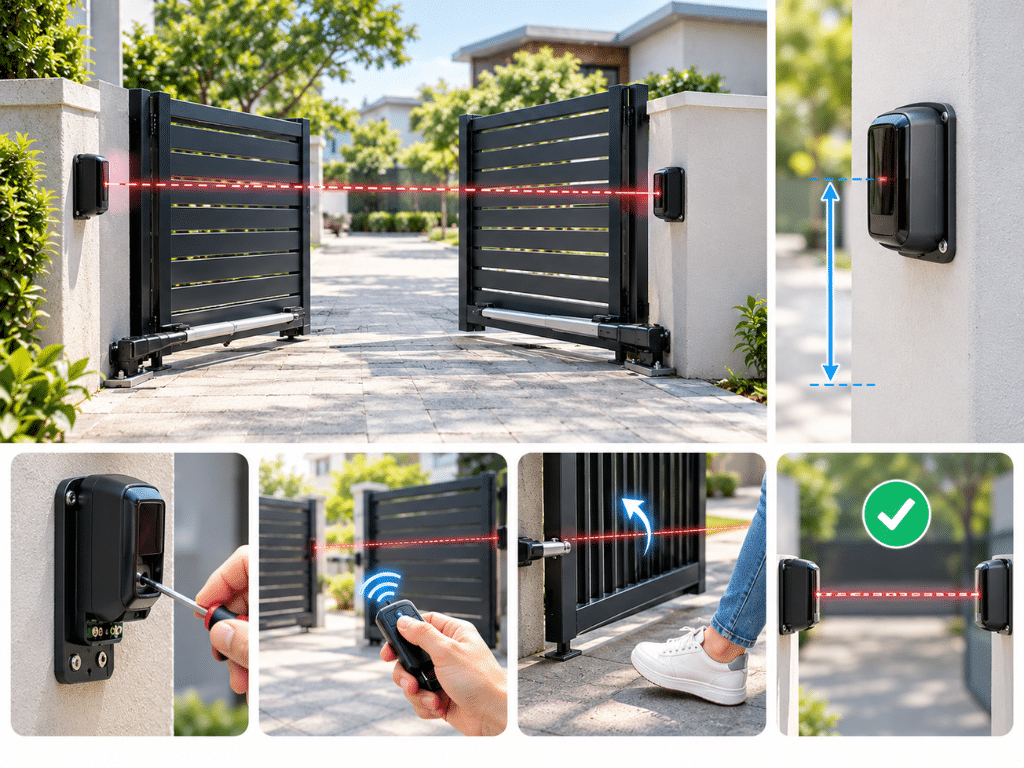
Measure the gate and the pillar first. Record the leaf width and weight, the hinge-to-pillar distance and the opening angle the driveway needs, then choose a ram, an articulated arm or an underground operator to suit. If the leaf is clad, rate the operator for the wind load. Add an electric lock on a long leaf and fit mechanical stops. Check that the gate has the safety devices required for power-operated gate safety under EN 12453, and plan drainage for any underground box. When you are ready, book a gate assessment and the operator will be matched to your measured gate, pillar and exposure.
Picking the right swing gate operator
Match a swing gate motor to the leaf width and weight, the pillar clearance, the opening angle and the wind load on the panel. An arm operator suits most driveways and costs less. An underground operator gives you the clean look and a 180-degree swing, in exchange for civil works and drainage. Rate a solid leaf for monsoon wind. Let a short gate self-lock, add an electric lock to a long one, and fit mechanical stops. Measure first, then specify, and the gate should swing cleanly for a decade.
Enforce Automatic Global supplies, installs and maintains swing gate motors, both arm-mounted and underground, for landed homes and commercial sites across Singapore. Book a gate assessment with Enforce to have your leaf, pillar and wind exposure measured, and get an operator matched with the right opening angle, locking and mechanical stops.
Frequently asked questions
What size swing gate motor do I need for my gate?
Size the operator to both the leaf width and the leaf weight, with some margin. An articulated arm like the CAME FERNI handles a 4-metre, 800-kilogram leaf, while a lighter unit covers 1.8 metres and 150 kilograms. A solid leaf also needs a rating that allows for wind load. The hinge-to-pillar distance decides whether a ram or an articulated arm will fit.
Is an underground gate motor better than an arm motor?
An underground operator wins on looks and on opening angle, reaching 180 degrees with the drive hidden in a box at the hinge. It costs more to install and needs waterproofing and drainage. An arm operator is cheaper, easier to service and simpler to retrofit. For a standard Singapore driveway, an arm operator is the practical choice unless the look matters to you.
Do double swing gates need two motors?
Yes. A double swing gate has one operator per leaf. Both are wired to a shared control board, which staggers the opening and closing so overlapping leaves meet cleanly. The operators can be rams, articulated arms or underground units, and each is rated for its own leaf’s width and weight.
Can a swing gate handle strong wind in Singapore?
Yes, if it is specified for it. A solid swing leaf catches wind like a sail during a Sumatra squall, so it needs a higher-rated operator, mechanical stops at both positions and, on a long leaf, an electric lock. An open grille leaf puts far less load on the motor. Rate the operator for wind load as well as weight and it will stay reliable.