

Accessible Automatic Door Singapore: 2025 Code Checklist
An accessible automatic door in Singapore must stay open at least 5 seconds after it’s triggered and sense anyone in its closing path. It needs 850 mm of clear opening and has to meet every manual door rule too.
This covers new buildings and renovations whose plans first went to BCA from 1 November 2025. At Enforce Automatics Global in Singapore, we supply and install power-operated doors, including our automatic swing door range for hinged entrances.
What does the Code on Accessibility 2025 require for an automatic door?
The Code treats a power-operated door as a door first. It must pass the manual door rules in clause 4.4, then two extra rules that apply because of the motor. Still choosing the door itself? Start with our automatic swing door advice.
|
Rule |
What the Code asks |
What we check on your site |
|
Hold-open time (Cl 4.4.1.2) |
Open at least 5 seconds after the button or sensor is released, longer where people need it |
The timer setting, and who uses the door |
|
Presence detection (Cl 4.4.1.2) |
Detect a person standing in the door’s closing area |
Sensor coverage across the whole closing zone |
|
Clear opening (Cl 4.4.2.1) |
At least 850 mm, measured with the door at 90 degrees |
Width left after the stop, hinge side and operator arm |
|
Level doorway (Cl 4.4.1.1) |
Doorway and the wheelchair turning space must be level |
Steps, raised thresholds and ramps at the door |
|
Manoeuvring space (Cl 4.4.6.1) |
Clear floor on both sides; 1500 x 1500 mm on the pull side of a one-way swing door |
Planters, counters and queue posts in that zone |
|
Leading edge (Cl 4.4.6.2) |
Opening edge no more than 250 mm from an obstruction on the push side, 150 mm on the pull side |
Doors set deep in a recess |
|
Glass motifs (Cl 4.4.5.1) |
Unframed full-height glass doors and the glass walls beside them marked |
Side screens as well as the door |
|
Door handles (Cl 4.4.9.1) |
Push-pull without grasping, lever handles on latched doors, colour contrast |
Handle model and finish |
|
Opening force (Cl 4.4.10.1) |
Swing doors no more than 30 N to start, 20 N at 30 degrees |
A push test with the power off |
The mistake to avoid is assuming the motor exempts the door from the manual rules. It doesn’t, and in a power cut your automatic door becomes a manual door anyway.
Does the 2025 Code apply to my building or renovation?
It applies when your works need plan approval from BCA’s Commissioner of Building Control and the first set of plans was submitted on or after 1 November 2025. That covers new buildings and existing areas going through addition and alteration works, which BCA calls A&A.
BCA’s circular launching the Code on Accessibility 2025 sets that date. Projects whose first plans went in before it stay under the 2019 Code, so ask your architect which version your project sits under before you finalise the door.
If you’re a clinic or shop tenant doing a fit-out that goes to BCA, the entrance door is in scope. If you’re only swapping a worn operator on the same door with no plan submission, the Code isn’t triggered. We’d still set it up to the 2025 numbers. The next A&A job will pull that door into scope, and the settings cost little to get right now.
How long must an accessible automatic door in Singapore stay open, and what must it sense?
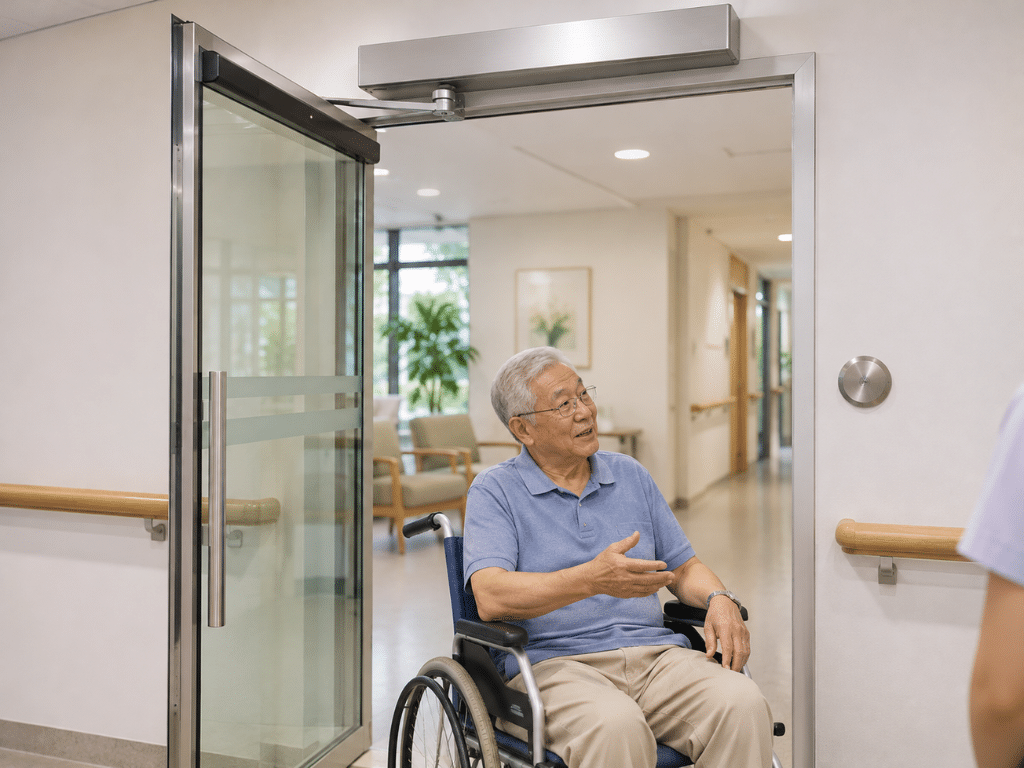
An accessible automatic door in Singapore must stay open at least 5 seconds after the button or sensor is released. It must also detect a person standing in its closing area.
The 5 seconds start when the hand leaves the button or the person leaves the sensor’s field, not when the door starts moving. Treat it as the minimum. The Code on Accessibility 2025 also asks for longer where people need it. For a clinic or eldercare centre, set it longer and test it with the slowest user you expect.
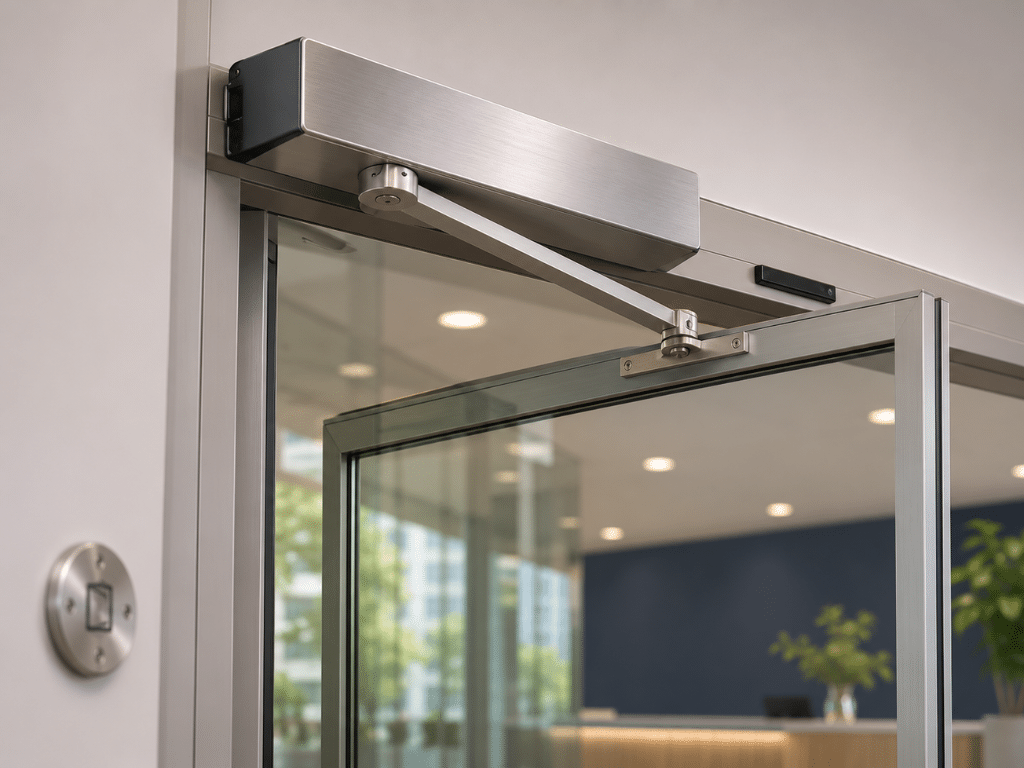
Presence detection is where cheap installs fall short. A radar that only spots people walking towards the door doesn’t count. The Code wants the door to know someone is standing in its closing path. On a swing door, that means a safety sensor on the leaf covering the swing area. On a sliding door, it means a presence sensor across the threshold.
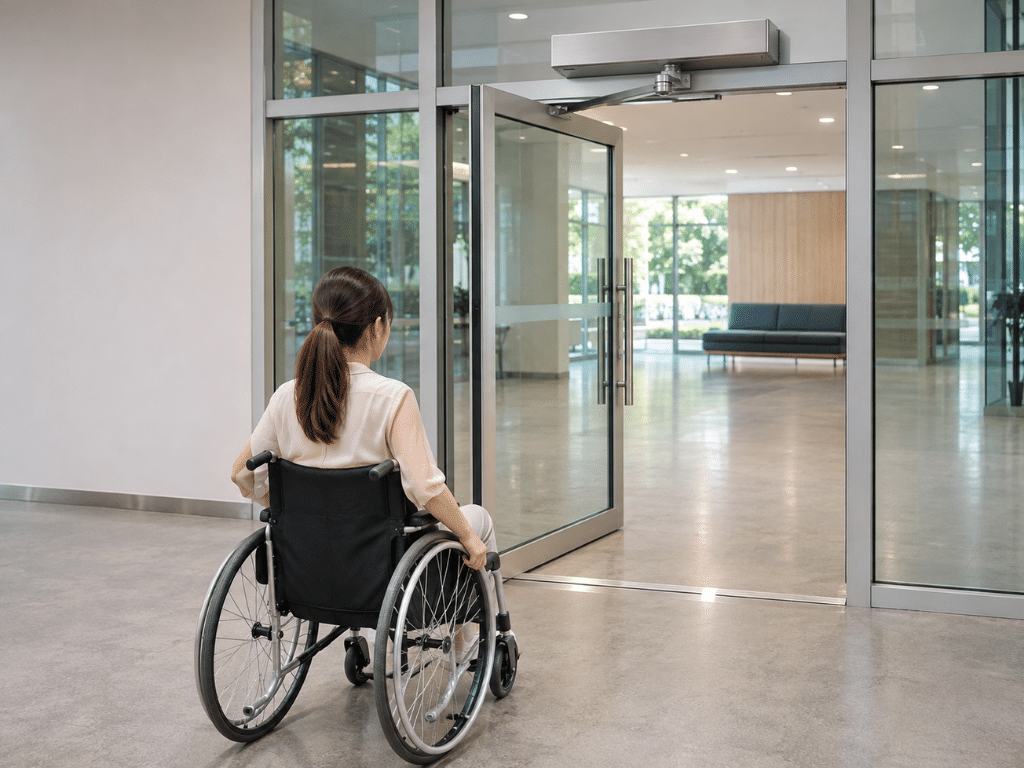
How much space does a wheelchair accessible entrance door need?
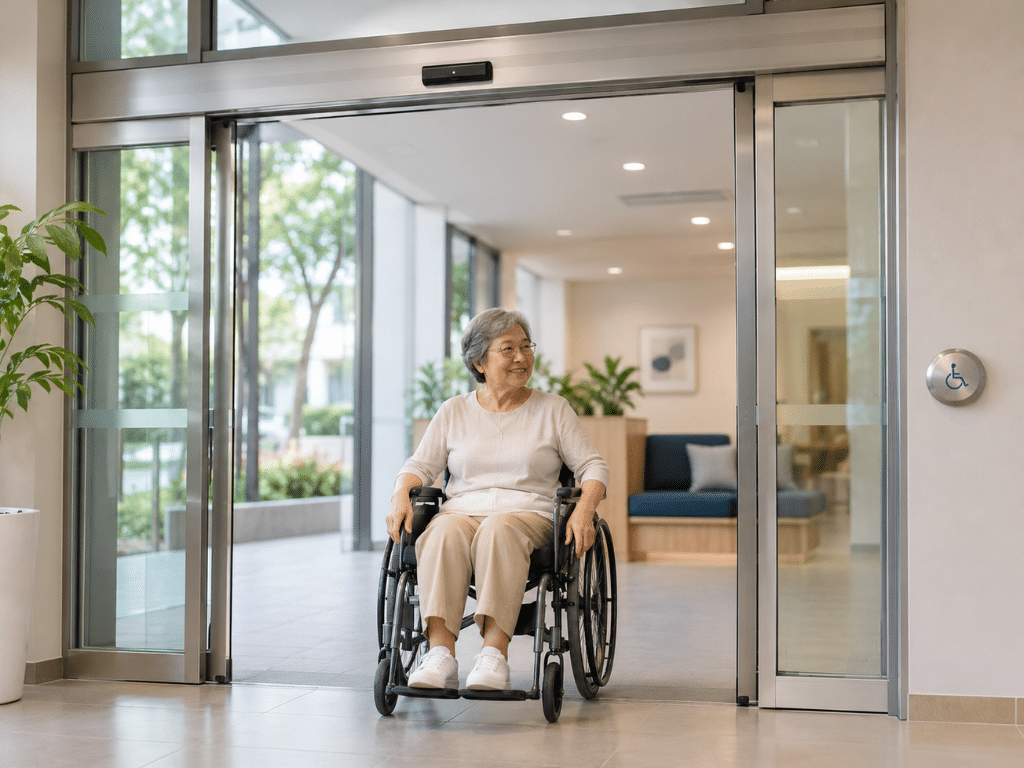
A wheelchair accessible entrance door needs at least 850 mm of clear opening and a level doorway. It also needs clear floor space on both sides so a wheelchair user can line up and turn.
Clear opening is measured from the face of the open door to the doorstop, with the door at 90 degrees. A 900 mm leaf can come up short once the hinge side, stop and operator arm take their share. Check this on the drawing, because widening a frame after it’s installed costs far more than getting it right first.
The doorway and the turning space must be level, so no step and no raised threshold. On the pull side of a one-way swing door, the Code asks for 1500 x 1500 mm of clear floor.
It also wants 600 mm of clear wall beside the opening edge on that side. The push side needs 1200 x 1200 mm plus 300 mm. A sliding door or a two-way swing door needs 1200 x 1200 mm plus 300 mm on both sides.
Those spaces are written for doors opened by hand. Plan them for automatic doors too, because a tripped breaker turns yours into a hand-opened door.
Watch the leading edge as well. A door set more than 250 mm back in a recess on the push side, or 150 mm on the pull side, is out of a wheelchair user’s reach. Where two swing doors sit one after the other in a lobby, the gap must be at least 1200 mm plus the width of the door swinging into it.
Swing or sliding: which power-operated door is easier to make accessible?
A sliding door is easier to make accessible. Pick sliding unless the door sits on a fire escape route or there’s no side room for the panel.
On an accessible route, sliding wins on two counts that matter for wheelchair users. It gives the full clear width with nothing swinging into the path. It also needs only 1200 x 1200 mm of clear floor each side, against 1500 x 1500 mm on a swing door’s pull side. In a tight lift lobby or a narrow clinic frontage, that difference decides whether the entrance passes.
Swing is the right call on an escape route, because the SCDF Fire Code requires doors in a path of travel to be swing type. It also suits narrow openings with a wall beside the door. If that’s yours, budget for a leaf sensor, a longer hold-open time and the bigger pull-side space. Our comparison of sliding and swing doors covers traffic and wind as well.
For a flat, sheltered entrance off the escape route, look at our automatic sliding door range first. Send us a marked-up plan of the entrance, and we’ll tell you which type passes with the space you have.
What do glass panels, handles and opening force need to meet?
Unframed glass needs motifs and handles must work without a tight grip. A swing door must also open by hand with no more than 30 N.
Motifs are bands or patterns on the glass that stop people walking into it. The 2025 Code extends them from unframed full-height glass doors to the glass walls and screens beside them. If your frameless shopfront or clinic entrance has clear side panels, they need marking too, so agree a design with your interior designer before the glass goes in.
Handles moved from recommendations in 2019 to firm requirements in 2025. Pick push-pull handles that don’t need gripping, lever handles on any door with a latch, and a colour that contrasts with the door. A brushed steel pull on a silver aluminium frame is likely to fail the contrast test.
For swing doors, opening force is capped at 30 N to start the door moving and 20 N once it’s open 30 degrees. That’s a light one-handed push. Heavy glass leaves with strong closing springs can exceed it with the power off, so have the push force measured with the operator off before handover.
What should go into the QP door schedule?
Your Qualified Person, the architect or engineer who signs the plans, owns the compliance submission. The door supplier owes them the data to back it.
For each automatic door, the schedule should show the door type and operator model, the clear opening at 90 degrees, the hold-open setting and the presence sensor coverage. Add the threshold detail, the handle, the glass motif, and for swing doors, the manual opening force. Ask your door supplier for every line of it in writing.
For a straight answer on your entrance, we need the floor plan with dimensions on both sides of the door. Add the door’s size and material, photos of the frame and threshold, and whether it’s on an escape route. Tell us too whether plans are going to BCA, because that decides which Code version applies.
What we’d do for your entrance
Build every automatic entrance to the 2025 numbers, whether or not your plans go to BCA. Choose sliding where the door is off the escape route and side space allows. Where it can’t, choose swing with leaf sensors and a longer hold-open.
To confirm the door type and settings, we need to see the entrance plan, the threshold and the space on both sides. Book a free site survey and we’ll check it against the Code on site.
FAQs About Accessible Automatic Door Singapore
Can our existing automatic door be upgraded to meet the 2025 Code?
Usually, yes, if the opening already gives 850 mm and the threshold is level. The fixes are then a longer hold-open setting, a presence sensor, glass motifs and compliant handles. A narrow opening or a step means changing the frame or floor. Enforce can survey the door to confirm which applies.
Is a push button enough to open an accessible automatic door?
Yes. The Code counts the 5-second hold-open from the release of the activating device, and a push button is one. Mount it where a wheelchair user can reach it without sitting in the door’s swing path. A card reader works the same way for staff-only doors.
What does it cost to make an automatic door accessible?
Changing the hold-open setting costs the least. Adding sensors, motifs and handles comes next. Widening the opening or removing a step costs the most, because it touches the frame or floor. For a new door, Enforce’s automatic door installation cost guide puts a simpler commercial entrance at about SGD 4,000 to 6,500.