

Automatic Swing Door Operator Singapore: Arm or Concealed
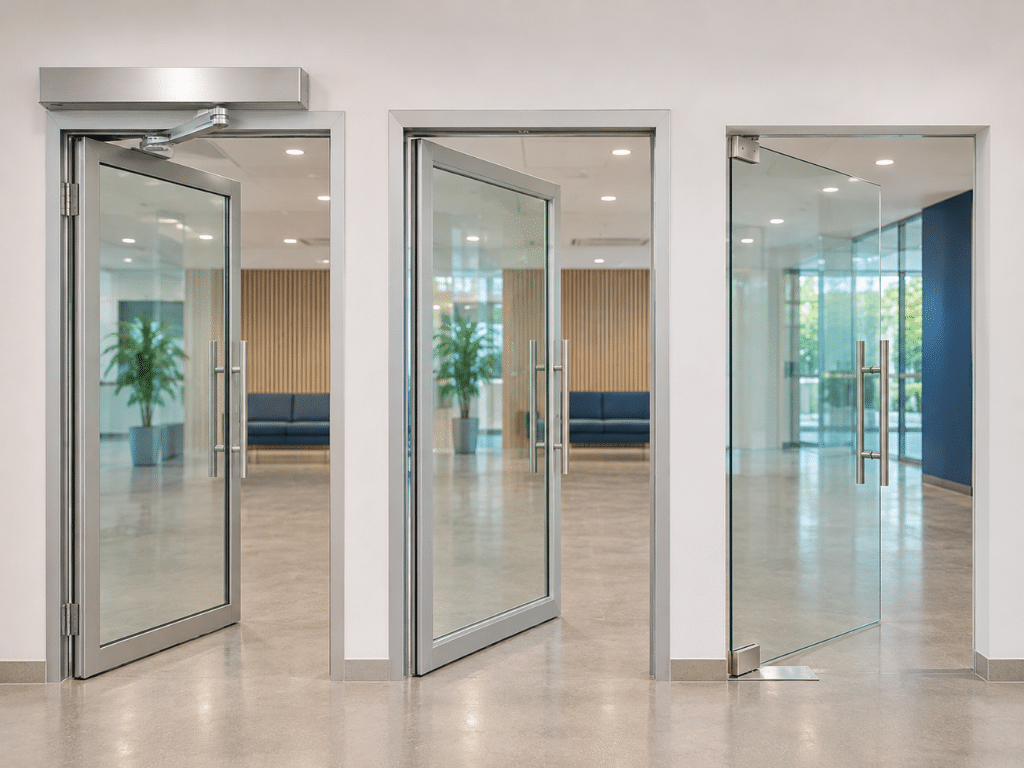
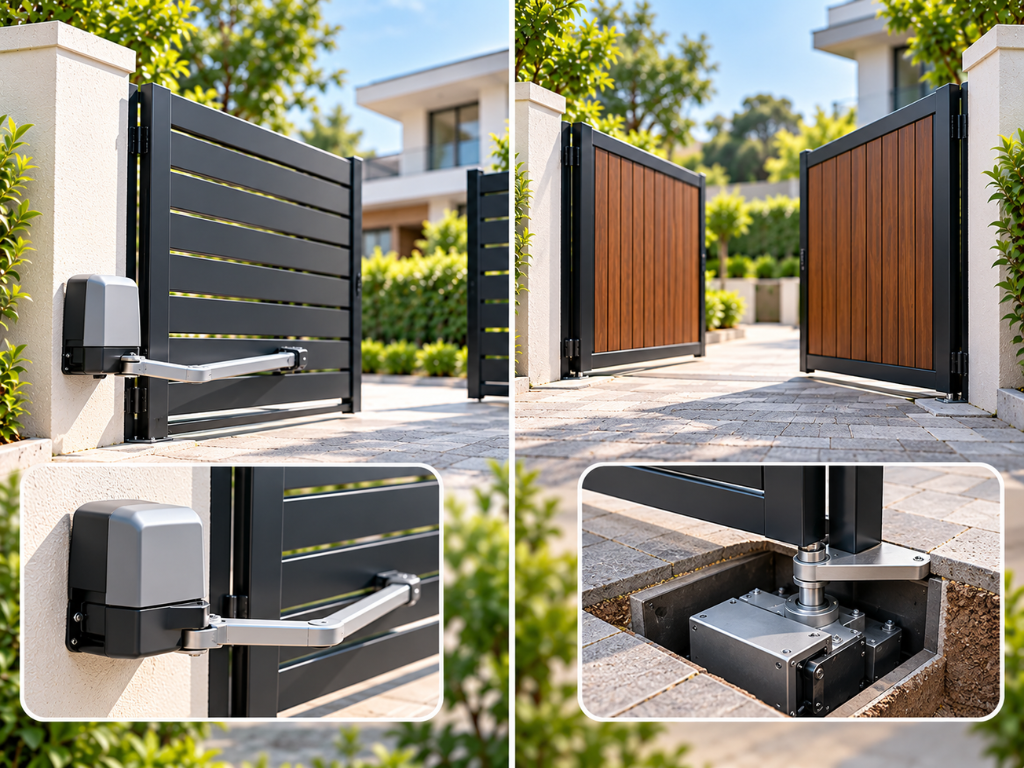
An automatic swing door operator in Singapore comes in three mounts. There’s a surface arm on the frame, a top concealed unit in the header and a floor concealed unit under the door. Your door’s weight and what’s above and below it decide which fits, so settle it before the frame is made.
At Enforce Automatics Global in Singapore, we supply and install all three on our automatic swing door range.
Which automatic swing door operator in Singapore suits your door?
Go surface arm for a door that’s already hung or a heavy door, and top concealed for a new framed entrance. Keep floor concealed for frameless glass indoors. If you’re still deciding between swing and sliding, start with our automatic swing door advice.
|
Mount |
Where it sits |
Heaviest door on our range |
Best for |
Watch for |
|
Surface arm |
Box on the frame or transom face, arm to the door |
450 kg (Ditec DAB305) |
Existing doors, heavy doors, tight budgets |
Box and arm stay visible |
|
Top concealed |
Inside the transom or header |
200 kg (EF T200W) |
New framed aluminium entrances |
Header must be planned before fabrication |
|
Floor concealed |
In a pocket in the floor slab |
150 kg (EF U200A) |
Indoor frameless glass doors |
Slab depth, water at the threshold, servicing access |
Those weights are the most each operator is rated to move. Pick one with headroom above your leaf, because an operator running at its limit slows down, strains and wears out first.
When is a surface mounted door operator the right choice?
A surface mounted door operator is the right choice for retrofits, heavy doors and anyone who wants the easiest servicing.
The operator is a box fixed to the face of the frame or transom, with an arm down to the door. On the Ditec DAB105, that box is about 72 cm long and 13 cm deep. It goes on with no hacking, so it suits tenants automating an existing office, clinic or toilet door. It also comes off at the end of a lease.
The arm depends on which side the box sits. If the door swings away from the box, you get a push arm, which folds like an elbow. If the door swings towards the box, you get a pull arm, which slides in a track fixed to the door.
Put the box on the inside where you can, because the Ditec DAB range is rated IP20, which means it’s built for indoor conditions, not rain.
Surface arms also carry the heaviest doors. The DAB205 moves up to 400 kg on a push arm. The DAB305 takes up to 450 kg on its articulated arm but only 370 kg on a sliding arm. The side you mount on can change the model you need. Compare the three on our Auto Swing Arm range, then send us the leaf weight and which way the door swings.
What does a concealed swing door operator need above the door?
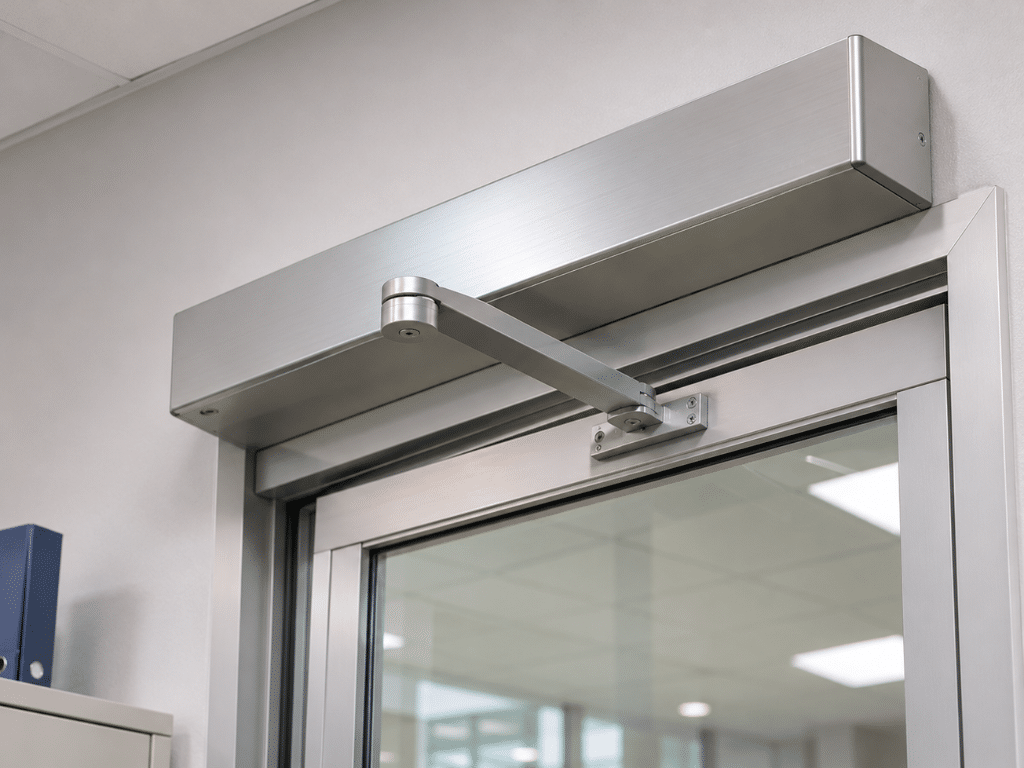
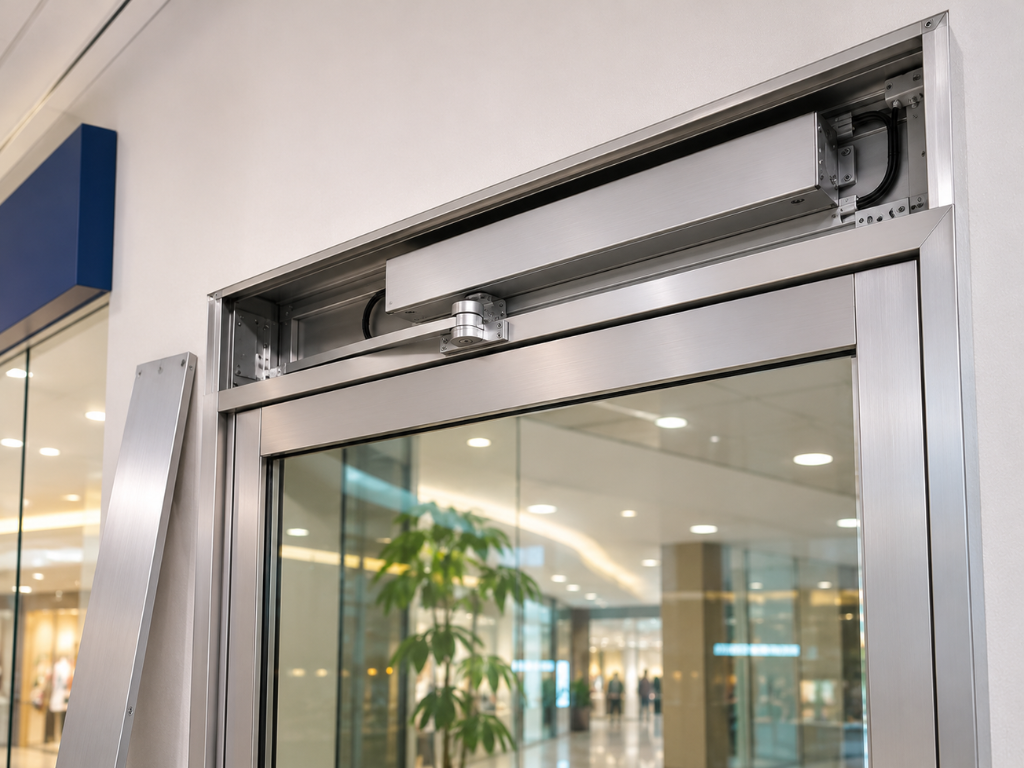
A top concealed swing door operator needs a transom or header deep enough to hide the unit and strong enough to carry it. That’s easiest to arrange before the aluminium frame is fabricated.
Once the frame is made without room for the operator, you’re back to a surface arm or a new header. Building a new shopfront or office lobby in framed aluminium and want only the door on show? Tell your designer and fabricator at drawing stage.
If the header sits inside a false ceiling, check the ceiling depth too, and leave an access panel so the unit can be reached for servicing.
Our EF T200W top concealed operator takes doors up to 200 kg and runs on a 24 V DC motor. That covers framed aluminium and glass doors in offices and shops. For a heavier leaf, a surface arm is the better buy.
Is a floor concealed door operator worth it?
A floor concealed door operator is worth it for an indoor frameless glass entrance where nothing can show above the door. For a wet or exposed threshold, it rarely is.
The unit sits in a pocket in the floor under the door’s pivot. That suits frameless glass doors hung on glass patch fittings, the metal clamps at the corners of the glass.
There’s no frame to fix a box to, so a floor unit keeps the clean look. The catch is the slab. You need enough slab depth for the pocket, and in an existing building that means hacking the floor, so check with building management what runs underneath first.
Water is the bigger risk in Singapore. A pocket at an outside door collects rain unless the threshold drainage is planned, and a wet operator fails early. Servicing also means lifting the cover plate at floor level. Our EF U200A floor concealed operator takes doors up to 150 kg, so check that a thick, full-height glass leaf comes in under that before you commit.
How do leaf weight and width decide your automatic swing door operator in Singapore?
Leaf weight and leaf width decide it together, because a wide door puts more load on the operator than its weight alone suggests.
Get the leaf weight in kg from your door or glass supplier rather than guessing. Full-height toughened glass is heavier than it looks, and a timber fire door is heavier again. Then check the width. The DAB305 handles leaves from 500 mm to 1,600 mm wide on its articulated arm, but only 750 mm to 1,400 mm on its sliding arm.
The mistake to avoid is pricing an operator from the door size alone. Two doors of the same size can differ by tens of kilograms once the glass, frame and handles are counted, and that difference decides the model.
For a straight answer on your door, we need the leaf weight in kg, or the glass thickness and size, plus the width, height and swing direction. Add a photo of the frame, the space above the door and the floor at the threshold, and tell us whether it’s an outside door.
What opening speed, hold-open time and closing force should you ask for?
Ask for an opening speed people find comfortable, a hold-open time of at least 5 seconds, and a closing force light enough to push open by hand.
These are settings, so get them agreed before handover. The Ditec DAB105 opens in 3 to 6 seconds and holds open anywhere from 1.5 to 30 seconds. That range goes below what the Code on Accessibility 2025 asks of power-operated doors, which is at least 5 seconds after the button or sensor is released. Set it there or longer, and longer again for a clinic.
The DAB105 and DAB205 close on a spring and motor, so the door shuts even in a power cut. That spring also sets how hard the door is to push by hand.
On an exit route, SCDF Fire Code 2023 caps that at 30 N to start the door moving and 20 N once it’s open 30 degrees. Have it measured with the power off. On a main entrance, add the battery kit the DAB range takes, so a short power trip doesn’t stop the door.
What we’d fit on your door
For an existing door or anything over 200 kg, we’d fit a surface arm with the box on the inside. For a new framed entrance, plan a top concealed unit into the header. Keep floor concealed for indoor frameless glass under 150 kg.
To confirm the model, we need the leaf weight, width, swing direction and photos above and below the door. Book a free site survey and we’ll check it on site.
FAQs About Automatic Swing Door Operator Singapore
Can one operator run a double swing door?
Plan on one operator per leaf, set to work as a pair so both open together and close in the right order. Size each operator to its own leaf weight, because the two leaves are rarely identical. On a surface arm, the two boxes can often sit side by side on one transom.
Can I switch from a surface arm to a concealed operator later?
Only with building work. A top concealed unit needs a header with room inside, and a floor unit needs a pocket in the slab. Either way, the frame or floor has to change. If you think you’ll want the concealed look later, plan the header now, even if you start with a surface arm.
Which swing door operator costs the least?
A surface arm costs the least, because it fixes onto the existing frame with no hacking. Top concealed costs more because of the header work. Floor concealed costs the most, since the slab is cut and the threshold detailed for water. Enforce prices it after a free site survey, because leaf weight decides the model.