

Automatic Swing Door Wind Load: Why Doors Stall or Slam
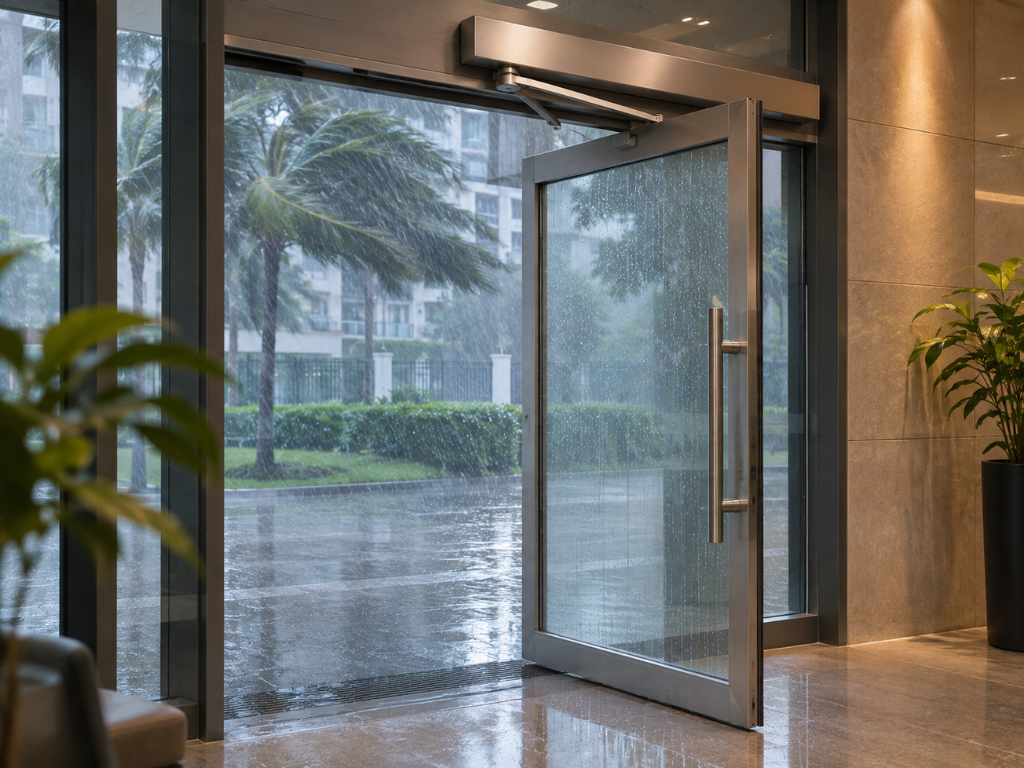
Automatic swing door wind load is the push of wind or air pressure on the door leaf. When it beats the operator, the door stalls, reverses or slams.
It hits exposed entrances, condo lobbies and tall air-conditioned buildings hardest, and the Northeast Monsoon starts next month. At Enforce Automatics Global in Singapore, we supply and install the operators on our automatic swing door range, including models built to adjust for wind.
How does automatic swing door wind load make a door stall, reverse or slam?
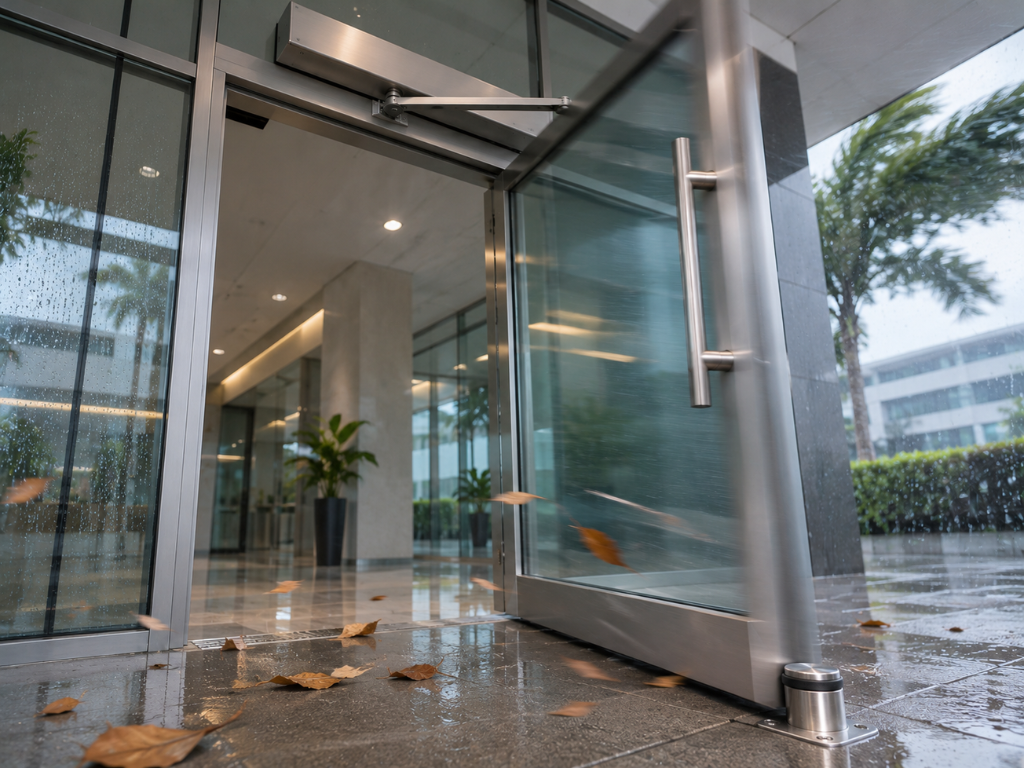
Wind pushes on the whole face of the door, so a big glass leaf acts like a sail. When that push is stronger than the operator’s torque, the turning force the motor can apply, the door misbehaves in one of four ways.
|
What you see |
What’s happening |
First thing to check |
|
Door stops halfway open |
Wind is pushing against the opening, and the motor runs out of torque |
Operator size for the leaf, opening force setting |
|
Door opens, then reverses back |
The operator reads the wind’s resistance as someone in the way |
Obstacle sensitivity, wind setting |
|
Door slams shut or bangs open |
A gust catches the leaf and the operator can’t hold the speed |
Closing force, speed control, door stop |
|
Door won’t close fully |
Wind or lobby pressure holds it off the frame |
Closing force, building pressure |
Leaf area matters more than weight. A wide, full-height glass door can carry less weight than a timber door and still catch far more wind. If you’re still choosing the operator, our advice on surface arm and concealed operators covers sizing.
When does the Northeast Monsoon hit entrance doors in Singapore hardest?
The Northeast Monsoon runs from December to early March, and the first half brings monsoon surges with winds of 25 to 35 km/h.
So December and early January are when doors facing north or north-east start acting up, usually during the heavy rain of a surge. The later half, from late January to early March, is drier but still windy. A door that behaved all year can start stalling in the first week of December.
If your entrance faces open ground, a road or the sea on its north or north-east side, plan the fix in November. Adjusting an operator before the surge costs far less than replacing a bent arm after one.
Is it the wind, or is your building pushing the door?
Often it’s the building, and you can tell because the door misbehaves on still days too.
A pressure difference at an air-conditioned lobby comes from the air handling. If the building takes in less fresh air than it exhausts, the lobby sits at lower pressure than outside. The door then gets pushed or pulled by the gap.
In a tall building, the cool air inside is heavier than the warm air outside, so it sinks and presses out through the ground floor. That’s the stack effect, and it gets stronger the taller the building.
Signs it’s building pressure rather than wind:
- The door struggles with no breeze outside
- It’s worse when the aircon is running or at certain times of day
- You hear air whistling through the gap when the door is shut
- A door on the sheltered side of the building has the same problem
If that’s you, an operator change alone won’t cure it. Ask your M&E engineer or building management to check the air balance, then set the operator to match.
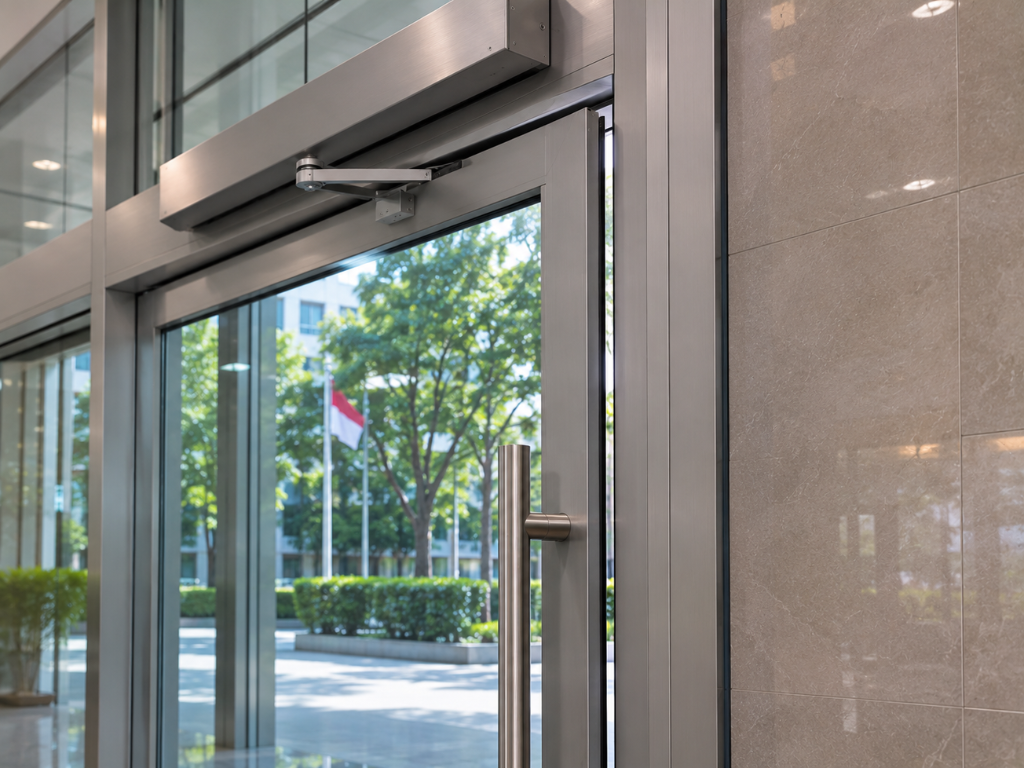
Can operator settings fix automatic swing door wind load?
Settings fix mild cases, so try them first, because they cost the least. A bigger operator or a change to the building only makes sense once the settings run out.
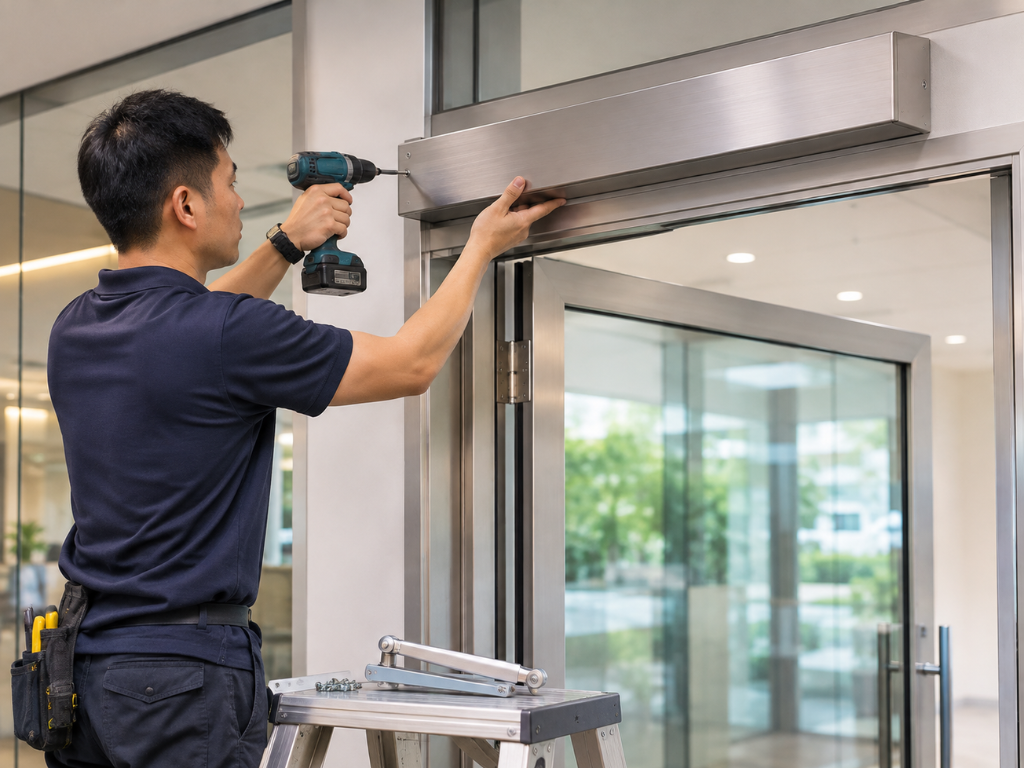
A technician can raise the closing force so the door shuts against the wind. Slowing the closing speed stops a gust turning it into a slam. They can also set back-check, the braking near full open that stops the door being flung into the wall. Fit a floor or wall stop as well, because toughened glass doesn’t take kindly to hitting a wall edge.
Closing force has a ceiling. Too much and the door hits people hard. On an escape route, it must still push open by hand at no more than 30 N under Clause 2.3.9 of the SCDF Fire Code 2023. If you need more closing force than that allows, the answer is a different operator or less wind.
Some operators are built for this. The Ditec DAB305 adjusts its closing force automatically to wind pressure, and the DAB105 can be set up for doors exposed to wind. Compare them on our Auto Swing Arm range.
When do you need a bigger operator, a new swing direction or a sliding door?
Move up to a stronger operator when settings can’t hold the door. Change the swing direction or the door type when the wind will beat any operator you fit.
A heavier-rated operator gives more torque, so it opens against the wind without stalling. On our range, the DAB305 takes leaves up to 450 kg on its articulated arm, against 200 kg on the DAB105. It also handles leaves up to 1,600 mm wide.
Swing direction changes how the wind works on the door. A door opening into the wind gets pushed shut and fights the motor on the way out. A door opening away from it gets caught and flung open. Your QP may not let you change it, because doors serving more than 50 people must open in the direction of escape.
For a busy, exposed entrance, a sliding door handles wind better. It moves across the opening instead of swinging like a sail. Our comparison of sliding and swing doors covers when each wins.
What building changes stop wind reaching the door?
A canopy, side screens or a vestibule cut the wind before it reaches the leaf, and they fix the cause instead of fighting it.
A canopy over the entrance keeps off driving rain and breaks gusts coming over the top. Glass side screens block wind coming along the building face, which is where corner entrances get hit. A vestibule, a short lobby with a door at each end, works best. The outer door takes the wind and the inner door takes the lobby pressure, so neither faces both.
A vestibule needs floor space, and on an accessible route the gap between two swing doors has to allow for a wheelchair. Get your designer to check it against the Code on Accessibility before building.
For a straight answer on your entrance, send us a short video of the door stalling or slamming, and tell us which way it faces. Add photos of the operator cover and the space around the entrance, and say whether it’s worse with the aircon on.
What we’d do with your door
For a door that stalls or slams in the monsoon, we’d start with the settings, add a door stop, and check the lobby air pressure. If that’s not enough, a wind-adjusting operator like the DAB305 is the next step. On a busy, exposed entrance, a canopy, vestibule or sliding door beats any operator.
To confirm which fix suits your door, we need a video of the problem, the direction it faces and the operator model. Book a free site survey before the December surges.
FAQs About Automatic Swing Door Wind Load
Can strong wind damage an automatic swing door operator?
Yes. A door that keeps stalling makes the motor work at its limit, and a slam can bend the arm or crack the glass at the stop. Ignore it through one monsoon season and the arm or gearbox wears out early. Have the arm, fixings and stop checked before the next surge, and Enforce can survey the door.
Should I leave the door on hold-open during strong wind?
No. A door held open in a gust puts the full wind load on the arm and its fixings. In a surge, keep the door on automatic so it closes between users, or switch it off and shut it until the wind drops. Keep it free to open by hand if it’s on an escape route.
Can a manual door closer stop a swing door slamming in the wind?
Not on an automatic door, because the closer would fight the operator on every opening. The fix is in the operator’s own closing force and speed settings, or a stronger operator. On a manual door, a closer with back-check and an adjustable closing speed does help.