

Automatic Gate Motor Singapore: Types, Weight & Cost
Choosing an automatic gate motor in Singapore starts with two numbers: what your gate weighs and how many times a day it opens. Brand and price come after. Get those two numbers wrong and the motor fails early. A residential unit rated for 600 kilograms will burn out on a condo gate that cycles hundreds of times a day. Here is how the motor types differ, how to size one by gate weight, and what pushes the cost up, before you commit to an automatic gate installation.
What is an automatic gate motor, and what does it do?
An automatic gate motor is an electromechanical operator that opens and closes a gate when it receives a control signal. On a sliding gate it drives a rack-and-pinion. On a swing gate it drives an arm. A control board runs the motor, the safety sensors and the access control.
The signal can come from a remote, a keypad, a card reader or a vehicle loop in the driveway. The motor pushes the gate open, then holds it shut. Every operator carries two ratings: the gate weight it can move and the number of cycles it can handle each day. Both have to match the gate you actually have, using its real weight. Get the sizing right and the automation lasts for years, which is when you see the full benefit of a gate motor over a manual gate.
Sliding, swing, or underground: which motor type do you need?
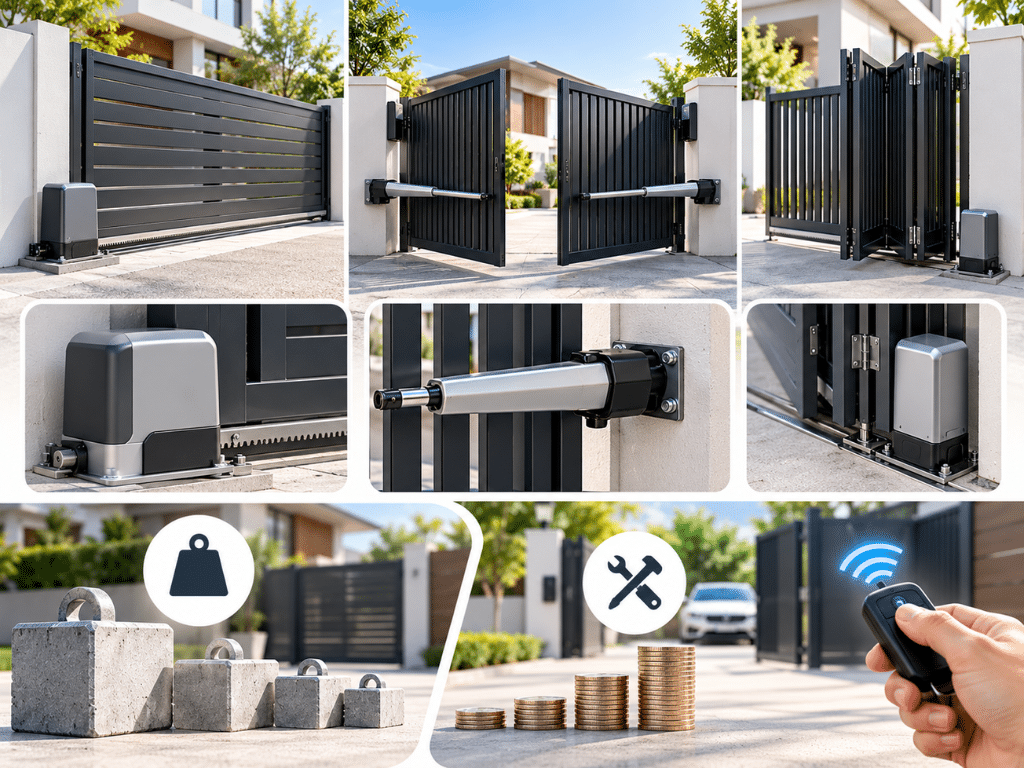
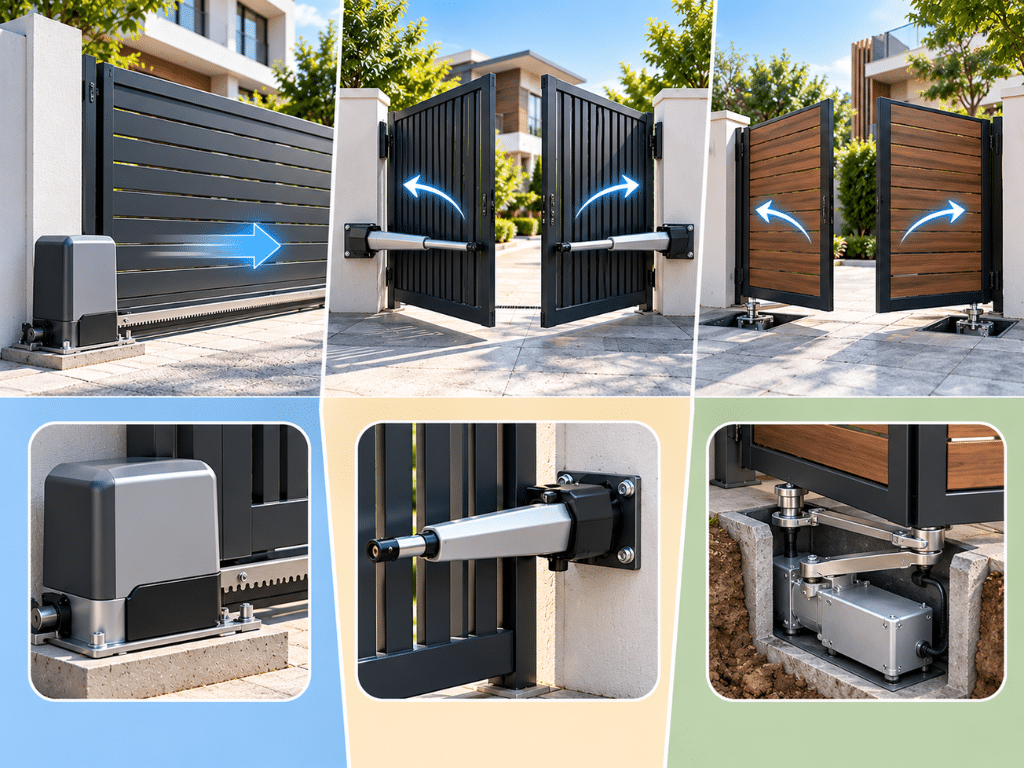
The gate decides the motor. Sliding gates use a rack-and-pinion operator. Swing gates use an arm or a linear ram, and swing gates that need to look clean use an underground operator hidden at the hinge.
Your site decides the gate in the first place. A sliding gate needs room along the fence line for the panel to travel, and its rack-and-pinion motor copes well with heavy leaves. A swing gate needs clear space for the leaves to open inward. It can run on an articulated arm, a hydraulic ram or an underground operator. The underground type sits below the driveway with no arm or housing on show. Owners of premium landed homes pick it for the look and accept the extra civil works. So the first call is between a sliding and a swing gate, and the motor type follows.
How does a sliding gate motor work?
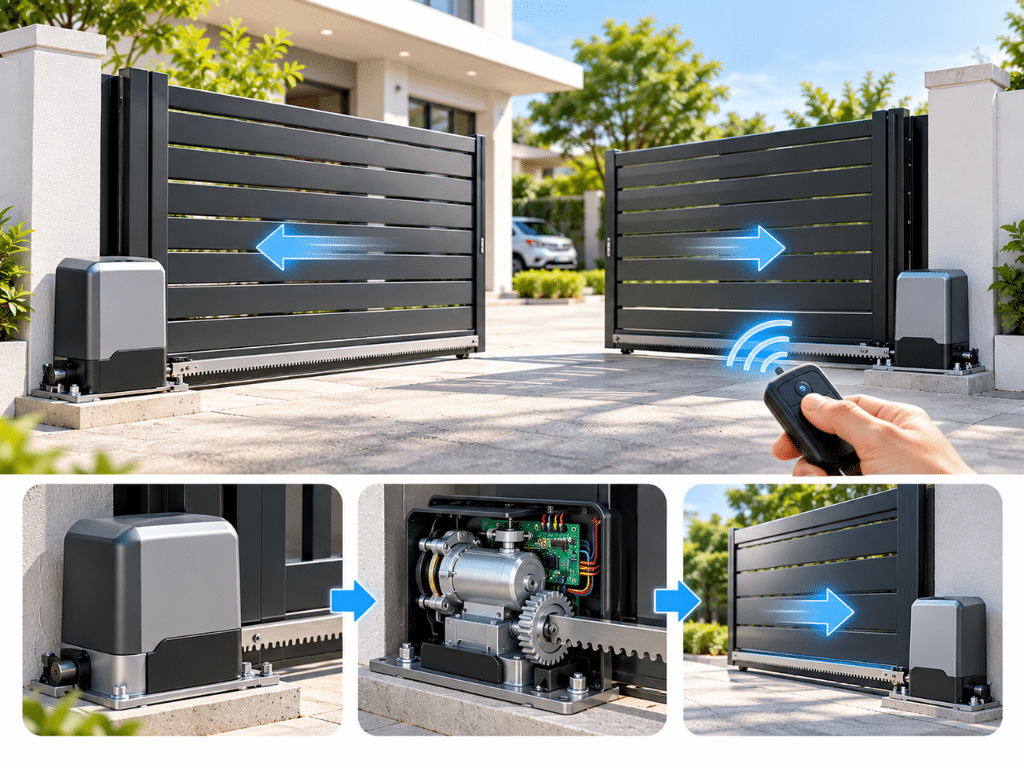
A sliding gate motor moves the gate sideways with a rack-and-pinion. A toothed rack is fixed along the gate, and a pinion gear on the motor meshes with it to push and pull the gate along its track. It is the most common drive for sliding gates, and the most reliable.
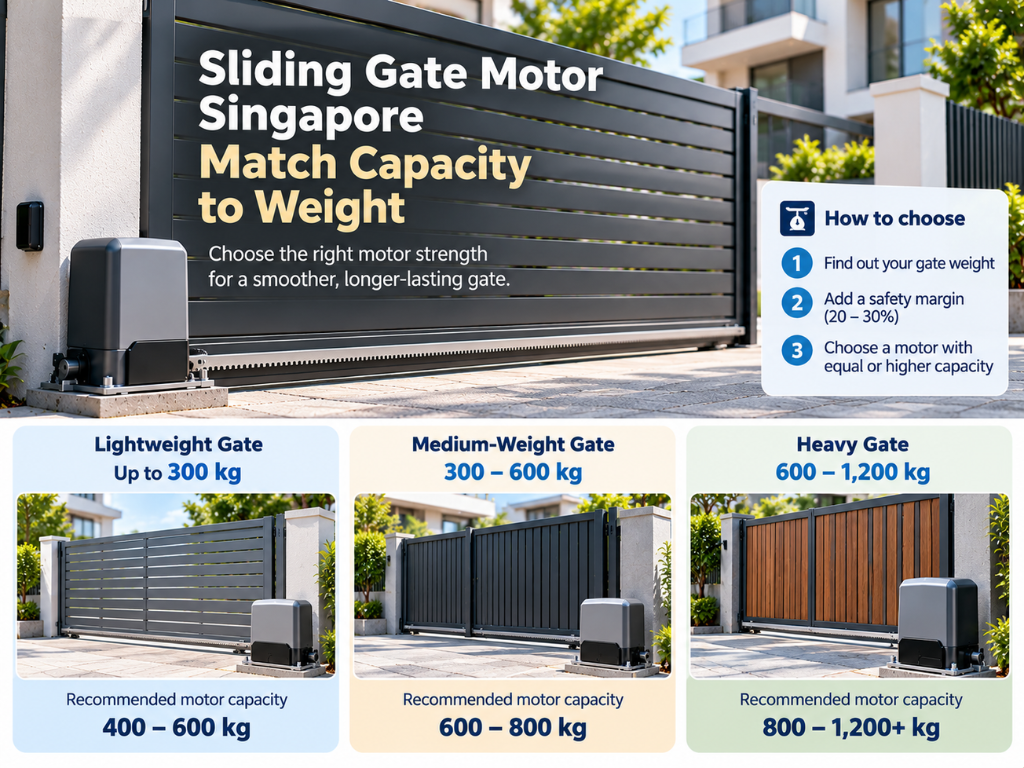
Nothing else handles heavy gates and frequent use as well. Residential sliding motors usually cover gates of 400 to 600 kilograms. A mid-range unit such as the DEA Livi goes up to 900 kilograms. Industrial gates need heavy-duty operators like the Dormer DE2 (1,600 kilograms) or the DEA Gulliver (2,500 kilograms). The rack comes in galvanised steel or nylon. Power draw is modest: a Comunello FORT 400 uses about 70 watts at its rated 400-kilogram load. Warehouses and factories often pair a high-capacity sliding motor with a cantilever gate, which needs no ground track.
Arm, ram, or underground: how do swing gate motors differ?
There are three kinds of swing gate motor. An articulated arm pushes and pulls the leaf. A linear ram extends and retracts like a piston. An underground operator hides at the hinge. All three swing the leaf through an arc of roughly 90 to 130 degrees.
Each one fits a different gate. The articulated arm is the usual commercial pick: a hinged two-part arm that moves the leaf smoothly and fits most gates. The linear or hydraulic ram is compact and strong, and it’s popular on simple residential leaves. The underground operator sits in a foundation box at the pivot and disappears once installed, so heritage and architect-designed homes tend to choose it. Swing motors carry two ratings, leaf weight and leaf length. A long, light leaf can load the operator as heavily as a short, heavy one. If nobody measures the leaf length, the motor strains every time the gate opens.
How do you size a gate motor by gate weight?
Start with the gate’s weight, add a safety margin, then check the motor against how often the gate runs each day. A motor rated at exactly the gate’s weight works at its limit on every cycle and wears out fast. Choose one rated comfortably above the real load.
Weight also decides the power supply. Landed sliding gates under 1,500 kilograms run on a single-phase motor. Industrial gates between 1,500 and 4,000 kilograms need three-phase, which gives more starting torque and runs cooler. Daily usage is the second check, measured as duty cycle: the share of time a motor can run before it has to rest. Duty cycle is what separates commercial motors from residential ones. A condo gate opening hundreds of times a day needs a high duty-cycle motor that a landed home would never need. Size on weight alone, ignore the cycle count, and the gate can burn out in two years when it should have lasted ten.
24V DC or 230V AC: which should you choose?
For most residential gates, go with a 24-volt DC motor. It runs quieter, starts more gently and keeps working on battery when the power goes out. A 230-volt AC motor makes sense where you want raw power at a lower price and can do without those extras.
A 24V DC motor steps the mains supply down to low voltage inside the unit. That gives you soft start and soft stop, which take the shock off the gate and hinges. It also runs almost silently, and its battery backup can open the gate during a blackout. A 230V AC single-phase motor runs straight off the standard Singapore household supply. It’s cheaper and handles gates up to about 1,500 kilograms at moderate use, but it starts harder and has no backup. On a landed home where a power cut could trap the car behind the gate, the battery backup makes the 24V DC motor the clear pick. Owners who fit a 230V motor with no backup on a single-access driveway tend to regret it the first time the power fails.
What control board features actually matter?
Five features matter: soft start and stop, adjustable limit switches, a photocell safety input, an auto-close timer and battery backup. They govern how safely and smoothly the gate runs, and they count for more than the motor’s raw power.
Treat the safety inputs as mandatory. A photocell, or safety beam, reverses the gate the moment something crosses its path. BS EN 12453, the safety standard for power-operated gates, reflects this requirement. Limit switches fix the exact open and closed positions, so the gate stops cleanly instead of slamming. Soft start and stop extend the life of the motor and the hinges. The auto-close timer shuts the gate after a set delay so it never stays open by accident, and battery backup keeps it working through an outage. An automated gate with no safety beam can crush a person or a car. No price saving justifies leaving it off.
Why does lightning surge protection matter in Singapore?
Singapore has some of the highest lightning activity in the world, and a surge through the control board is one of the most common reasons gate motors fail here. Every gate controller in Singapore needs a surge protector and proper earthing.
The Meteorological Service Singapore documents how lightning-prone the region is. A nearby strike can send a voltage spike down the line that kills an unprotected control board in a fraction of a second. The gate works one evening and is dead after an overnight storm. In most cases the board takes the hit and the motor survives. A surge protection device and a proper earth on the controller protect the most fragile and expensive electronic part of the system. Skip them, and the board sits exposed to a hazard this climate guarantees.
What drives the cost of an automatic gate motor?
Five things drive the cost: the motor type, the gate weight it has to move, the voltage and duty cycle, the brand, and any civil works. An underground operator costs more than a surface one before you price a single component, because it needs a foundation box and drainage.
The variables stack up. A heavier gate needs a higher-rated motor, and the price rises with the rating. Commercial units with high duty cycles sit above residential ones. A 24V DC motor with battery backup and soft start costs more than a basic 230V unit. Underground operators add civil works for the buried housing, which surface arm and sliding motors avoid. Brand and control features, from safety beams to smartphone control, push the figure further. A useful quote prices your specific gate, its usage and the site. That is how the real automatic gate installation cost gets set, and why a headline rate tells you very little.
Choosing an automatic gate motor in the right order
Work through the decision in sequence. The gate type tells you whether you need a sliding, swing or underground operator. Gate weight and daily cycles set the rating and duty cycle. Voltage decides whether you get soft start and battery backup, and the control board covers safety. Add surge protection for Singapore’s lightning and size the motor above the real load, and the automation should run for a decade. Cut the margin or leave out the safety beam, and expect it to fail early.
Enforce Automatic Global supplies, installs and maintains automatic gate motors for landed homes, condos and industrial sites across Singapore. Book a site assessment with Enforce to match the motor type, weight rating and control features to your gate and traffic, with surge protection fitted from the start.
Frequently asked questions
How much does an automatic gate motor cost in Singapore?
It depends on the motor type, the gate weight, the voltage, the brand, and whether an underground operator needs civil works. A residential 24V DC sliding motor sits at the lower end. High duty-cycle commercial units and concealed underground operators cost considerably more. A site assessment fixes the specification first, so the quote reflects your actual gate.
What size gate motor do I need for my gate?
Match the motor to your gate’s weight plus a safety margin, then to how many times the gate opens each day. Landed sliding gates under 1,500 kilograms run on single-phase motors. Industrial gates from 1,500 to 4,000 kilograms need three-phase. For a swing gate, measure both leaf weight and leaf length, because the motor is rated on both.
Does an automatic gate motor need battery backup?
A 24V DC gate motor comes with battery backup, so the gate still opens in a power cut. That matters on a single-access driveway, where a dead gate traps the car inside. A 230V AC motor runs straight off the mains with no backup. For a landed home in Singapore, the backup alone makes the 24V DC unit worth the extra cost.
Can you replace just the gate motor and keep the gate?
Yes. When a motor fails, it can usually be swapped on its own while the gate, track and rack stay in place, which costs far less than a full replacement. The new operator has to be rated for the existing gate’s weight and matched to the control board, so the installer checks compatibility before the swap.