

Smoke Vent Not Opening: 6 Faults That Fail Inspection
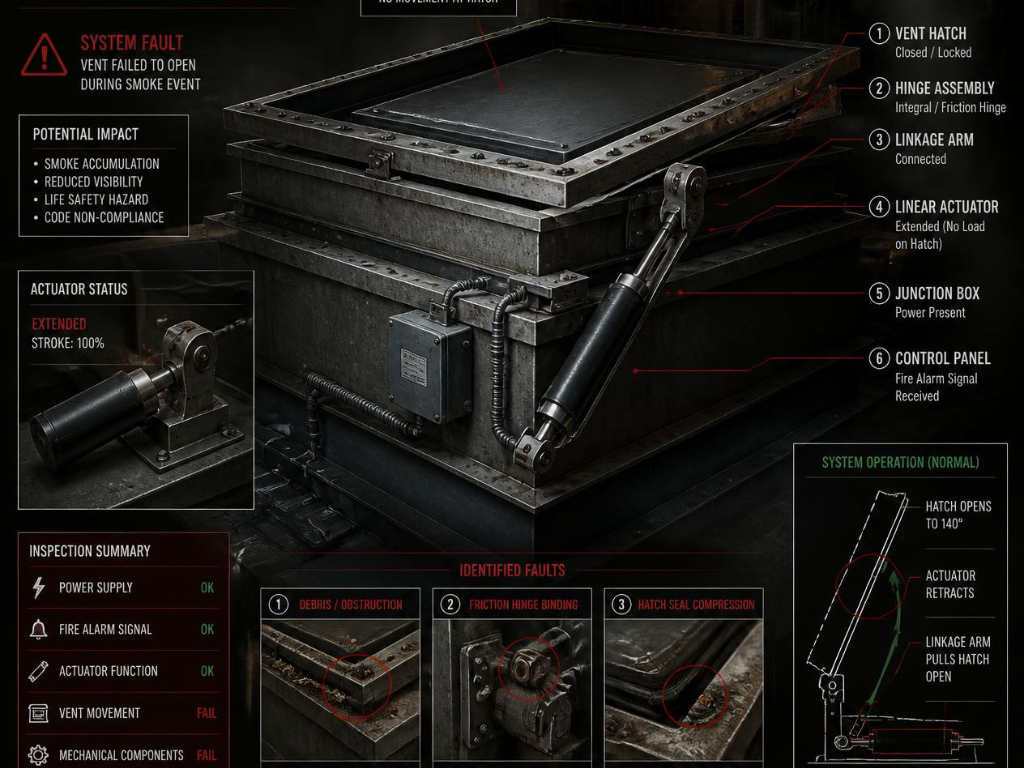
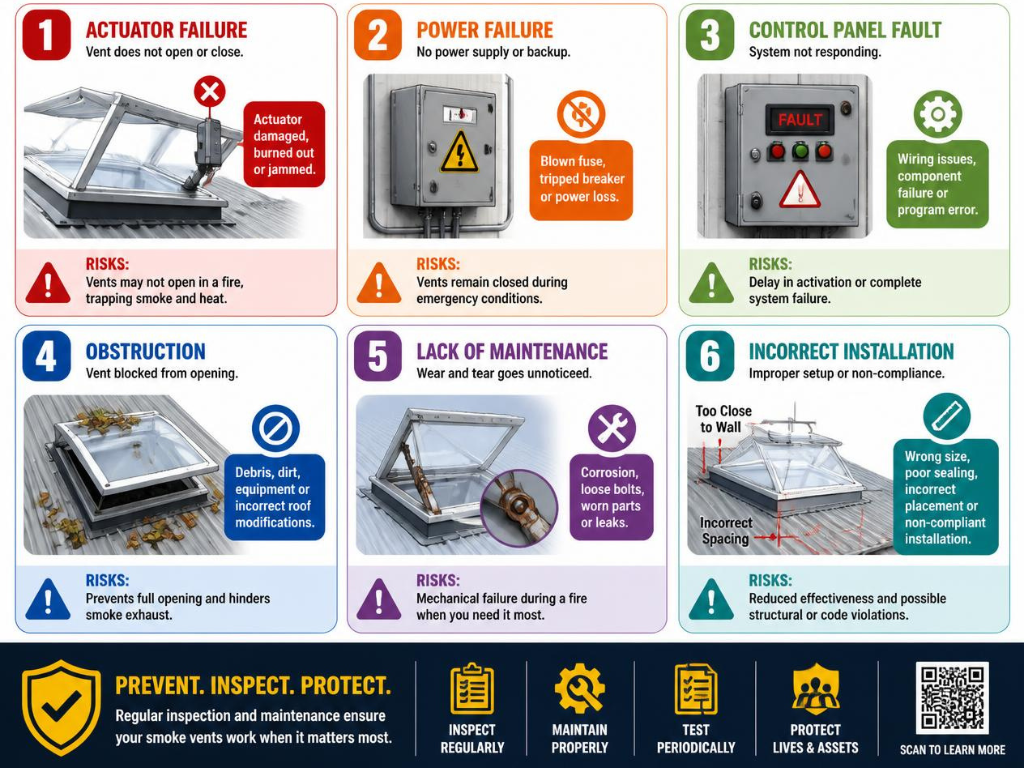
A smoke vent not opening on test in Singapore is a Fire Certificate failure, since the SCDF Fire Code demands every vent open fully within 60 seconds. Smoke vents fail silently between fires, so the fault only surfaces at the annual test. This blog walks you through the six faults that fail an inspection, each part of a compliant smoke release window system, and how each is fixed.
What happens when a smoke vent fails its Fire Certificate test?
A smoke vent that fails its test is logged as a defect and must be rectified before the Fire Certificate is granted or renewed. The SCDF certifies a working system, so a vent that will not open, opens slowly, or fails on backup power blocks the certificate.
The failure is treated as a fire safety defect because that is what it is. A vent that does not clear smoke turns a protected stairwell into a chimney, so the inspector records it, and the building owner carries the liability until it is fixed. As AOV specialist Gemini AMPM notes, the most common failures are “control panels with exhausted batteries, and faults on the fire alarm interface,” most of them repairable without replacing the vent. The six faults below account for nearly every smoke vent that fails a test, and each maps to a specific check the inspector runs against the types of smoke release systems installed.
Fault 1: The actuator stalls or a blown fuse kills the drive
The first fault is a dead actuator: the motor has seized, drifted out of adjustment, or lost power to a blown fuse, so the vent gets no drive at all. The panel signals correctly, but nothing moves.
The actuator is the muscle of the vent, and when it fails, the opening area you designed for does not exist. A 24-volt DC chain or spindle actuator can seize from age or corrosion, drift out of its stroke adjustment so it no longer reaches the fire-open position, or lose power to a blown output fuse at the control panel. An actuator originally selected for comfort ventilation and later expected to perform as a life-safety device is a common culprit, since it cannot overcome wind load and seal resistance at the fire-open angle. The fix is to replace the fuse or the actuator and confirm the stroke drives the vent to its full designed opening. An actuator that opens the vent halfway fails the test as surely as one that does not move.
Fault 2: A seized hinge or corroded chain jams the sash
The second fault is mechanical binding: the actuator drives, but a seized hinge, a corroded chain, or a sash fouling the frame stops the vent opening fully. The drive works; the movement does not.
Singapore’s humidity and coastal salt air make this the fault that creeps up on a facade. A corroded chain, a stiff or rusted hinge, or a sash that binds against cladding, a reveal, or a security grille all stop the vent reaching its designed angle, so it opens partially or not at all. The vent must open to the full fire position without binding, and a partial opening delivers only part of its effective area. The fix is to free or replace the seized hinge, replace the corroded chain, and clear whatever the sash fouls against. Leaving a binding sash to be forced by the actuator accelerates the wear and the next failure.
Fault 3: A flat standby battery fails the secondary power test
The third fault is a dead battery: the standby batteries have aged past their capacity, so the vent works on mains but fails when the tester cuts the power. This is one of the most common inspection failures.
The battery is the power the system runs on during a fire, so the test that cuts the mains is the one that catches it. Sealed lead acid standby batteries degrade over roughly four years and lose the capacity to drive the actuators, so a panel showing a healthy light on mains still fails the secondary power test. The fix is to load-test and replace the two 12-volt batteries, and to confirm the charger is holding them. A control panel that passes on mains and fails on backup has failed the half of the test that matters, since a fire commonly kills the mains first.
Fault 4: A broken fire alarm interface stops the vent responding
The fourth fault is a dead interface: the volt-free connection between the fire alarm and the smoke vent panel has failed, so the vent does not open when the alarm activates. The vent works on its own switch but ignores the fire signal.
The interface is the single connection that makes the vent a life-safety device, so a fault here is a serious finding. A miswired or failed volt-free contact, a detector signal that never reaches the panel, or a broken cause-and-effect link all leave the vent inert on a real alarm. The inspector triggers the fire alarm interface, not a local button, and times the response, so a vent that only opens on manual override fails. The fix is to repair the fire alarm interface and prove the signal path end to end, from detector to panel to actuator. A vent that opens on its switch but not on the alarm is useless in the fire it exists for.
Fault 5: Reverse-polarity or loose wiring drives the vent the wrong way
The fifth fault is a wiring error: reversed 24-volt polarity or a loose cable termination makes the actuator drive the wrong way or lose contact. The vent closes on the fire signal, or stops mid-travel.
The 24-volt actuators are polarity-sensitive, so a reversed connection is not a minor error. Swapped polarity sends the actuator in the wrong direction, so a fire signal that should open the vent instead closes it, and a loose cable termination interrupts the drive so the vent stalls partway. These faults often appear after building alterations or a hurried repair, and line monitoring at a good control panel flags the broken termination before the test. The fix is to correct the polarity and re-terminate the connections to a secure, monitored joint. A vent wired to close on the exact signal that should open it is the most dangerous of the wiring faults.
Fault 6: Sealant, paint, or an obstruction holds the vent shut
The sixth fault is a physical block: over-applied sealant, paint, or an obstruction has bonded or jammed the sash so the actuator cannot open it. The vent is sealed shut by the very work meant to weatherproof it.
This fault comes from the trades that touch the facade after the vent is installed. A bead of sealant over-applied around the sash, a coat of paint across the joint, or debris and stored items obstructing the vent path all hold the sash closed against the actuator’s push. A smoke vent must be free to open, so an inspector’s visual check for a painted or sealed sash is a standard part of the test. The fix is to cut the sealant, free the painted joint, and clear the vent path so the sash moves freely. A vent sealed shut for weathering is a smoke vent that cannot do its one job.
How do you rectify a failed smoke vent before the certificate?
Rectify a failed smoke vent by logging the fault, fixing it, and re-testing before the certificate is issued, since the SCDF certifies a working system, not a promise to fix one. Every defect goes into a corrective action register with a close-out date.
Rectification is the gate to compliance. The technician diagnoses which of the six faults applies, replaces the fuse, actuator, battery, chain, or interface, corrects the wiring, or clears the obstruction, then re-triggers the vent and times it against the 60-second limit. The building owner is accountable, and only an SCDF-registered fire safety contractor may carry out the work on a smoke control system. Under SCDF Clause 7.4, the actuator must be sprinkler-protected with fire-resistant cabling and operate within 60 seconds, so the re-test confirms all of it. A defect left unrectified simply blocks the Fire Certificate.
How do you catch these faults before the inspection?
Catch these faults before inspection with scheduled servicing that function-tests every vent, load-tests the batteries, and proves the fire alarm interface end to end. The faults are predictable degradations, so a maintenance regime finds them months before the audit.
Prevention is a discipline, not luck. A proper service opens and closes every vent on both the panel and the detection signal, load-tests the standby batteries against their roughly four-year life, checks hinges and chains for corrosion, and verifies the volt-free interface and the actuator polarity. Certified natural smoke and heat exhaust ventilators tested to BS EN 12101-2 hold their performance only if the moving and electrical parts are maintained. Running the service well ahead of the certificate date leaves time to rectify anything found, which is where the value of automatic window opener systems under a maintenance contract shows up. A vent proved open on a schedule never surprises you at the audit, so book a pre-certificate inspection rather than discovering a fault on the day.
Conclusion
A smoke vent that fails its test almost always traces to one of six faults: a stalled actuator or blown fuse, a seized hinge or corroded chain, a flat standby battery, a broken fire alarm interface, reversed or loose wiring, or a sash sealed shut by sealant or paint. Each is a Fire Certificate failure until rectified, and each is catchable on a maintenance schedule. Prove every vent open ahead of the audit, fix any defect before the certificate, and the inspection holds no surprises.
Enforce Automatic Global services and repairs smoke vent systems to SCDF requirements across Singapore, diagnosing actuator, battery, interface, and mechanical faults. Book a smoke vent inspection ahead of your Fire Certificate renewal, and have every vent proved open, any defect rectified, and the system certified on time.
Frequently asked questions
What is the most common reason a smoke vent fails inspection in Singapore?
The most common failures are exhausted standby batteries, seized or drifted actuators, and faults on the fire alarm interface. Sealed lead acid batteries degrade over roughly four years, so a panel that passes on mains fails the secondary power test. Each is repairable without replacing the vent, provided it is rectified before the Fire Certificate is issued.
Can one smoke vent fault fail the whole Fire Certificate?
Yes. A single smoke vent that will not open within 60 seconds, or fails on backup power, is a defect that blocks the Fire Certificate until rectified. The SCDF certifies a working system, so the building owner must have an SCDF-registered contractor fix and re-test the vent before the certificate is granted or renewed.
How long does it take to rectify a smoke vent fault?
A wiring, fuse, or obstruction fault is fixed in a single visit, while a failed actuator or battery may carry a parts lead time of several weeks for proprietary components. This is why the annual test is run well ahead of the Fire Certificate date, so a defect has time to be closed out rather than blocking the certificate.
Who can repair a failed smoke vent in Singapore?
Only an SCDF-registered fire safety contractor holding the correct registration category may repair a smoke control system in Singapore. The building’s Fire Safety Manager oversees the work and records it, and engaging an unregistered party does not relieve the building owner of liability if the vent fails at the next inspection.