

Smoke Vent Control Panel Singapore: Fire & Backup
A smoke vent control panel in Singapore is the brain of a smoke release system, the unit that takes the fire signal, drives the vents open, and holds power in reserve when the mains fail. Get the panel wrong and the actuators do nothing on alarm. This blog walks you through the fire alarm interface, battery backup, and ventilation override behind a compliant smoke release window system.
What is a smoke vent control panel, and what does it do?
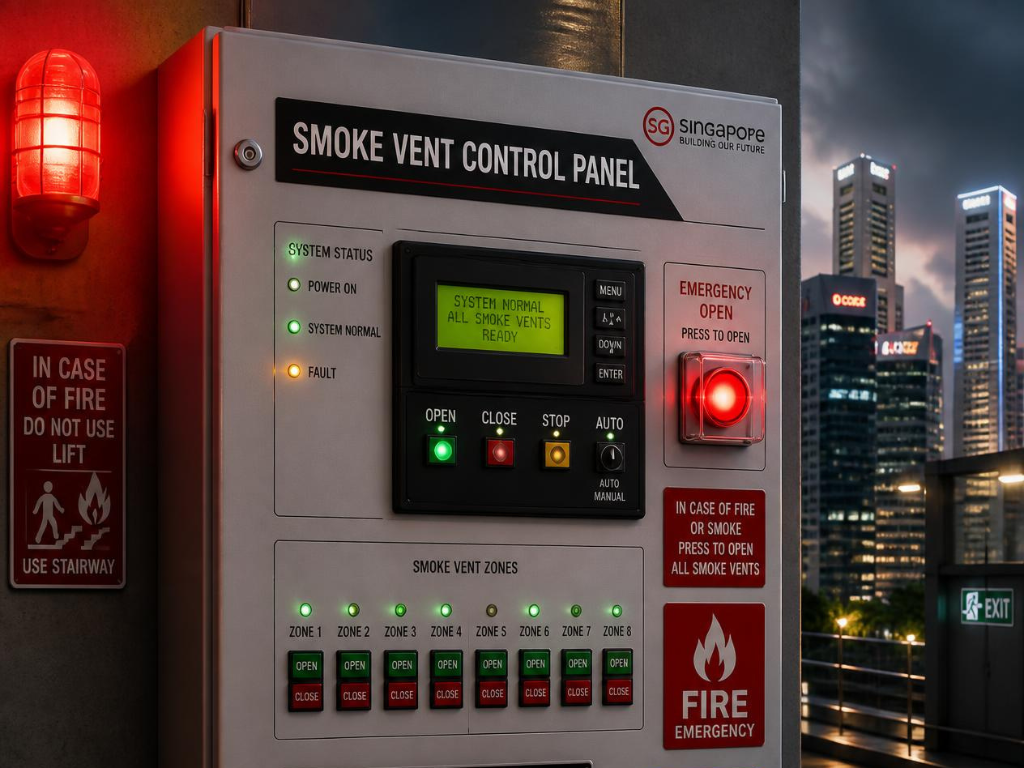
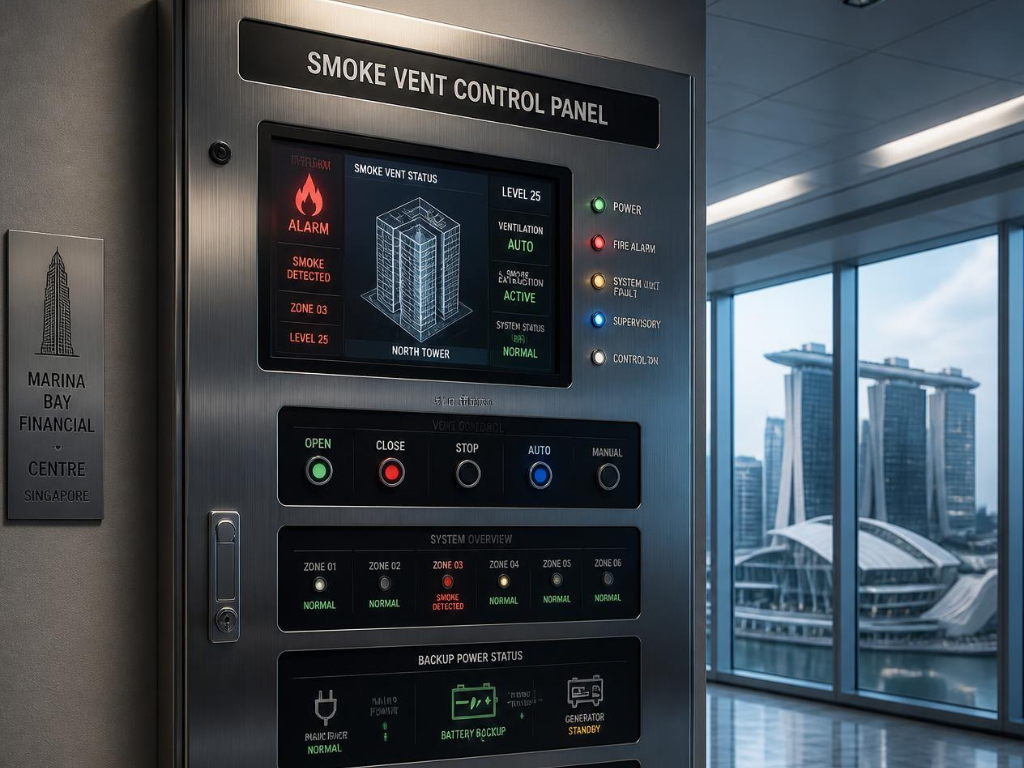
A smoke vent control panel is the electronic controller that monitors a smoke ventilation system, powers the actuators, and drives the vents open on a fire signal. It sits between the building fire alarm and the vents, translating a detection signal into an opening command.
The panel is the accountable component in the chain. As smoke control supplier Teal Products puts it, “smoke vent panel, smoke ventilation control panel, and AOV panel are interchangeable terms” for the unit that monitors, powers, and operates the automatic opening vents. It supplies 24-volt DC to the actuators on vents, windows, and roof lights, commonly in stairwells, corridors, and smoke extract shafts, and it carries a battery so those actuators still fire on a mains failure. The panel also handles day-to-day comfort ventilation, then overrides it the instant a fire is detected. A vent system without a proper control panel is a set of motors with nothing to command them.
How does the control panel interface with the fire alarm?
The control panel interfaces with the building fire alarm through a volt-free contact, so when the alarm activates, a relay signals the panel to drive the vents to their fire position. This dry-contact link is what makes the vents respond to a real fire rather than a wall switch.
The interface is engineered for clean, monitored signalling. The panel accepts fire alarm inputs from smoke detector circuits, a fire alarm interface, or manual call points, typically as a volt-free changeover contact that carries no voltage of its own and simply closes on alarm. On that signal, the panel switches to fire mode and opens the vents, and it can also report status back through a signal changeover contact. A panel wired to a local switch but not to the fire alarm interface is not a smoke control installation, since it will not open when detection triggers. The volt-free contact is the single connection that turns a comfort vent into a life-safety device.
Why does a smoke vent control panel need battery backup?
A smoke vent control panel needs battery backup so the vents still open when a fire cuts the mains, which is the exact moment they are needed. The battery is not a convenience; it is the power the system runs on during the incident.
The backup is built to a standard and sized to the load. The panel carries two 12-volt sealed lead acid batteries in series to deliver 24 volts, commonly 2 by 7Ah, 2 by 12Ah, or 2 by 17Ah depending on the actuator load, and its power supply and charger comply with BS EN 12101-10 for smoke control power supplies. A quality panel provides 72 hours of standby backup as standard, so the system stays available through an extended outage and still has the power to drive the vents. Under SCDF Clause 7.4, a smoke ventilation system runs on a secondary power supply for this reason. A panel specified without the correct battery capacity fails the standby duration the design requires.
What is ventilation mode override, and how does fire priority work?
Ventilation mode override means the panel runs the vents for daily comfort airflow, then fire mode overrides that control the instant the alarm sounds. Fire priority is absolute: a fire signal opens the vents fully regardless of the ventilation setting or a manual close.
The two modes share the hardware but not the authority. In ventilation mode, the panel opens the vents in small steps, often 10 percent increments, for comfort airflow, and a programmable limited-ventilation setting stops the windows opening fully on a hot day. The moment the fire alarm activates, the panel ignores the comfort logic and drives every vent in the zone to the smoke-extract position, and no occupant switch can close them while fire mode is active. This priority is the whole reason the panel exists, since a vent that a resident closed for the aircon must still open in a fire. Designing a system where comfort control can override fire mode is a dangerous inversion of priority.
How does zone control work on a smoke vent panel?
Zone control divides the building into smoke zones so the panel opens only the vents in the affected area, and monitors each zone independently. A single-zone panel serves one area; a multi-zone panel serves several from one controller.
Zoning matches the smoke strategy to the building. A small building uses a single-zone panel where all vents trigger together, while a larger building uses a multi-zone panel, some controlling 2 or up to 10 zones, so a fire in one stairwell opens that zone’s vents without disturbing others. Panels scale by actuator current, from a 1.5-amp single-zone unit to a 20-amp multi-zone controller driving many motorlines, sized to the total load. Each zone’s inputs and outputs are monitored separately, so a fault in one zone is isolated and identified. Sizing a single-zone panel onto a building that needs zoned control forces every vent open at once, which is rarely the right smoke response.
What manual controls and override does the panel provide?
The panel provides a manual override to open the vents on demand, plus status signalling and, where fitted, comfort ventilation switches. Firefighters and building staff can command the vents directly, independent of the automatic detection.
Manual control is a required layer, not an extra. An override switch lets a firefighter or a Fire Safety Manager open the vents manually, with status signalling showing whether they are open or closed, and comfort ventilation switches let occupants run daily airflow within the limited-ventilation setting. The panel reports vent position feedback so the operator sees the real state, not an assumed one. These manual paths sit alongside the automatic fire response covered across the types of smoke release systems, never replacing it. A panel with no manual override leaves firefighters unable to control the vents on arrival, which is a gap in the emergency response.
How does the panel indicate faults?
The panel indicates faults through line monitoring of every critical input and output, with fault LEDs and a status display flagging any break or failure. A smoke control panel that cannot detect its own faults is a liability, since a broken cable would otherwise pass unnoticed until a fire.
Fault monitoring is continuous and specific. The panel monitors the actuator lines, the detection inputs, and the battery in compliance with the control-panel standard prEN 12101-9 and ISO 21927-9, so a severed or short-circuited cable raises a fault immediately rather than at the annual test. Onboard LED status indications and a reset button show the panel’s state, and the unit enters an alarm condition if its internal temperature exceeds 75 degrees Celsius. This constant self-check is what keeps a dormant life-safety system trustworthy between fires. A panel without line monitoring hides its own failures, which defeats the purpose of a supervised system.
What cable and fire rating does the panel need?
The panel needs fire-resistant cable between it and the actuators, so the circuit survives the early minutes of a fire while the vents are opening. Standard cable that fails in heat would cut power to the vents at the worst moment.
Cable choice is a code requirement, not a preference. Under SCDF Clause 7.4, the electrical power supply cables to the actuator must be fire resistant, so the panel-to-actuator wiring is specified as fire-rated cable that maintains circuit integrity under fire. The line monitoring then supervises that cable, so damage is flagged before an incident. Pairing a compliant panel with ordinary cabling undoes the panel’s reliability, since the smoke system is only as dependable as its weakest circuit. The fire rating of the cable is part of the specification, not an install-time afterthought.
How is a smoke vent control panel specified and commissioned in Singapore?
Specify a smoke vent control panel by the actuator load, the number of zones, the battery standby, the fire alarm interface, and the fire-rated cabling, then commission it against the code. The specification names the amp rating, the zones, the battery capacity, and the standards.
Start from the load and the layout. Total the actuator current to size the panel’s amp rating, count the smoke zones to choose single or multi-zone, and confirm the battery delivers the required standby, backed by an EN 12101-10 power supply. Confirm the volt-free fire alarm interface and the fire-resistant cabling, and require line monitoring to the control-panel standard. On commissioning, the batteries charge for at least 12 hours before a full functional test, and every zone is triggered and timed against the 60-second requirement. A supplier offering integrated automatic window opener systems can match the panel, the actuators, and the cabling as one certified system. When your design is ready, request a panel specification review so the controller is sized and wired to the Fire Code before it goes to SCDF.
Conclusion
A smoke vent control panel is the component that decides whether a smoke release system works: a volt-free fire alarm interface that drives the vents on alarm, a 24-volt battery backup sized for 72 hours of standby, fire priority that overrides every comfort setting, zone control matched to the building, and line monitoring that flags its own faults. Specify it to the actuator load and the standards, wire it in fire-rated cable, and commission every zone against the 60-second limit, and the vents open the moment they must.
Enforce Automatic Global supplies, installs, and commissions smoke vent control panels and actuators engineered to SCDF requirements across Singapore. Request a panel specification review of your smoke ventilation, and receive a controller sized to your actuator load, your zones, and the battery standby your building needs.
Frequently asked questions
What voltage does a smoke vent control panel use?
A smoke vent control panel outputs 24 volts DC to drive the actuators, taking a 240-volt AC mains input. The 24-volt standard lets the panel run on a battery backup during a mains failure, since two 12-volt sealed lead acid batteries in series provide the 24 volts. Panels are sized by current, from 1.5 amps to 20 amps or more.
What battery does an AOV control panel use?
An AOV control panel uses two 12-volt sealed lead acid batteries wired in series to give 24 volts, commonly 2 by 7Ah, 2 by 12Ah, or 2 by 17Ah depending on the actuator load. A quality panel provides 72 hours of standby backup, and its power supply and charger comply with BS EN 12101-10. The batteries charge for at least 12 hours before full testing.
Does the fire alarm override the ventilation on a smoke vent panel?
Yes. Fire mode always overrides comfort ventilation on a smoke vent control panel. When the fire alarm activates, the panel drives every vent in the affected zone fully open regardless of the ventilation setting or any manual close, and no occupant switch can shut them while fire mode is active. This fire priority is the core function of the panel.
What standard applies to smoke control panels in Singapore?
Smoke control panels follow the BS EN 12101 series: EN 12101-9 covers the control panels and their line monitoring, and EN 12101-10 covers the power supplies and battery charging. In Singapore, the installation must also meet SCDF Fire Code Clause 7.4, including fire-resistant actuator cabling and full operation within 60 seconds of activation.