

Window Actuator Singapore: Chain, Linear & Rack Types
A window actuator in Singapore is the motor that drives a smoke vent open on a fire signal, and the wrong type or size leaves a vent that fails the code. The SCDF Fire Code 2023 demands full opening within 60 seconds. This blog walks you through chain, linear, and rack actuators, and how to size one, so your smoke release window system opens every time.
What is a window actuator, and what does it do?
A window actuator is an electric drive that opens and closes a window or vent automatically, replacing the manual handle. In a smoke vent, it opens the sash on a signal from the fire alarm so hot smoke can escape, and it does so on a tight time limit the code sets.
The actuator is the moving muscle of a smoke release system. It mounts to the window frame and sash, extends to push the sash open through a chain, a rigid rod, or a rack, and retracts to close it. For life-safety duty, it runs on 24-volt DC power backed by a battery so it still opens when a fire cuts the mains, and it interfaces with the fire alarm panel rather than a wall switch. A comfort ventilation actuator does the same mechanical job for everyday window ventilation, but a smoke vent actuator carries certification and duty ratings a comfort unit does not. Getting the type and size right is what turns a window into a compliant vent.
Chain, linear, or rack actuator: what’s the difference?
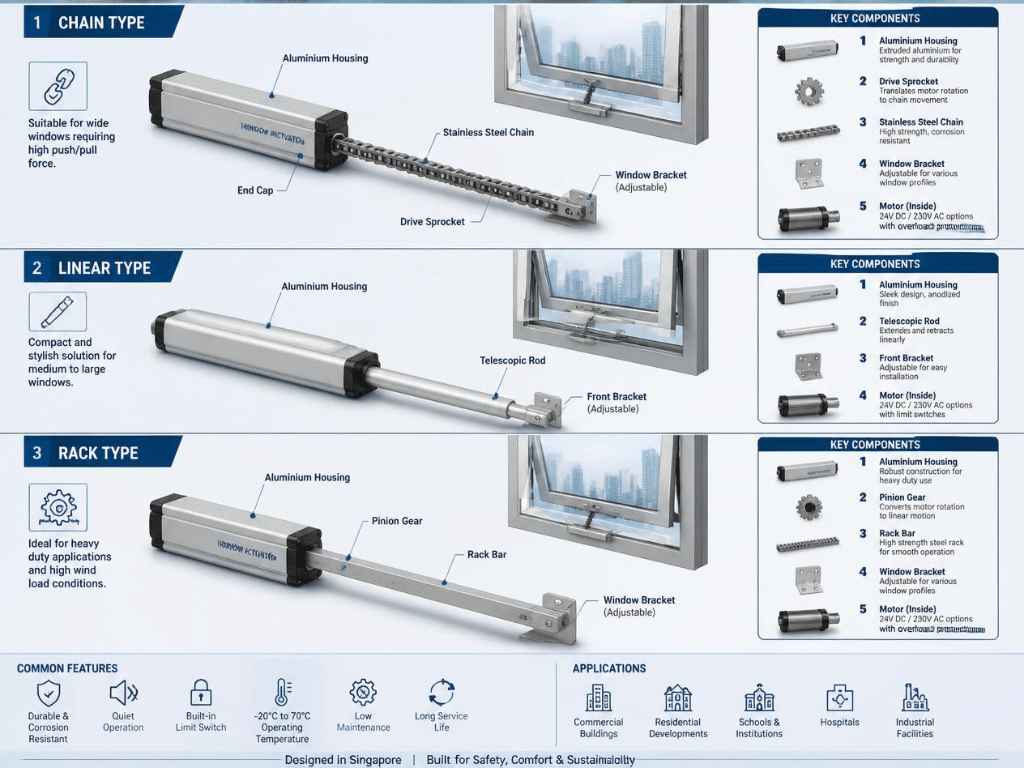
The three types differ in how they push the sash: a chain actuator uses a folding steel chain, a linear actuator uses a rigid spindle or rod, and a rack actuator uses a toothed rack and pinion. Each suits a different sash weight, location, and stroke.
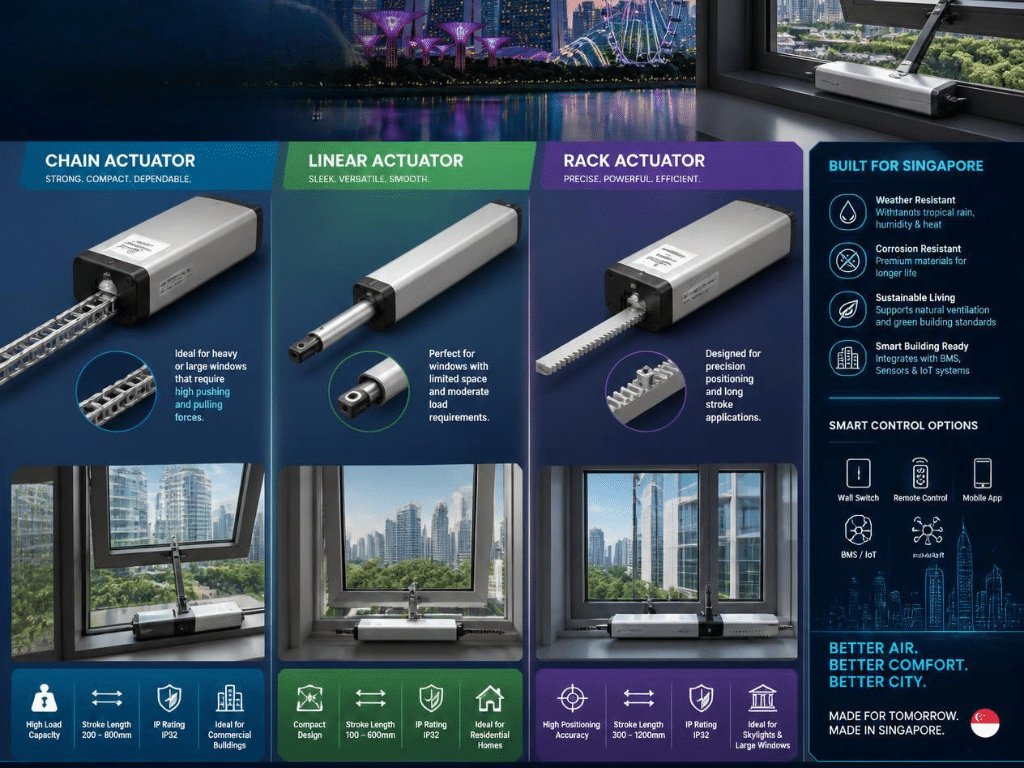
The mechanism decides the force and the feel. A chain actuator is compact and folds into a slim housing, delivering roughly 150 to 300 newtons for lighter sashes, and it is the workhorse for most automatic opening vents. A linear or spindle actuator gives a rigid mechanical connection through the full stroke, delivering up to 1,000 newtons with greater positional stability, which suits heavier and external windows. A rack and pinion actuator delivers consistent force across a long stroke, commonly 500 to 1,000 newtons, and runs more quietly than a chain, so it is favoured for rooflights, louvres, and facade windows above 400mm of travel. Matching the mechanism to the sash is the first decision, before any number is calculated.
When should you choose a chain actuator?
Choose a chain actuator for lighter top-hung or bottom-hung windows, which covers most natural ventilation and smoke vent applications. It is the default for a reason: compact, proven, and simple to install.
The chain drive fits where space and weight are modest. A 150-newton chain actuator handles a top-hung window up to around 25 kilograms, while a heavier double-link chain unit reaches 300 newtons with adjustable strokes from 100 to 400 millimetres. Chain actuators run in both 24-volt DC for smoke duty and 230-volt AC for comfort use, and the slim housing suits profile-integrated or surface-mounted installation. Where a chain actuator struggles is a wide sash, since a single chain can twist the frame as it opens, which is why wider vents use a tandem pair. For the ordinary casement or top-hung smoke vent, the chain actuator is the right and economical choice.
When should you choose a linear or spindle actuator?
Choose a linear or spindle actuator for heavy windows, external installations, and anywhere you need sustained high force. Its rigid rod gives a solid connection the chain cannot match, holding the sash stable through the whole stroke.
The rigid drive is what earns the premium. A linear actuator delivers up to 1,000 newtons of thrust across strokes from 70 to 1,000 millimetres, with a stainless steel spindle and ball bearings built to last in a harsh setting. It holds position better than a chain under wind load, which matters on an exposed facade, and it accepts an IP65 or higher rating to shrug off rain and humidity. Many linear units synchronise up to four actuators with genuine position feedback, so a large sash opens evenly. For a heavy louvre, a rooflight, or any external smoke vent on a Singapore facade, the linear actuator is the durable specification.
When should you choose a rack and pinion actuator?
Choose a rack and pinion actuator for wide rooflights, domes, and louvres where you need high force delivered smoothly and quietly over a long stroke. The rack gives consistent force from closed to fully open, without the clicking of a chain.
The rack shines on the large and the demanding. A rack actuator delivers 500 to 1,000 newtons of push-pull force across strokes up to 1,000 millimetres, and it holds that force evenly, which is why it is specified where strokes exceed 400 millimetres and consistency matters. Its quiet operation makes it the architectural choice for facade windows where the sound of a chain would intrude. Wide rooflights and domes use a synchronised dual-rack arrangement for two-point opening that stops the sash binding or racking. Built for high-duty-cycle systems, the rack actuator resists the fatigue a chain would suffer on a heavily cycled vent.
How do you size a window actuator?
Size a window actuator by matching its thrust to the opening resistance and its stroke to the required opening, then add a safety margin. The thrust must overcome the sash weight, the hinge friction, and the wind load, and the stroke must open the vent far enough to deliver the free area the fire strategy calls for.
The calculation is specific and unforgiving. As actuator specialist Vent Trade advises, the force output must exceed the combined opening resistance “with a 20 to 30 percent safety margin,” so an actuator sized exactly to the static sash weight will stall against wind. The stroke length is set by the opening distance in the ventilation design, since a vent that opens only halfway delivers only part of its effective area and fails the 2.5 percent aggregate opening rule. A wide or heavy sash needs a synchronised tandem or dual-point pair, using a function like D+H’s TMS+ tandem, to open evenly without twisting the frame. Confirm the bracket set matches the window type, since top-hung, bottom-hung, and pivot sashes each need a specific mounting. Sizing an actuator to weight alone and ignoring wind and stroke is the error that leaves a vent that opens slowly or not at all.
What makes a smoke vent actuator different from a comfort one?
A smoke vent actuator is certified for life safety, runs on backed-up 24-volt DC power, and interfaces with the fire alarm, none of which a comfort actuator requires. The certification is the dividing line, since a smoke vent actuator must be tested as part of a natural smoke and heat exhaust ventilator.
The duty is a different order of reliability. A smoke vent actuator and its window profile must be certified together to BS EN 12101-2, the standard for natural smoke and heat exhaust ventilators, and carry the appropriate CE marking. It runs on 24-volt DC so it pairs with a monitored power supply and battery standby, and its cabling and control sit within the smoke control system so the vent opens on detection. Under SCDF Clause 7.4, the electric actuator must be sprinkler-protected with fire-resistant power cables, and the whole system must open within 60 seconds of activation. A comfort actuator opening the same window on a timer meets none of this and cannot be substituted into a smoke vent.
How does Singapore’s climate affect actuator choice?
Singapore’s heat, humidity, and coastal salt air push the specification toward higher IP ratings and corrosion-resistant materials. An external actuator here needs weather protection a temperate climate would not demand.
The environment is harder on hardware than it looks. An external window actuator should carry an IP65 rating or higher to resist the driving rain and constant humidity, and a stainless steel spindle and anodised aluminium housing resist the corrosion that salt air accelerates near the coast. A unit rated only for indoor use degrades fast on an exposed facade, so the IP rating and materials are specified to the mounting position, not the catalogue default. Actuators with end-position dampening and a reverse-on-obstacle function also last longer by protecting the gaskets and the drive. For a coastal or fully exposed installation, corrosion resistance is not optional, since a seized actuator is a failed smoke vent.
How do you specify and integrate window actuators in Singapore?
Specify a window actuator by the sash weight and type, the required stroke, the smoke or comfort duty, and the mounting environment, then integrate it with the control system. The specification names the actuator type, the thrust and stroke, the voltage, the IP rating, and the certification.
Start from the window and the duty. Calculate the thrust against sash weight and wind with the safety margin, set the stroke to the opening the ventilation design requires, and choose chain, linear, or rack to suit the sash and location. For smoke duty, confirm EN 12101-2 certification with the window profile, 24-volt DC operation, and the fire alarm interface with battery backup. A provider offering the full range of automatic window opener systems can match the actuator, the control panel, and the certified profile as one system. When you are ready to scope it, request an actuator sizing review so each vent gets the right drive for its sash and its duty.
Conclusion
A window actuator is chosen on four things: the mechanism that suits the sash, the thrust that beats the weight and the wind with a margin, the stroke that delivers the required opening, and the certification the duty demands. Chain drives suit most lighter vents, linear actuators handle heavy and external sashes, and rack actuators serve wide, quiet, high-cycle openings. Size it properly, certify it to EN 12101-2 for smoke, and protect it against the climate, and the vent opens every time it must.
Enforce Automatic Global supplies, installs, and maintains automatic window actuators and smoke vent systems engineered to SCDF requirements across Singapore. Request an actuator sizing review of your smoke vents, and receive the right chain, linear, or rack drive matched to each sash, its stroke, and its life-safety duty.
Frequently asked questions
What voltage do window actuators use in Singapore?
Smoke vent actuators use 24-volt DC power because it pairs with a monitored power supply and battery standby, so the vent still opens if a fire cuts the mains. Comfort ventilation actuators run on either 24-volt DC or 230-volt AC. The 24-volt standard is what lets a smoke vent stay functional during the electrical disruption a fire causes.
How much force does a window actuator need?
A window actuator needs enough thrust to exceed the sash weight, the hinge friction, and the wind load combined, with a 20 to 30 percent safety margin on top. Chain actuators deliver around 150 to 300 newtons for lighter sashes, while linear and rack units reach up to 1,000 newtons for heavy or external windows. Sizing to weight alone risks a stalled vent.
Can two actuators open one window?
Yes. Wide or heavy sashes use two synchronised actuators in a tandem or dual-point arrangement, such as D+H’s TMS+ function, so the window opens evenly without twisting. Some linear systems synchronise up to four actuators on one large sash. A single drive on a wide vent can rack the frame, which is why paired actuation is standard on larger openings.
Are smoke vent actuators different from normal window actuators?
Yes. Smoke vent actuators are certified to BS EN 12101-2 as part of a natural smoke and heat exhaust ventilator, run on backed-up 24-volt DC power, and interface with the fire alarm to open within 60 seconds under SCDF Clause 7.4. A comfort actuator carries none of this certification and cannot be used as a smoke vent drive.