

Smoke Release System Maintenance Singapore: Testing
Smoke release system maintenance in Singapore is what stands between a passed Fire Certificate and a failed one, since the SCDF renews the certificate annually against an up-to-date inspection of fire protection systems. A seized actuator found at audit is a compliance failure, not a small repair. This blog walks you through annual testing, service scope, and certificate readiness for a compliant smoke release window system.
What does smoke release system maintenance involve?
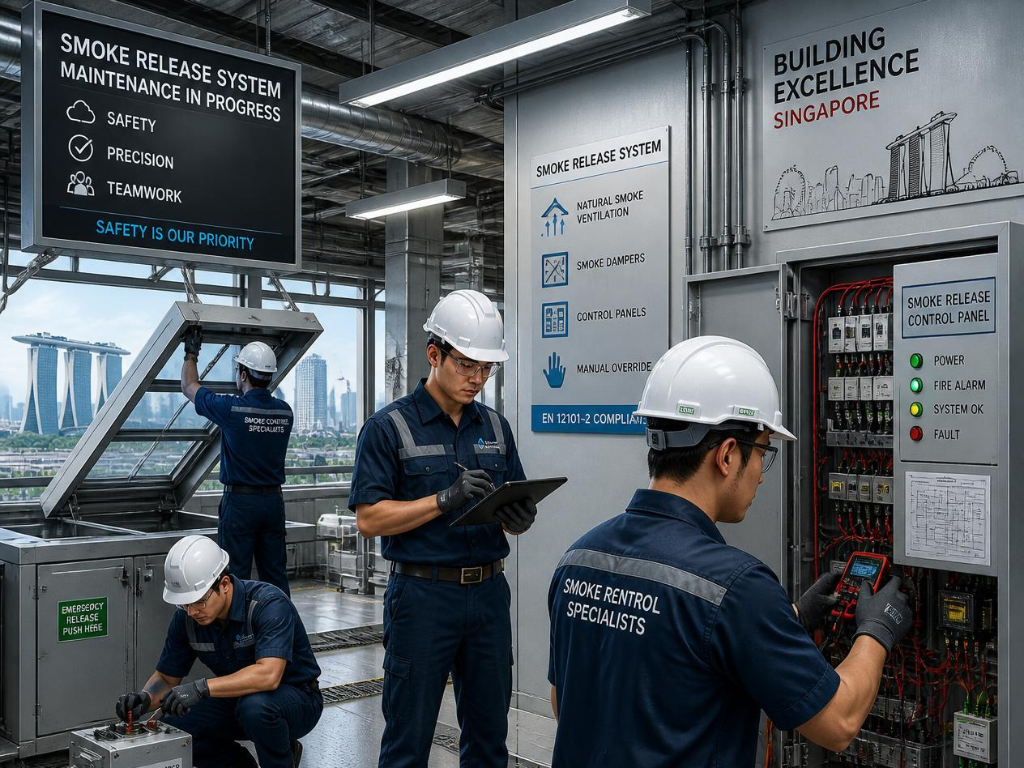
Smoke release system maintenance is the scheduled testing, servicing, and record-keeping that keeps automatic smoke vents opening on demand and passing their annual inspection. It covers the actuators, the seals, the control panel, the battery backup, and the interface to the fire alarm.
The work targets the parts that fail silently. A technician tests each vent’s actuator for full travel within the code’s time limit, checks the seals and hinges, confirms the control panel and battery deliver power on a mains failure, and verifies the fire alarm interface still triggers the vents. Every check is logged, since the record is what proves compliance at audit. A smoke vent that has not been operated in a year commonly seizes or drifts out of adjustment, which is exactly the failure a maintenance regime exists to catch. A vent that also serves everyday window ventilation is exercised regularly and seizes less than one that only opens in a test. Maintenance is a life-safety obligation measured against the Fire Code, not an optional service.
How often must a smoke release system be tested in Singapore?
A smoke release system is tested comprehensively at least once a year, aligned to the annual Fire Certificate renewal, with SCDF requiring an up-to-date inspection of all fire protection systems. Higher-risk premises test more often as directed.
Annual is the baseline for the comprehensive service. SCDF requires a full inspection and servicing of all fire protection systems, smoke control included, by registered fire safety contractors each year, with the results feeding the Fire Certificate renewal. In practice, a Fire Safety Manager also runs periodic functional checks between the annual services, so a vent problem surfaces months before the audit rather than on the day. The annual maintenance contract report becomes the evidence an auditor reconciles against, so the test date and the certificate date have to line up. Leaving the comprehensive test to the week before the certificate expires is how buildings end up scrambling, since a failed vent then has no time to be rectified.
What is included in a smoke vent service scope?
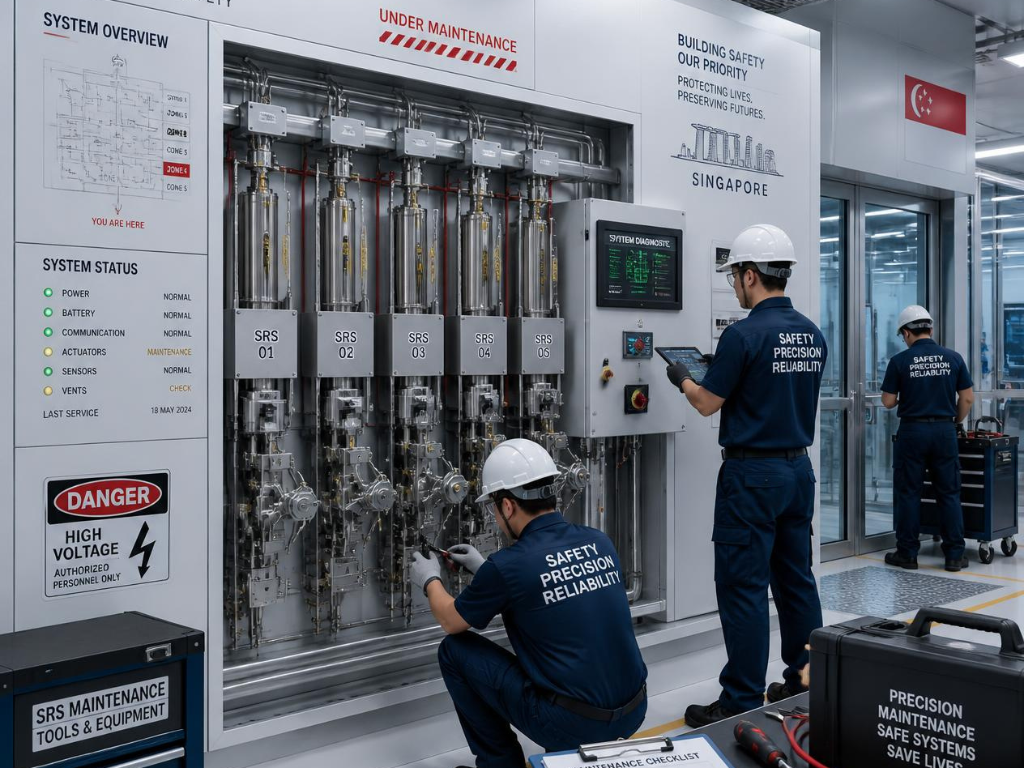
A proper service scope covers five areas: actuator function and travel, seal and hinge condition, control panel and battery, the fire alarm interface, and a documented test of every vent. A quote that only says “inspection” without naming these is too vague to compare.
Each area maps to a failure mode. The actuators are driven through their full stroke to confirm each vent opens completely, the seals and hinges are checked so the vent both opens and closes cleanly, and the control panel and battery are tested to confirm backup power. The fire alarm interface is triggered to prove the vents respond to a real signal, and every individual vent and zone is tested rather than a sample, since one seized actuator in a zone is one failure too many. Worth noting: a service that tests the panel but never drives each actuator has skipped the check that matters most. The scope should end with a written service log recording each vent’s condition, which supports both the maintenance history and the wider smoke release system design records the building keeps.
What is a simulated alarm activation test?
A simulated alarm activation test triggers the smoke release system through the fire alarm interface and confirms every vent opens fully within the code’s time limit. It proves the system responds to a real fire signal, not just to a manual button.
The test replicates the fire scenario without a fire. The technician activates the fire alarm interface for the smoke zone and times the vents, since under SCDF Clause 7.4 the system’s operation “shall not exceed 60 secs from the time of activation.” Every vent in the zone must drive fully open within that window, and any that lags, stalls, or opens partially is logged as a defect. This test is the single most important one in the service, because a vent that opens on its own switch but not on the alarm signal is useless in a fire. Timing each zone against the 60-second limit is what separates a system that passes on paper from one that performs.
How is the secondary power supply tested?
The secondary power supply is tested by cutting the mains and confirming the smoke vents still open on battery. A fire commonly kills the mains, so the backup is the power the system actually runs on when it matters.
The test proves the fail-safe. The technician isolates the mains supply to the smoke vent control panel and triggers the system, confirming the battery drives the actuators fully open and holds the system available. The battery condition and charge are checked, since a battery past its service life will not carry the load through an incident. Where the replacement air path uses a mechanical system, that too must run on a secondary power supply, which is checked in the same pass. A smoke release system that opens perfectly on mains but fails on backup has passed the easy half of the test and failed the half that counts.
Why must defects be rectified before certification?
Any defect found during testing must be rectified before the Fire Certificate is granted or renewed, because SCDF certifies a working system, not a promise to fix one. A logged fault with no rectification blocks the certificate.
Rectification is the gate to compliance. A seized actuator, a flat battery, a broken seal, or a vent that misses the 60-second limit is entered in a corrective action register with a target close-out date, then fixed and re-tested before the certificate is issued. The building owner carries the liability here, since SCDF holds the owner accountable for engaging properly registered contractors and for the system’s condition at audit. Under the Fire Safety Act, non-compliance can draw fines of up to 200,000 dollars, which makes an unrectified defect an expensive gamble. The disciplined approach is to run the comprehensive test early enough that any defect has weeks to be closed out, not hours.
Who is responsible for smoke vent maintenance and records?
The building owner is accountable for maintaining the smoke release system, the Fire Safety Manager keeps the records and oversees the checks, and an SCDF-registered fire safety contractor performs the servicing. All three roles are needed for compliance.
The responsibility is shared but the liability is not. SCDF requires fire protection systems to be serviced by registered fire safety contractors holding the correct registration category, and engaging an unregistered party does not relieve the owner of liability if a system fails at inspection. The Fire Safety Manager’s duties, set out in the Fire Safety Managers Regulations, include keeping fire protection systems operational and maintaining records, and from 1 April 2025 FSMs must submit the Annual Fire Safety Report through the eFSM portal. Buildings above 5,000 square metres and public assembly premises must appoint a registered FSM. The service log the contractor produces is the document the FSM presents at audit, which is why the record matters as much as the repair.
How long do spare actuators take, and why plan ahead?
Spare actuators and control components often carry lead times of several weeks, because smoke vent hardware is frequently proprietary and imported. A defect found late with no stock on hand can leave a vent non-compliant past the certificate deadline.
Lead time is the hidden risk in the annual cycle. A failed chain or spindle actuator on a certified natural smoke and heat exhaust ventilator must be replaced with a matching, certified unit, not a generic substitute, and sourcing that unit can take weeks if it is not held locally. This is the practical reason to run the comprehensive test well ahead of the certificate date and to hold critical spares under a maintenance contract. A supplier who both installs and stocks the automatic window opener systems shortens that lead time to days. Discovering a failed actuator with a two-week lead time and a one-week certificate window is the scenario a planned contract exists to prevent.
How do you set up a smoke release maintenance contract in Singapore?
Set up a maintenance contract that schedules the annual comprehensive test ahead of the certificate date, defines the full service scope, uses an SCDF-registered contractor, and secures spare parts. The contract names the test frequency, the scope, the response time, and the parts arrangement.
Start by aligning the service to the certificate calendar so rectification has time to happen. Confirm the contractor holds the correct SCDF registration for smoke control work, and that the scope covers actuator travel, the fire alarm interface, and the secondary power test on every vent. Agree a response time for defects and where spare actuators come from. A provider offering integrated supply, installation, and servicing keeps the install history, the certification, and the parts under one accountable team. When your renewal is approaching, book a smoke vent inspection so the system is tested, any defect is rectified, and the certificate is ready on time.
Conclusion
Smoke release system maintenance in Singapore is an annual discipline tied to the Fire Certificate: a comprehensive test by a registered contractor, a simulated alarm activation timed against the 60-second limit, a secondary power test, and every defect rectified before certification. Run it early, log everything, and keep the spares to hand, and the certificate renews without a scramble. Leave it to the last week, and a single seized actuator can put the whole building out of compliance.
Enforce Automatic Global services and maintains automatic smoke release window systems to SCDF requirements across Singapore. Book a smoke vent inspection ahead of your Fire Certificate renewal, and receive a full functional test, a documented service log, and any rectification handled before the audit.
Frequently asked questions
How often should smoke vents be tested in Singapore?
Smoke vents are tested comprehensively at least once a year, aligned to the annual Fire Certificate renewal, by an SCDF-registered fire safety contractor. A Fire Safety Manager typically runs functional checks between annual services so faults surface early. Higher-risk premises may test more often where SCDF directs, but the annual comprehensive test is the baseline every certified building meets.
What happens if a smoke vent fails its test?
A failed smoke vent is logged as a defect in a corrective action register and must be rectified and re-tested before the Fire Certificate is granted or renewed. The building owner carries the liability, and under the Fire Safety Act non-compliance can draw fines of up to 200,000 dollars. This is why the annual test is run early enough to close out defects.
Who can legally service smoke release systems in Singapore?
Only SCDF-registered fire safety contractors holding the correct registration category may service smoke control systems in Singapore. Engaging an unregistered party does not relieve the building owner of liability if the system fails at inspection. The building’s Fire Safety Manager oversees the servicing and keeps the records that the SCDF audit reconciles against.
Do smoke vents need testing for the Fire Certificate?
Yes. The Fire Certificate is renewed annually against an up-to-date inspection of all fire protection systems, and smoke release systems are tested as part of that inspection. Every vent must open on a simulated alarm within 60 seconds and operate on secondary power, with results documented in the maintenance records SCDF can request at any time.