

Smoke Release System Singapore: Fire Code & Testing
A smoke release system in Singapore is a life-safety installation under the SCDF Fire Code 2023, not a comfort feature, and treating it as optional fails inspection. The code demands full operation within 60 seconds of activation. This blog walks you through how these systems work, what Clause 7.4 requires, and what gets tested, so you can specify a compliant smoke release window system from the start.
What is a smoke release system, and how does it work?
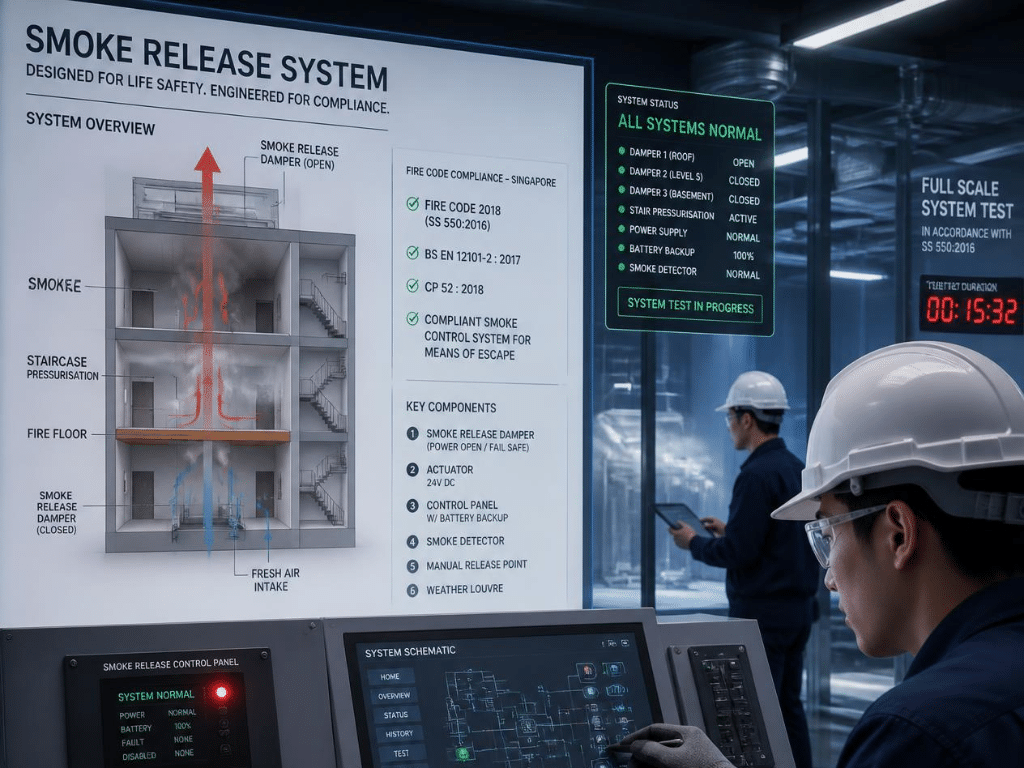
A smoke release system is a set of automatic vents or windows that open on a fire signal to let hot smoke escape a building, keeping escape routes and firefighting access clear. In a natural system, smoke rises to a high-level smoke reservoir, and the vents release it while fresh replacement air enters low down.
The physics is simple and the timing is not. Hot smoke is buoyant, so it collects under the roof or ceiling in a designed smoke reservoir, and automatic roof or facade vents open to exhaust it before it banks down to head height. Low-level inlets supply the replacement air that lets the smoke flow out, since a sealed room cannot vent. The vents open through electric actuators triggered by the fire alarm, and the whole zone must clear to the design within a tight time window. Smoke is the leading cause of death in building fires, which is precisely why the SCDF regulates these systems as active life-safety equipment rather than ventilation.
What does the SCDF Fire Code require for smoke release?
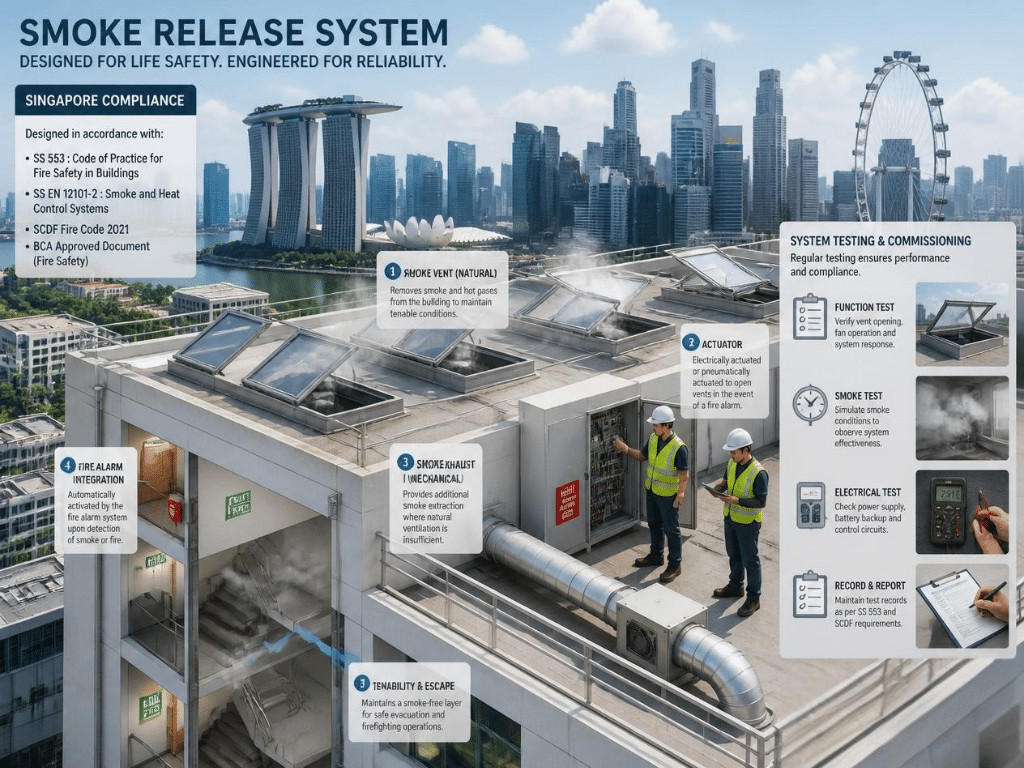
The SCDF Fire Code 2023 governs smoke release under Chapter 7, Clause 7.4, Smoke Control System, which sets the sizing, the response time, and the equipment standards. The headline requirement is speed: for a smoke zone, Clause 7.4 states the system’s operation “shall not exceed 60 secs from the time of activation.”
The clause is specific about limits and standards. Under Clause 7.4, a natural smoke ventilation smoke reservoir for the room of origin shall not exceed 2,000 square metres, and where a smoke reservoir sits above a false ceiling, that ceiling must be a perforated type with at least 25 percent opening. All smoke control equipment must be supplied and installed in accordance with BS EN 12101 and BS 7346 Part 7 or equivalent, and the electric actuator must be sprinkler-protected with fire-resistant power cables. These are not design preferences; they are the pass or fail criteria a Fire Safety Engineer works to. A system that opens in 90 seconds or runs an oversized reservoir does not comply, regardless of how well it vents.
How is the smoke reservoir and vent opening sized?
The smoke reservoir is capped at 2,000 square metres for a natural system, and individual smoke vents carry minimum dimensions the code sets directly. A vertical smoke vent must be at least 400mm by 600mm, and a horizontal roof or ceiling vent at least 0.25 square metres in area.
Sizing follows the space and its risk. The reservoir is bounded by the building structure or by smoke screens so that hot smoke does not spread thin and cool, since a shallow, cool smoke layer vents poorly. For certain protected spaces such as car park levels, the code requires ventilation openings of at least 2.5 percent of the largest floor area, with the exhaust high and the fresh air inlet low. Glass blocks are not permitted as smoke vents, and any glass used as a smoke screen must withstand the design temperature. Getting the reservoir and vent areas right is an engineering calculation against the compartment, not a catalogue selection, which is why the types of smoke release systems are chosen to the space rather than the other way around.
How does a smoke release system interface with the fire alarm?
The smoke release system connects to the building fire alarm panel, which triggers the vent actuators to open automatically the moment a fire is detected. This interface is what turns a window into a life-safety device, since manual operation alone cannot meet the 60-second requirement.
The signal path is engineered for reliability. On alarm, the fire alarm control panel sends a signal to the vent actuators, typically 24-volt DC electric openers, which drive the windows or louvres fully open within the code’s time limit. The actuator’s power cabling must be fire-resistant so the circuit survives the early minutes of a fire, and the actuator itself is sprinkler-protected where sprinklers are present. Manual override at a firefighter’s panel lets responders control the vents on arrival. A smoke release system wired only to a local switch and not to the fire alarm panel is not a compliant installation, because it will not open on detection when the room is already filling with smoke.
Why does a smoke release system need battery backup?
A smoke release system needs battery backup so it opens even when the fire has already cut mains power to the building. A vent that relies solely on mains supply is useless in the exact scenario it exists for.
Backup power is a life-safety necessity, not an add-on. A fire commonly trips or damages the electrical supply, so the smoke vent control panel carries a battery that drives the actuators open on loss of mains, holding the system available through the incident. The design ensures the vents fail to the safe state, which for smoke release means open, so smoke is never trapped by a dead circuit. This mirrors the logic applied across automated window ventilation, where control reliability decides whether the system performs when it is needed. Specifying a smoke release system without confirmed battery backup and fire-resistant cabling is specifying a system that stops working the moment the fire reaches the switchboard.
What is replacement air, and why does it matter?
Replacement air is the fresh air that enters a space at low level to replace the smoke being vented out at high level, and without it the smoke release system stalls. Smoke cannot exhaust from a sealed room, because something has to fill the volume it leaves.
This is the half of the design that inexperienced installers forget. A natural smoke ventilation system needs a low-level inlet, whether an open doorway, a louvre, or a dedicated air path, sized to admit air as fast as the vents expel smoke. Where the replacement air is too small, the smoke layer stops descending cleanly and the vents underperform, so the calculated exhaust rate never materialises. The inlet is designed alongside the vents, not treated as an afterthought, and the balance between the two sets the real performance of the system. A beautifully specified roof vent over a room with no replacement air path is a system that looks compliant on paper and fails in a test.
Natural or mechanical smoke ventilation: which applies?
Natural smoke ventilation suits spaces where a smoke reservoir up to 2,000 square metres can vent through roof or facade openings, while mechanical or engineered smoke control is required for basements, atriums, and deep or windowless spaces. The code does not allow the two to be mixed within the same zone.
The choice follows the geometry. A natural system uses buoyancy and roof vents and suits single-storey halls, warehouses, and upper floors with external walls or roofs. A powered smoke exhaust system becomes necessary where natural buoyancy cannot clear the space, such as a basement car park or a tall atrium, and these engineered systems are designed under the same Chapter 7 smoke control framework. Natural ventilation shall not be used together with mechanical ventilation in one zone, since combining them complicates the smoke reservoir depth and undermines both. Choosing the wrong approach for the space is a redesign, not a tweak, which is why the ventilation strategy is set early with the fire engineer.
What gets tested at Fire Certificate inspection?
At inspection, the tester verifies that the smoke release system activates on a fire signal, opens fully within 60 seconds, has working replacement air, and operates on backup power. A Registered Inspector checks the installed system against the approved plans before a Fire Safety Certificate is granted.
Testing is a functional demonstration, not a document check. The inspector triggers the fire alarm interface and confirms every vent in the zone drives fully open within the code’s 60-second limit, that the actuators run on battery when mains is cut, and that the replacement air path is present and unobstructed. The reservoir dimensions, vent areas, and actuator protection are checked against the endorsed design. A building requiring a Fire Safety Certificate is re-inspected on a defined cycle, and the Fire Safety Manager keeps the system maintained between inspections. A smoke release system that opens slowly, misses a vent, or lacks replacement air is written up as a non-compliance that must be rectified before the certificate is issued.
How do you specify and maintain a smoke release system in Singapore?
Specify a smoke release system against the compartment, the Fire Code clause, and the equipment standard, then maintain it on a scheduled cycle so it passes every re-inspection. The specification names the reservoir size, the vent areas, the actuator type, the fire alarm interface, and the replacement air path.
Get the design settled with the fire engineer before hardware is chosen, since the reservoir and vent sizing drive the whole installation. Confirm the actuators meet BS EN 12101 or equivalent, carry fire-resistant cabling, and interface to the fire alarm panel with battery backup. Schedule maintenance so actuators, seals, and the control panel are tested well before the Fire Safety Certificate renewal, because a vent that has seized between inspections fails the next test. When you are planning or upgrading a system, request a compliance review so the installation is measured against Clause 7.4 rather than assumed to pass.
Conclusion
A smoke release system in Singapore lives or dies on the SCDF Fire Code: a smoke reservoir within 2,000 square metres for a natural system, vents that open fully within 60 seconds of a fire signal, a fire alarm interface, battery backup, and a replacement air path that lets the smoke out. Design it to Clause 7.4 with the fire engineer, specify equipment to BS EN 12101, and maintain it on a cycle, and it passes inspection and does its job when a fire starts.
Enforce Automatic Global supplies, installs, and maintains automatic smoke release window systems engineered to SCDF requirements across Singapore buildings. Request a compliance review of your smoke ventilation, and receive a specification and maintenance plan built to Clause 7.4 and the Fire Safety Certificate your building needs.
Frequently asked questions
What is the difference between smoke ventilation and smoke release?
The terms describe the same life-safety function: removing smoke from a building during a fire. Smoke release usually refers to the automatic vents or windows that open to exhaust smoke, while smoke ventilation is the broader system, including the reservoir and replacement air, that the SCDF Fire Code 2023 governs under Clause 7.4.
How fast must a smoke release system open in Singapore?
A smoke ventilation system within a smoke zone must be fully operational within 60 seconds of activation, under SCDF Fire Code 2023 Clause 7.4. This is why the vents open through electric actuators triggered by the fire alarm rather than by manual operation, which could not reliably meet the 60-second limit across every vent in the zone.
Do smoke release windows need battery backup?
Yes. Smoke release windows require battery backup so the actuators still open if the fire cuts mains power, which is common in a real fire. The smoke vent control panel drives the vents to the open position on loss of supply, and the actuator cabling must be fire-resistant so the circuit survives the early stages of the fire.
Who tests and certifies smoke release systems in Singapore?
A Registered Inspector tests the installed smoke release system against the approved plans, and the system forms part of the works certified before the SCDF grants a Fire Safety Certificate. A Fire Safety Manager maintains it between inspections in applicable buildings, and the Qualified Person designs it to Chapter 7 of the Fire Code 2023.