

Operable Wall Panel Jamming: Causes & Fixes Singapore
Operable wall panel jamming in Singapore almost always traces to one of three culprits: the track, the carriers, or the seals. A wall that dragged for months rarely fails overnight. This blog walks you through why panels jam, drag, and stop sealing, and how each fault is fixed, so you can diagnose a misbehaving operable and movable wall system before the next event depends on it.
Why do operable wall panels jam or get stuck?
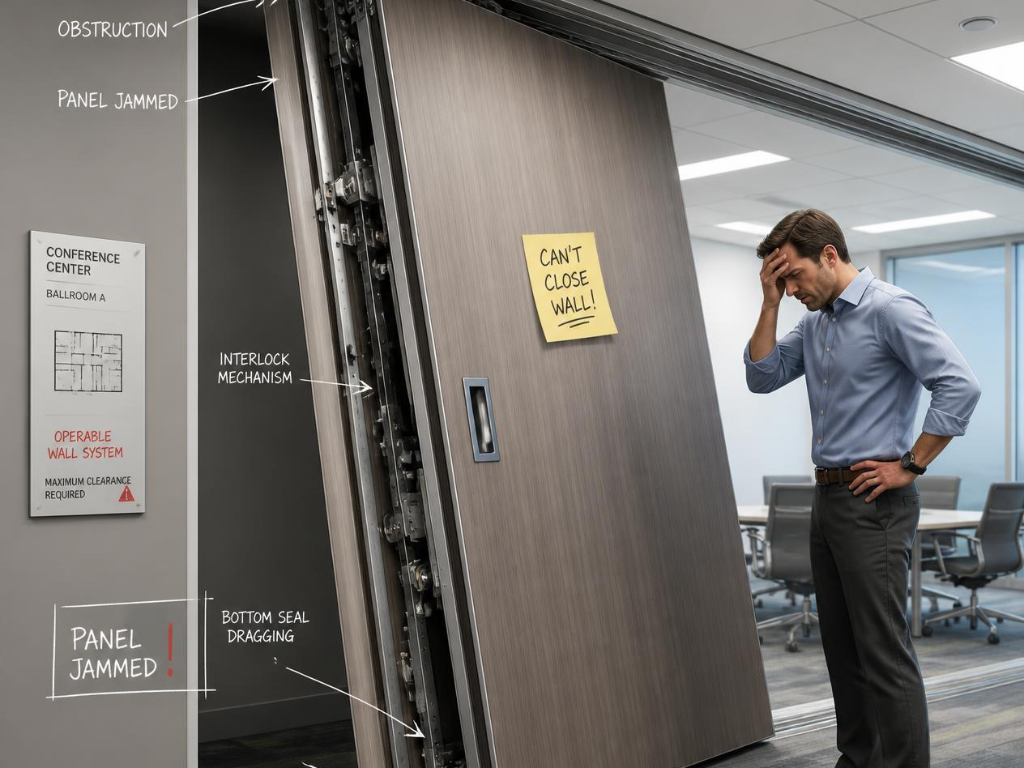
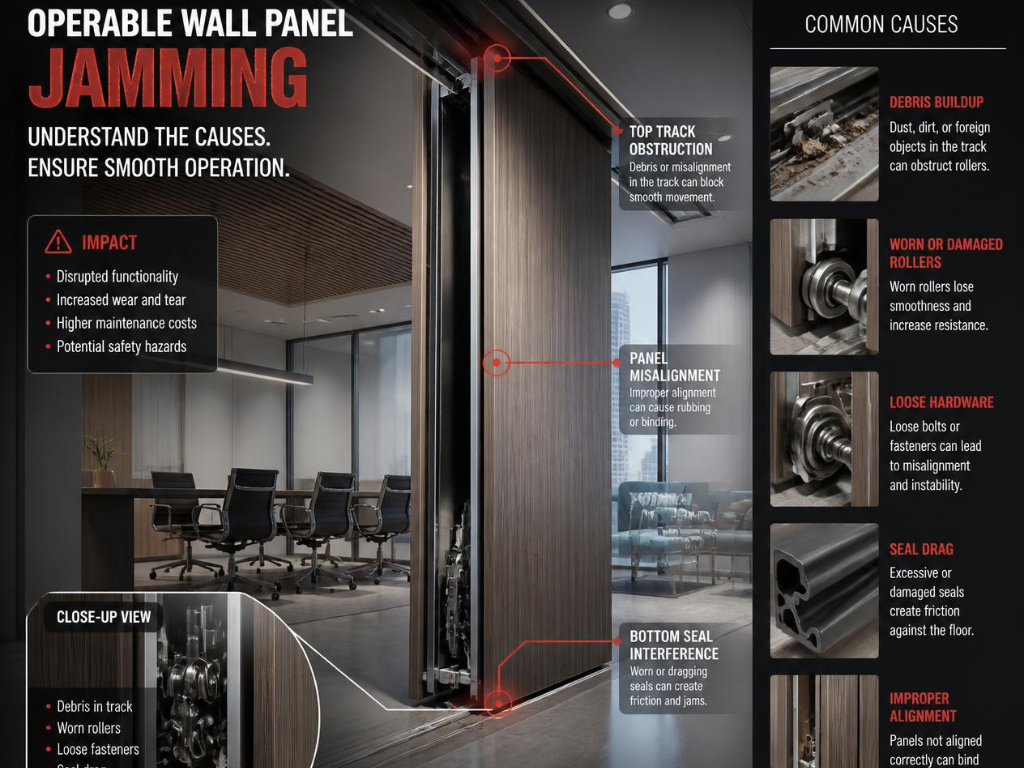
Operable wall panels jam most often because of debris in the track, a warped panel, or a worn carrier that no longer rolls cleanly. The track is the first place to look, since a build-up of dust and grit is the single most common cause of a panel that suddenly resists.
The fault usually starts small and compounds. Grit collects in the overhead track, the carrier wheels drag through it, and the panel that once glided now needs a shove. A warped or dented panel binds against its neighbour, and a carrier that has stopped in a track intersection can appear stuck until it is walked back the way it came. The fix for a jam is ordered: clean the track thoroughly, apply a silicone-based lubricant to the carrier bearings, and inspect for a warped panel that needs resetting or replacing. Forcing a stuck panel is the worst response, because it drives the carrier harder into whatever is binding it and turns a cleaning job into a carrier replacement.
Why does an operable wall panel drag or turn hard to push?
A panel drags when its carrier system is worn or loose, because the whole weight of the panel hangs from those trolleys. Operable wall repair specialist Nettles notes that once the carrier system loosens, “the panels will start to drag.”
Dragging is a wear symptom, not a one-off. Each top-hung panel rides on trolleys with ball-bearing wheels, and as those bearings wear, the panel sits lower and scuffs along its path. A loose carrier bolt has the same effect, dropping the panel out of true. The correct fix is to clean the track and lubricate the trolley wheel bearings first, then replace worn rollers or bearings where lubrication no longer restores smooth travel. A panel that has started to drag on the floor is also a warning that the bottom edge and any floor seal are taking damage, so leaving it accelerates a second fault. Catch dragging early and it is a bearing service; ignore it and it becomes a carrier and panel repair.
Why has the operable wall stopped sealing or started leaking sound?
An operable wall stops sealing when the drop-seal mechanism fails, the seals have aged, or a panel is no longer hanging plumb. Sound leaking between two divided rooms is the clearest sign, and it points straight at the perimeter seals rather than the panel core.
The seal system is where acoustic performance quietly dies. A mechanical drop seal lowers to meet the floor and lock the panel, and if that mechanism breaks while the seal is up, the wall still moves but sound passes underneath. Aged rubber seals lose compression and let noise flank over, under, and between panels. A panel set out of plumb never makes full contact with its neighbour, so the joint leaks regardless of seal condition. The fix depends on the cause: replace worn seals, repair or reset the drop mechanism, and reset any panel that is not hanging plumb by pulling it back and re-seating it under constant edge pressure. A wall that has lost its rating is failing at the seals, which is exactly where the acoustic performance of operable walls is won or lost.
How does track misalignment cause faults, and how is it corrected?
Track misalignment causes panels to bind, drag, and seal poorly all at once, because a track that is no longer level or straight throws off every carrier running on it. Buildings settle over time, and the track settles with them, which is why a wall that worked for years can slowly stiffen.
Misalignment is the root fault that breeds others. As the structure shifts, the track loses its level, carriers run unevenly, and panels no longer seat square, so binding “accelerates every other wear point,” in the words of specialist Advanced Equipment. A track can also loosen at its fixings, deform, or corrode, each of which pulls it out of true. Correcting it means checking the track against a laser level, adjusting the hanger spacers to bring it back to level, and tightening or replacing loose fixings. This is not a lubrication job; it is a realignment that resets the geometry the whole wall depends on. Left uncorrected, a misaligned track wears carriers and seals far faster than a level one.
How does an out-of-level floor affect the wall?
An out-of-level floor makes panels drag and stops the bottom seal closing, because the drop seal is sized for a specific gap that an uneven floor destroys. The floor under an operable wall should stay flat to within roughly 3mm over 2 metres, a tolerance tighter than most slabs are poured to.
The floor is half of the seal, and it is often overlooked. A drop seal extends a set distance to meet the floor, so where the slab rises, the panel drags, and where it dips, the seal cannot reach and sound leaks under. ASTM E557 sets the flatness the installation needs, and the floor tolerance for operable partitions is far stricter than a general commercial slab finish. The fix is either grinding and filling the high and low spots or adjusting the seal drop where the range allows. Diagnosing a seal fault without checking the floor is a common mistake, because the seal is often working and the floor is the problem.
Can Singapore’s humidity make panels swell or seals fail faster?
Singapore’s humidity does accelerate two operable wall faults: it can warp susceptible panel cores and it ages rubber seals faster than a dry climate. A warped panel binds against its neighbour, and a hardened seal loses the compression that holds the acoustic rating.
The tropical climate is a real variable here. Sustained high humidity swells and warps panel cores that are not moisture-stable, and a warped panel is a documented cause of jamming and poor closure. Rubber and vinyl seals also harden and lose elasticity faster in a hot, humid environment, so a seal that might last a decade elsewhere degrades sooner. The practical response is to specify moisture-stable panel cores in the first place and to inspect seals more frequently than a temperate-climate schedule would suggest. A wall installed in an air-conditioned, humidity-controlled space ages more slowly than one in a naturally ventilated hall, which is worth weighing when you plan the maintenance interval, since a well-specified operable wall system accounts for the operating environment from the start.
Why won’t the drop seal engage or retract?
A drop seal fails to engage or retract when its operating mechanism jams, wears, or is left in the wrong position, which either traps the panel or leaves a gap at the floor. On a retractable system, the seal is driven up and down by an operating key, and that mechanism is a wear point.
The behaviour tells you the state of the mechanism. If the seal will not retract, the panel resists moving because the seal is still gripping the floor, and forcing it damages both. If the seal will not extend, the panel moves freely but leaves a gap that leaks sound. The fix is to service or replace the drop-seal mechanism and to confirm the operating sequence, since retractable seals must be fully retracted with the key before the panel is moved. This is a mechanism repair, not a seal replacement, and mixing up the two wastes a service visit. Confirm the seal fully retracts before moving any panel, because a half-retracted seal dragging on the floor is how a minor fault becomes a torn seal.
Which faults can you fix yourself, and which need a technician?
Facilities staff can safely clean tracks and confirm operating sequences, but carrier, track, and seal repairs need a trained technician. The dividing line is simple: cleaning and correct operation are in-house tasks, while anything involving the suspension, the alignment, or a broken component is not.
Knowing where to stop protects both the wall and the people near it. Cleaning debris from a reachable track, applying the right lubricant, and training staff to set panels plumb and retract seals correctly all prevent faults without a callout. Realigning a settled track, replacing worn carriers, repairing a drop mechanism, and any work on the pendant suspension belong to a technician, because a panel hangs overhead and a mishandled carrier is a safety risk. The guiding rule from specialists is plain: operate the wall with “no forcing panels that resist,” since a panel that fights back is reporting a fault that forcing will only worsen. When a fault sits above the reach of cleaning and adjustment, an operable wall service visit is the safe and cheaper path.
How do you prevent these faults in the first place?
Prevent operable wall faults with regular track cleaning, scheduled carrier and seal inspection, and correct daily operation. The three faults that dominate service calls, jamming, dragging, and seal failure, all begin as gradual wear that a routine inspection catches early.
Prevention is cheaper than repair by a wide margin. A clean track and lubricated carriers stop the drag and bind that account for most breakdowns, while a scheduled seal check catches compression loss before the room fails an acoustic test. Training the operators to move panels one at a time, avoid stopping in intersections, and never force a resisting panel prevents the operator-induced damage that fills repair logs. Logging each wall’s manufacturer, age, and condition turns a future service call into a fast diagnosis. With movable partitions growing at a 7.82 percent annual rate through 2031 on Mordor Intelligence’s figures, more Singapore buildings now carry walls that depend on this routine. Handled this way, an operable wall keeps sealing and gliding for a decade, which protects the value operable walls deliver against a fixed wall that cannot flex at all.
Conclusion
Operable wall panels jam, drag, and stop sealing for a small set of traceable reasons: a dirty or misaligned track, worn or loose carriers, aged or broken seals, an out-of-level floor, and the humidity that accelerates all of them. Match the symptom to the cause before reaching for a fix, keep the track clean and the carriers serviced, and never force a panel that resists. Done consistently, the wall serves the room for years rather than failing on the morning it matters most.
Enforce Automatic Global services and repairs operable and movable walls across Singapore, diagnosing track, carrier, and seal faults on all major systems. Book a service inspection to have a stiff, dragging, or leaking wall diagnosed and corrected before a jammed panel takes a function room out of use.
Frequently asked questions
Why is my movable partition wall not closing?
A movable partition usually fails to close because of track misalignment, a worn carrier, or a closure panel that no longer seats, all of which stop the panels making full contact. Check the track is level and the carriers roll freely first. If the panels reach but will not seal, the drop seal or panel plumb is the likely cause.
How do you fix an operable wall that won’t seal?
Fix a non-sealing operable wall by replacing aged perimeter seals, repairing the drop-seal mechanism, and re-seating any panel that is not hanging plumb. Check the floor too, since an out-of-level slab beyond the 3mm-over-2m tolerance stops the bottom seal closing. Enforce diagnoses whether the fault is the seal, the panel, or the floor.
Is it safe to force a stuck operable wall panel?
No. Forcing a stuck operable wall panel is unsafe and damaging, since a resisting panel is reporting a track, carrier, or seal fault that force will worsen. A panel hangs overhead on pendant bolts, so forcing risks both the hardware and the operator. The correct response is to stop and have the fault diagnosed by a technician.
How much does operable wall repair cost in Singapore?
Operable wall repair cost depends on the fault: a track clean and lubrication is minor, while carrier replacement, track realignment, or a drop-seal rebuild costs more and may carry a parts lead time of several weeks for proprietary components. A service inspection by Enforce fixes the diagnosis and scope before any quote.