

Movable Divider Wall vs Operable Wall Singapore
A movable divider wall in Singapore solves a different problem from an operable wall, and the wrong choice wastes money. Mordor Intelligence puts movable partitions on a 7.82 percent annual climb through 2031. This blog walks you through cost, acoustics, and portability so you can decide between a free-standing divider and a track-hung operable and movable wall system for your space.
What is a movable divider wall, and how does it differ from an operable wall?
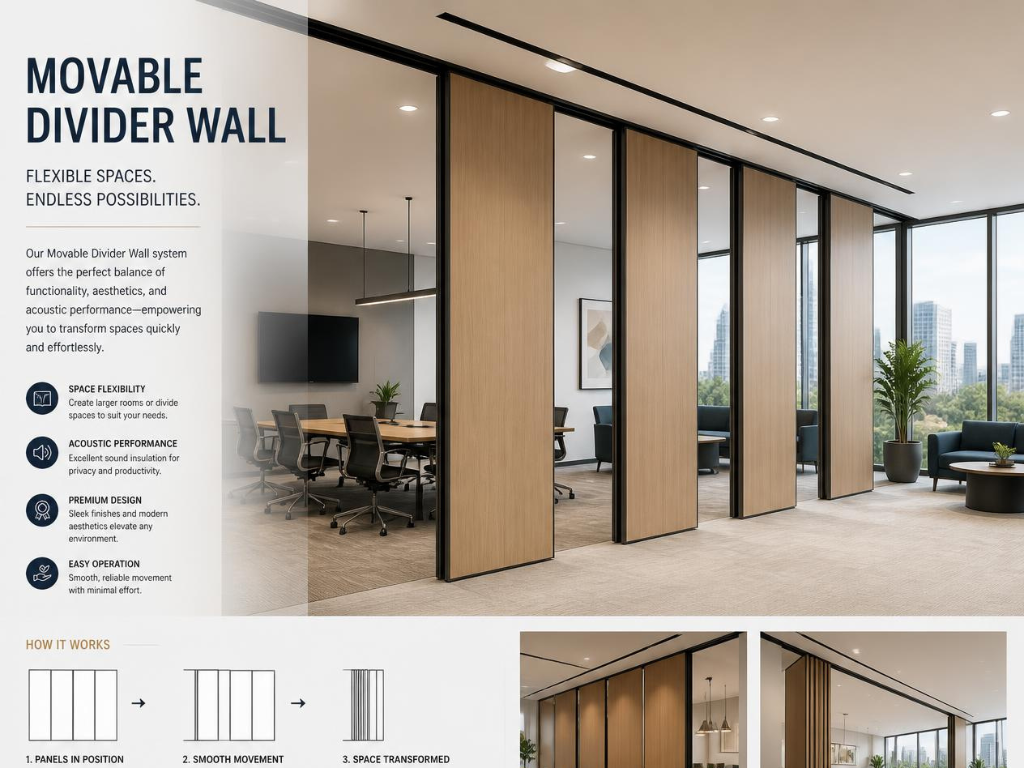
A movable divider wall is a free-standing, portable panel that screens or separates a space without a track, while an operable wall is a track-hung panel system that seals a room for sound. The divider stands on the floor; the operable wall hangs from the structure.
The difference is structural and functional. A movable divider rests on castor wheels or a base plate, weighs little enough for one person to reposition, and reaches a typical height of 4 to 6.5 feet, leaving gaps above and around it by design. An operable wall runs on an overhead track, seals floor to ceiling, and blocks sound at STC 40 to 56. One is furniture you move; the other is a building element you install. Choosing between them starts with whether you need to screen a space or genuinely divide it, which shapes everything from the value operable walls deliver to the price you pay.
Movable divider or operable wall: which should you choose?
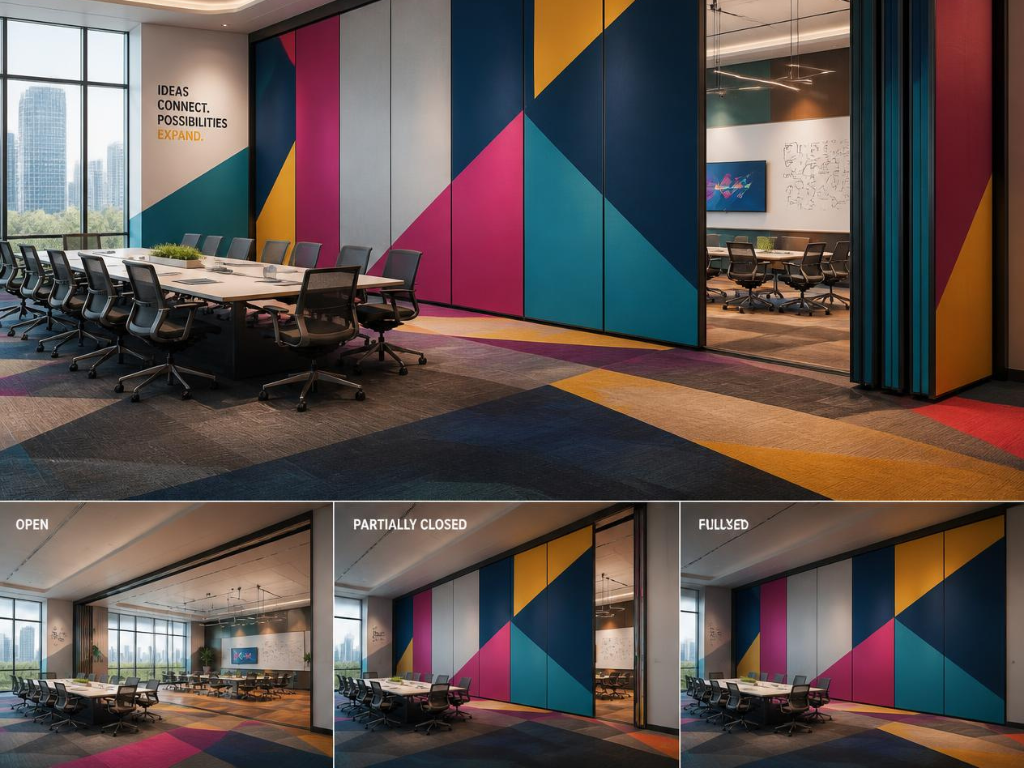
Choose a movable divider for flexible visual screening on a budget, and an operable wall when you need real sound separation between rooms. The deciding question is acoustics, because that is the one thing a divider cannot deliver and an operable wall is built for.
The decision splits cleanly on use. If you need to carve a temporary breakout zone, screen a workstation cluster, or reshape a layout weekly, a free-standing divider does it at a fraction of the cost and with no installation. If you need to turn one function room into two where a meeting on each side must not bleed through, only a sealed operable wall works. The cleaner approach is to name the acoustic requirement first: a room that needs privacy or STC-rated separation rules out a divider immediately. Mordor Intelligence reports fixed and framed partitions still held about 45 percent of the partition market in 2025, even as movable systems grow fastest, so both categories keep their place. Spending on an operable wall to occasionally screen a corner is overkill, and buying a divider to soundproof a boardroom is a guaranteed disappointment.
How much sound does a movable divider actually block?
A movable divider blocks almost no sound transmission; it absorbs and dampens noise rather than sealing it out. This is the single most misunderstood point in the category, and getting it wrong leads to an expensive disappointment.
The physics is unforgiving. A free-standing divider is rated by Noise Reduction Coefficient, which measures absorption, with quality acoustic panels reaching an NRC around 0.77 to 0.80, and that reduces echo and reverberation on the room side. It does not stop sound travelling over, under, and around the panel, because a mobile divider is not floor-to-ceiling and has gaps by design. As the specialist Portable Partitions puts it, “mobile room dividers can only achieve sound dampening and reduction of noise reverberation.” A sealed operable wall, by contrast, blocks transmission at STC 40 to 56, well above the STC 33 to 39 of a plain drywall wall. If you want quieter, not just less echoey, the divider is the wrong tool.
How much do movable dividers cost compared with operable walls?
Movable dividers cost a fraction of an operable wall, because they carry no track, no structural support, and no installation. A free-standing divider is a furniture-scale purchase, while an operable wall is a fitted building element with a design and install cost behind it.
The gap is structural, not incidental. A movable divider ships flat or rolls in on castors and is ready to use with no tools, so the price is the panel alone. An operable wall adds a suspension track, structural support steel, acoustic seals, and professional installation, which is why its cost runs into a different order entirely. The trade-off is exactly what you would expect: the divider saves money by doing less, and the operable wall costs more because it seals, spans full height, and lasts as a fixed asset. For a tight budget that only needs flexible screening, the divider wins on cost every time, and the detailed operable wall pricing drivers simply do not apply to a product with no track or install.
Do movable dividers need a track or installation?
No. A movable divider needs neither a track nor installation, which is its core advantage over an operable wall. It stands on its own base and moves on castors, ready to use out of the box.
This is the practical appeal for a fast-changing space. A free-standing divider requires no overhead track, no structural fixing to the slab, and no coordination with the ceiling or the M&E services, so it sidesteps the entire structural question an operable wall raises. Panels connect to each other with magnetic connectors or hinges to form L and C shapes, and they store against a wall when not needed. An operable wall, by contrast, demands a suspension track engineered to a tight deflection limit and fixed to the building structure. For a tenant who cannot alter the base building, or an event space that reconfigures constantly, the no-install nature of a divider is decisive.
Where do movable divider walls work best?
Movable dividers work best where the need is visual separation, flexibility, and speed rather than sound isolation. Classrooms, open-plan office breakout zones, training rooms, and event spaces are the natural fit.
The pattern is temporary or frequently changing division. A school splits a large room into activity zones and clears them in minutes, an office creates a quiet focus area or a project space that moves with the team, and an events company reshapes a floor for each booking. A free-standing acoustic divider of 8 feet wide and 6.5 feet tall screens a workstation cluster and cuts reverberation without any building work. The strength is reconfigurability, since the same panels serve a dozen layouts, which is the same flexibility logic behind the room divider ideas used in homes and small offices. Where the brief is flexible screening on a budget, the divider is the right answer.
Where does an operable wall beat a movable divider?
An operable wall beats a divider anywhere sound separation, full-height division, or a permanent flexible room matters. Hotel ballrooms, conference centres, divisible auditoriums, and function rooms need what only a sealed operable wall provides.
The advantage is acoustic and spatial. A hotel divides a ballroom into three soundproofed function rooms for simultaneous events, a school separates a hall into exam rooms where quiet is non-negotiable, and a conference centre reconfigures large openings daily with a wall that seals every time. These rooms demand STC 40 to 56 separation, full floor-to-ceiling coverage, and a wall that stacks neatly into a pocket, none of which a free-standing divider can offer. The movable walls market reached 4.5 billion US dollars in 2024 on IMARC Group’s figures, driven by exactly this demand for sealed, full-height division. The operable wall is the heavier investment precisely because it does the job a divider cannot, and the acoustic performance is the whole reason it exists. For a revenue space sold on privacy, the divider is not a cheaper option; it is simply the wrong product.
Can you move and reconfigure a movable divider yourself?
Yes. One person can move and reconfigure a movable divider without tools, which is the entire point of the product. Castor-mounted panels roll into position and lock, and connected panels reshape into new layouts in minutes.
The portability is designed in. A lightweight divider on wheels repositions in seconds, and panels join with magnetic connectors or hinges to form straight runs, L shapes, or C-shaped nooks around a team.
How do you choose between them for a Singapore space?
Choose by answering three questions: do you need to block sound, do you need full-height division, and is the layout permanent or constantly changing. The answers point clearly to one product or the other.
A space needing acoustic privacy or a fixed divisible room points to an operable wall every time, while a space needing flexible, budget-friendly screening points to a movable divider. Confirm the acoustic requirement in STC terms if sound matters, since that single figure settles most decisions. Consider whether you can alter the base building, because a tenant who cannot fix to the structure is steered toward a free-standing solution regardless. A supplier who works across both, comparing glass and timber divider options alongside operable systems, can match the product to the brief rather than sell you the one they stock. When you are ready to decide, arrange a space assessment so the recommendation fits your room, your acoustics, and your budget.
Conclusion
The choice between a movable divider and an operable wall comes down to one question: do you need to screen a space or seal it. A free-standing divider wins on cost, portability, and speed for flexible visual separation, absorbing noise at an NRC near 0.80 without any installation. An operable wall wins whenever real sound separation and full-height division matter, blocking transmission at STC 40 to 56 as a fitted building element. Match the product to the acoustic brief, and neither the money nor the expectation is wasted.
Enforce Automatic Global supplies operable and movable wall solutions across Singapore and helps clients weigh them against simpler divider options. Arrange a space assessment to confirm your acoustic target, layout flexibility, and budget, then receive a recommendation matched to the room rather than a catalogue.
Frequently asked questions
Are movable dividers soundproof?
No. Movable dividers are not soundproof; they absorb sound and reduce echo but do not block transmission between spaces. Free-standing panels reach a Noise Reduction Coefficient around 0.77 to 0.80 for absorption, yet leave gaps above and around the panel. For genuine sound separation, a sealed operable wall rated STC 40 to 56 is the only real option.
How tall are movable divider walls?
Movable divider walls typically stand 4 to 6.5 feet tall, enough to screen seated or standing workstations without reaching the ceiling. A common acoustic divider measures 8 feet wide and 6.5 feet tall. Because they are not floor-to-ceiling, they screen and absorb rather than seal, unlike an operable wall that spans the full room height.
Can a movable divider divide a whole room?
A movable divider can visually separate zones within a room, but it cannot divide a room into two acoustically separate spaces. It leaves gaps above and around the panels by design, so sound and sightlines pass over the top. For a true room-into-rooms division with sound separation, an operable wall on an overhead track is required.
Are movable dividers cheaper than operable walls?
Yes, significantly. Movable dividers cost a fraction of an operable wall because they carry no suspension track, no structural support, no acoustic seals, and no installation. The divider is a furniture-scale purchase ready to use out of the box, while an operable wall is a fitted building element with design, structural, and installation costs behind it.