

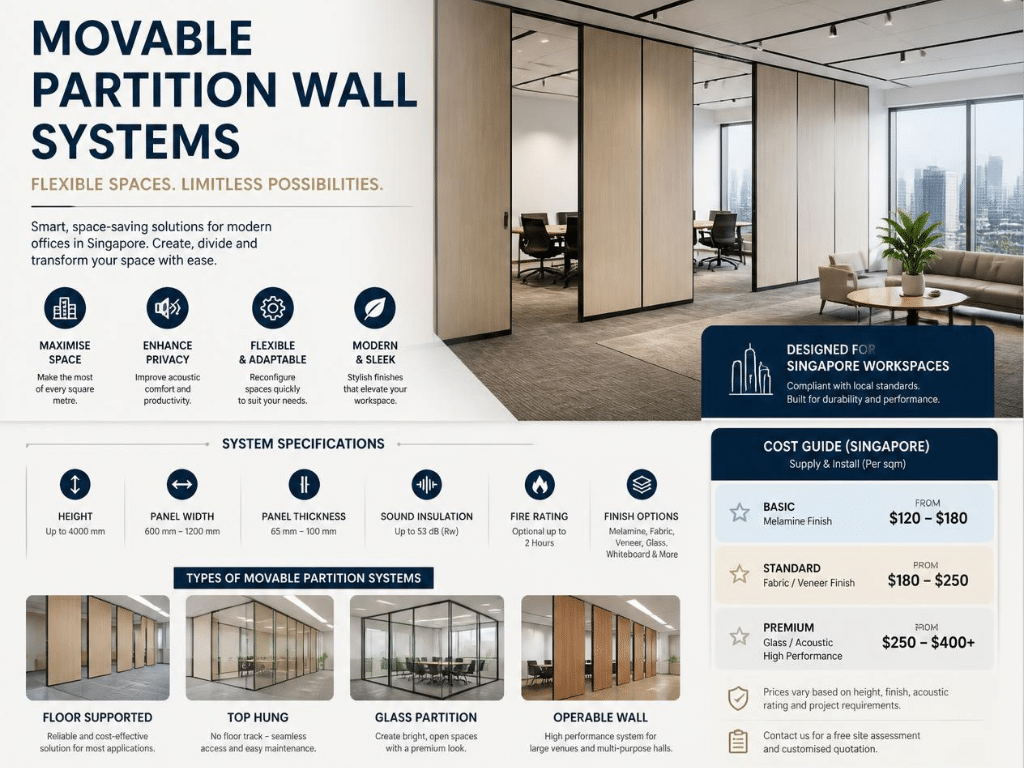
Movable Partition Wall Systems Singapore: Cost & Specs
Movable wall servicing in Singapore is the maintenance most facilities forget until a ballroom divider jams on an event morning. Mordor Intelligence has movable partitions growing 7.82 percent a year through 2031. This blog walks you through service intervals, maintenance scope, and what a failure costs, so you can keep an operable and movable wall system running instead of rescuing it.
What does movable wall servicing involve?
Movable wall servicing is the scheduled inspection, adjustment, and part replacement that keeps a panel system moving smoothly and sealing properly. It covers the track, the carriers that hang each panel, the seals, and the suspension hardware, not just a wipe-down of the panel faces.
The work targets the parts that wear. A service technician cleans and aligns the overhead track, checks and lubricates the carrier trolleys that carry each panel, adjusts the top and bottom seals, and tightens loose hinges, panel trim, and suspension components. On a motorised wall, the visit also covers the limit switches, clutches, and drive chains. The three problems that account for most service calls are panels that drag from trolley wear, tracks that bind as the building settles, and seals that leak sound as they age. Catch those early and the wall keeps performing for decades rather than failing mid-event.
How often should an operable wall be serviced?
Service an operable wall at least once a year, and twice a year for high-use venues like hotels and schools. Annual professional inspection is the industry baseline, because the wear on trolleys and seals is gradual and invisible until the wall becomes hard to move.
Frequency follows usage. A boardroom wall opened once a week tolerates an annual service, while a hotel ballroom divided and reopened daily needs a semi-annual or quarterly visit to stay ahead of trolley and seal wear. A school hall partition cycled several times a day sits in the same high-use bracket. The cleaner approach is to set the interval by cycles, not by the calendar alone, since a wall moved 500 times a year wears faster than one moved 50 times. Book the first inspection within twelve months of handover, because deferring the first service is where small alignment issues grow into expensive ones. With the office partition walls market on course for 12.53 billion US dollars by 2031 on Mordor Intelligence’s figures, the population of walls needing regular service is only growing.
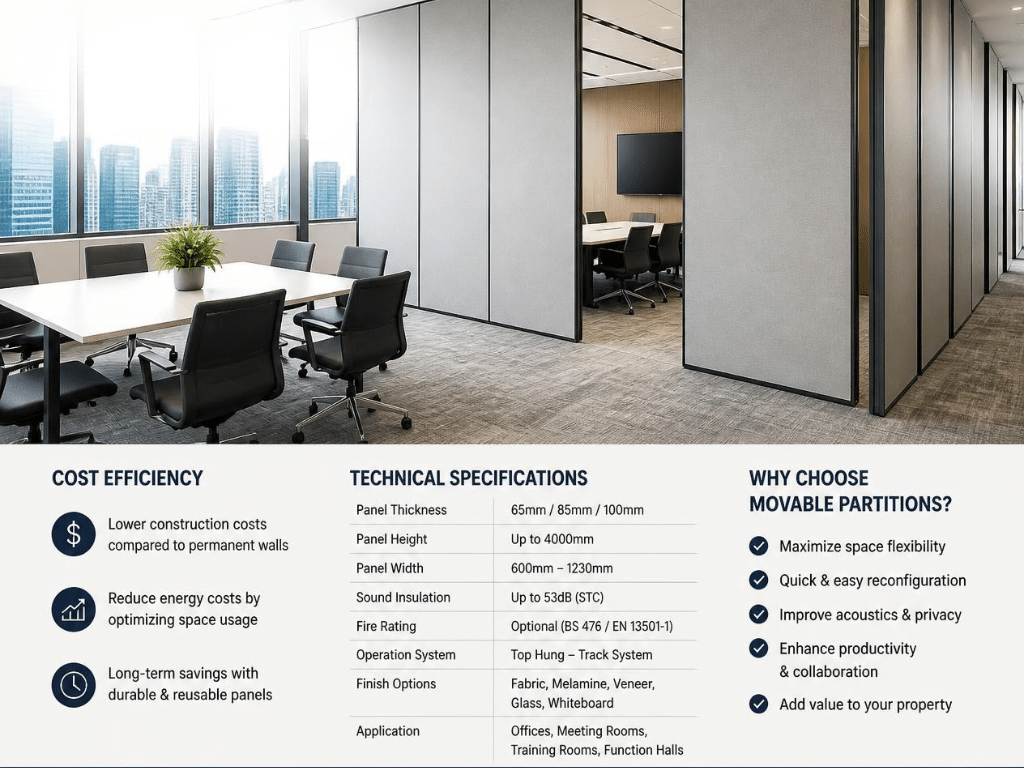
What is included in a movable wall service scope?
A proper service scope covers five areas: track cleaning and alignment, carrier inspection, seal adjustment, suspension bolt checks, and a documented condition report. A quote that lists only “inspection” without naming these is too vague to compare.
Each area targets a failure mode. Track cleaning clears the debris that makes carriers drag, and alignment correction stops the binding that accelerates every other wear point. Carrier trolleys are checked for worn wheels and bearings, since each top-hung panel hangs entirely on its trolleys. Top and bottom seals are adjusted or replaced to hold the acoustic rating, and the pendant suspension bolts that hang each panel are checked for tightness, because a loose one is a safety risk. As operable wall specialist Advanced Equipment notes, track binding “accelerates every other wear point,” which is why alignment leads the scope. The visit should end with a written service log recording the manufacturer, age, configuration, and condition of each wall, since that record makes the next service faster and supports any warranty claim tied to the long-term value of operable walls.
What are the signs an operable wall needs servicing?
The three clearest signs are a wall that takes more effort to move, visible gaps at the seals, and sound bleeding between the divided rooms. Any one of them means the system needs attention before it fails.
The symptoms map directly to the wear. Increased operating effort points to worn trolleys or a binding track, a gap at the seal line means the top or bottom seal has lost compression, and sound leaking between rooms shows the acoustic seals no longer hold the field rating. A panel that no longer sits level or plumb is a more serious signal, since it loads the suspension unevenly. Staff who operate the wall daily notice these first, which is why training the operators to report early symptoms is part of a good maintenance relationship. Treat a wall that has become hard to move as a service call, not a staffing problem, because forcing a binding panel accelerates the damage.
What happens if you skip movable wall maintenance?
Skipping maintenance turns cheap adjustments into expensive failures, and in a revenue space it stops the room earning. A seized carrier or a derailed panel can take a ballroom out of service for weeks while parts are sourced.
The costs stack up in three ways. A wall that will not divide cancels the function bookings that room was sold for, so the downtime is lost revenue, not just a repair bill. A leaking seal draws acoustic complaints and refunds in a hotel or a conference centre, since the STC rating the room was sold on no longer holds. The most serious failure is structural, because a panel hangs from pendant suspension bolts, and a neglected or overloaded suspension can let a panel move abruptly or fall, which is a genuine safety hazard. Worth noting: proprietary carriers and seals often carry lead times of several weeks, so a failure without a service contract can idle a room far longer than the repair itself takes. Preventive servicing at a few hundred dollars a visit is cheaper than a derailment that closes a revenue room for a month.
Why are suspension bolts and carrier condition a safety issue?
Suspension bolts and carriers are a safety issue because they are the only things holding a heavy panel in the air. Each top-hung panel hangs from pendant bolts threaded into its trolleys, and a panel can weigh anywhere from 25 kilograms per square metre upward.
The failure mode is not subtle. A worn carrier or a loose pendant bolt lets a panel drop, tilt, or move without warning, and lateral loads from wind or pressure differences can overstress the suspension enough to break components. A full-height ballroom panel that shifts abruptly near people is a real injury risk, which is why torque checks on suspension bolts and inspection of the carriers belong in every service visit. This is the part of maintenance that is invisible from the floor and easy to defer, and it is exactly the part that should never be skipped. A service that adjusts seals but never checks the suspension is doing the easy half of the job.
Should you sign a maintenance contract or call ad hoc?
Sign a maintenance contract for any operable wall in a revenue or institutional space, and keep ad hoc servicing only for a rarely-used single wall. A contract locks in scheduled visits, priority response, and faster access to genuine parts.
The economics favour the contract where the wall matters. A planned maintenance agreement schedules the annual or semi-annual visits automatically, so the wall never slips past its interval, and it typically guarantees a response time when something fails. Genuine carriers and seals come through authorised service channels, so a contract holder waits days rather than weeks for parts. Ad hoc calling works for a low-use wall where downtime carries no cost, but for a hotel divider it means competing for a technician’s calendar during peak season. The installed base is expanding, with the movable walls market reaching 4.5 billion US dollars in 2024 on IMARC Group’s figures, and that demand stretches service capacity, so a contract is how you secure it. Pairing the service plan with the original installer keeps one team accountable for the operable wall acoustic performance they commissioned.
How do you set up movable wall servicing in Singapore?
Set up servicing by commissioning a baseline inspection, agreeing an interval to usage, and putting the scope in writing. A clear agreement names the tasks, the frequency, the response time, and the parts terms.
Start with a condition survey of each wall to record its manufacturer, age, and current state, which sets the baseline for future visits. Agree an annual interval for standard use or semi-annual for a daily-cycled wall, and confirm the response time for a breakdown. Check whether the provider can source genuine carriers and seals, since proprietary parts decide how fast a failure is fixed. A supplier offering a full supply and maintenance service can hold the install history and the parts channel under one accountable team. When you are ready, arrange a service inspection so the wall is assessed and put on a schedule before it fails, not after.
Conclusion
Movable wall servicing protects a moving asset that most facilities ignore until it stops. Set the interval to usage, insist the scope covers track alignment, carriers, seals, and the suspension bolts that keep panels safely airborne, and hold a maintenance contract where downtime costs money. The alternative is a jammed or derailed wall, a room out of service for weeks while parts ship, and a repair bill far larger than the servicing that would have prevented it.
Enforce Automatic Global services and maintains operable and movable walls alongside the access and automation systems it installs across Singapore. Arrange a service inspection to baseline your walls, set an interval to their usage, and put them on a maintenance schedule that keeps every function room earning.
Frequently asked questions
How often should operable walls be inspected in Singapore?
Operable walls need professional inspection at least once a year, and twice a year for high-use venues such as hotels and schools. The interval follows cycles, so a ballroom wall divided daily wears faster than a boardroom wall opened weekly. Enforce recommends booking the first service within twelve months of handover.
How much does movable wall servicing cost?
Servicing cost is driven by the number of walls, panel count, usage, and whether it is a one-off visit or a maintenance contract. A single preventive visit runs at a few hundred dollars, far below the cost of a derailment that idles a revenue room for weeks. A site inspection by Enforce fixes the scope before pricing.
Can a movable wall be repaired, or does it need replacing?
Most movable walls can be repaired rather than replaced, since track, trolley, and seal faults are component-level fixes. Retrofitting hardware and seals or refurbishing panel faces restores a structurally sound wall without a full replacement. Replacement is reserved for systems beyond economical repair, and it resets the manufacturer warranty.
What is included in an operable wall maintenance contract?
An operable wall maintenance contract includes scheduled annual or semi-annual visits, track and carrier inspection, seal and suspension bolt checks, a guaranteed response time for breakdowns, and access to genuine parts. Enforce documents each visit in a service log recording the wall’s manufacturer, age, and condition to support warranty and planning.