

Operable Wall Price Singapore: Cost Per Panel & Sqm
Operable wall price in Singapore is quoted two ways, per panel and per square metre, and confusing them is how buyers misread a quote. Mordor Intelligence reports movable partitions growing 7.82 percent a year through 2031. This blog walks you through the cost drivers, quotation basis, and how to budget, so you can read an operable wall supply and installation quote clearly.
What does an operable wall cost in Singapore?
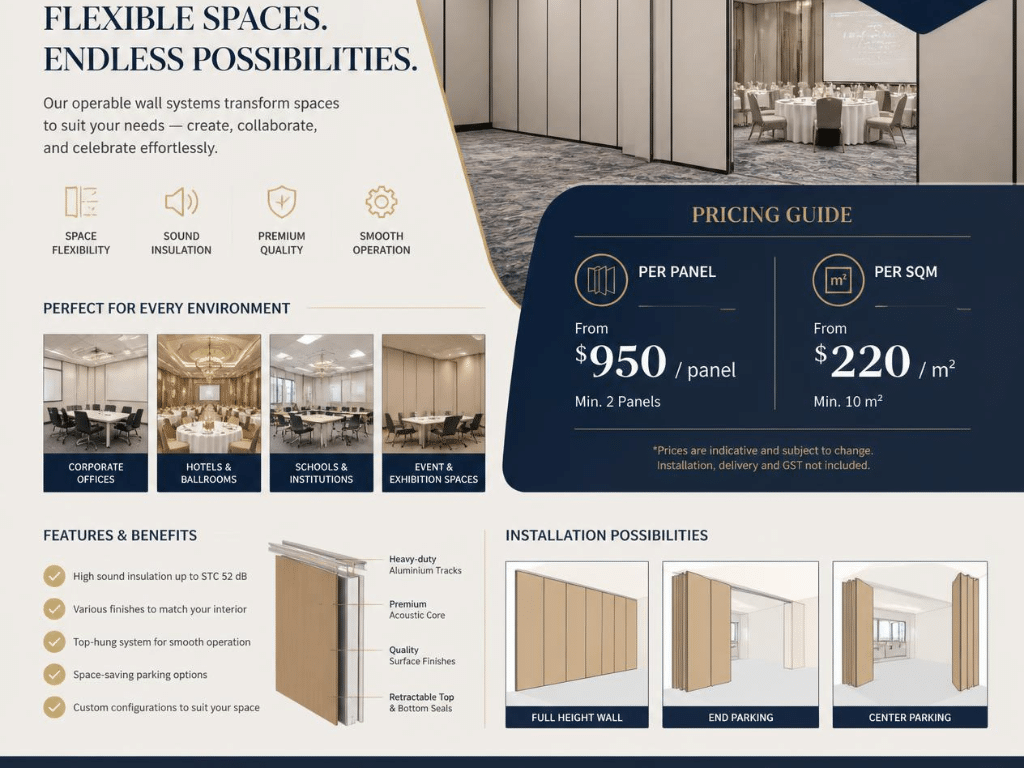
An operable wall in Singapore is priced by its specification, not by a flat rate, so the honest answer is a range that a site survey narrows to a firm figure. Industry price guides put factory-direct operable partitions at roughly 110 to 1,200 US dollars per square metre, and Singapore installed pricing sits above that band because it adds structural fixing, seals, pass doors, and commissioning.
The spread is wide for a reason. A basic accordion or framed glass wall at the low end and a high-acoustic motorised single-panel system at the top can differ by a factor of ten across the same floor area. The variables that move the number are the system type, the acoustic rating, the panel height, the finish, the track length, and the installation scope. A supplier who quotes a rate before seeing the opening is guessing, since the same 40 square metre opening prices differently at STC 40 versus STC 52. Treat any headline per-square-metre figure as a starting point, then let the specification set the real price.
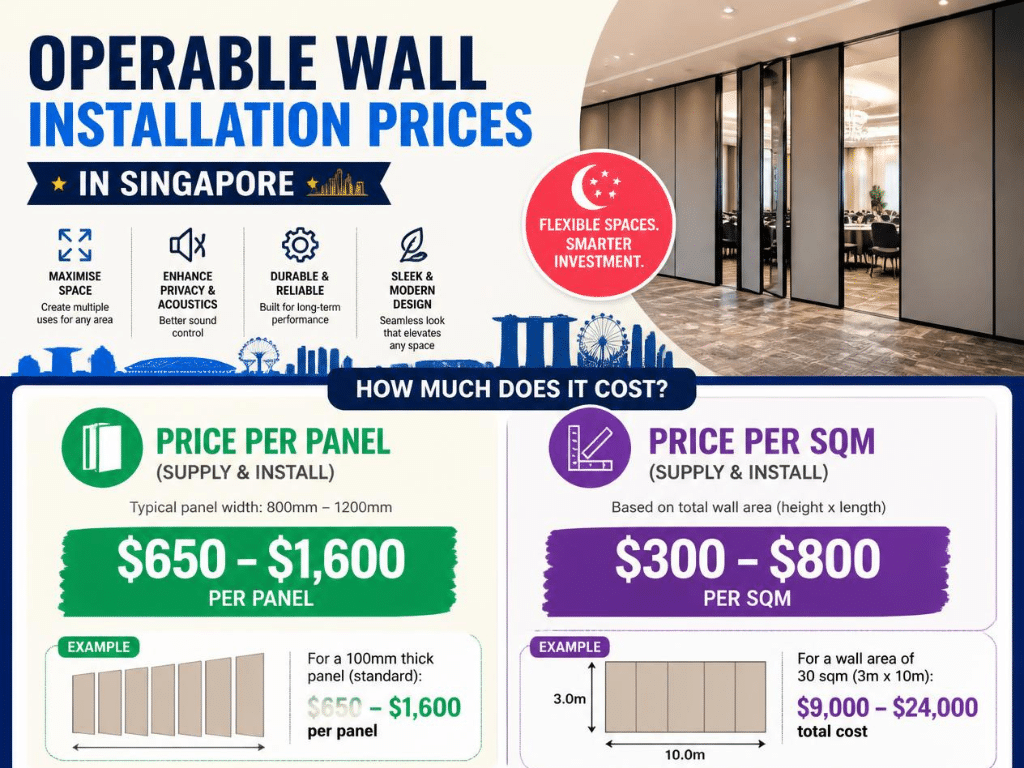
Is an operable wall priced per panel or per square metre?
Both, and knowing which basis a quote uses is the first step to comparing suppliers fairly. Per square metre is the comparison basis for budgeting across the whole opening, while per panel reveals how height, finish, and seals load onto each individual leaf.
The two views answer different questions. A per-square-metre rate lets you sanity-check the total against a benchmark and plan capex for the opening as a whole. A per-panel breakdown shows the effect of panel width, typically around 1,200mm, and panel height, since a taller or heavier panel costs more to build and to hang. The cleaner approach for a real project is to request both, because a quote given only as a lump sum hides which panels carry the cost and where value engineering is possible. A quote that states neither the panel count nor the square-metre rate is one to send back for detail before you compare it to anything.
What drives the price of an operable wall?
Six factors drive the price: system type, acoustic rating, panel height, finish, track length, and installation scope. Get those six on the table and you can explain almost any difference between two quotes.
System type sets the baseline, with a paired-panel manual wall costing far less than a motorised single-panel system. Acoustic rating is the next lever, since raising the target from STC 42 to STC 52 means denser panel cores and better seals that add cost per panel. Panel height drives both material and installation, as a 6 metre panel needs more structure and access equipment than a 3 metre one. Track length scales with the opening width, and a corner-routed track with a multi-directional switch costs more than a straight run. The reason two operable walls of equal area differ sharply in price is that these drivers rarely line up the same way twice, which is why the value operable walls add is best judged against a full specification rather than a rate card.
How much does panel height and size add to the cost?
Panel height is one of the steepest cost drivers, because taller panels need more material, heavier tracks, and access equipment to install. A standard system runs to about 9 metres, and specialist single-panel walls reach up to 18 metres, with price climbing at each step.
The cost rises on two fronts at once. A taller panel uses more core and skin material and weighs more, which forces a higher-rated suspension track and stronger structural fixing overhead. Installation also gets dearer above roughly 4 metres, since the work needs scaffolding or a boom lift rather than a simple ladder, and that access equipment is a line item in the quote. A double-height ballroom divider therefore costs more per square metre than a standard office wall of the same acoustic rating, purely on height. Confirm the clear floor-to-track height early, because it changes both the panel build and the access cost before any finish is chosen.
How does finish selection change the price (laminate versus fabric)?
Finish is the driver buyers control most directly, and the choice between laminate and fabric moves both price and durability. Laminate is the hard-wearing, lower-cost default, while acoustic fabric adds cost and improves sound absorption on the room side.
The trade-off is practical. A laminate finish resists knocks in a school hall or a function room and cleans easily, which is why it is the workhorse choice for high-traffic Singapore venues. Fabric lifts the acoustic comfort and the aesthetic in a boardroom, at a higher material cost and with more care needed over its life. Timber veneer and steel sit at the premium end for executive spaces. The finish rides on whichever panel core meets the acoustic target, so the same fabric costs more on an STC 52 panel than on a basic one, and choosing between glass or wooden partitions elsewhere in the fit-out follows the same logic of matching finish to use and budget.
What installation costs are in an operable wall quote?
Installation typically covers delivery, structural fixing, track mounting, panel hanging, seal setting, and commissioning, and it is where quotes diverge most. The supply price is only part of the total, and the install scope is where hidden costs hide.
The scope items add up quickly. Hoarding and site protection, after-hours working to fit around an operating hotel or school, and support steel where the soffit cannot carry a top-hung track are all real costs that belong in the quote. Access equipment for tall panels, making good the ceiling and floor after installation, and disposal of packaging round out the list. Worth noting: a low supply price with a thin install line often signals scope that will return later as a variation. According to Mordor Intelligence, direct sales hold about 68 percent of the partition market, which means most buyers deal with an installer directly and should scrutinise the install scope line by line rather than assume it is standard.
What is a provisional sum, and why is it in my quote?
A provisional sum is an allowance the supplier includes for work that cannot be priced exactly until the site is confirmed, and it signals a part of the scope that is not yet fixed. It is normal in construction quotes, but every provisional sum is a number that can move.
The mechanism protects both sides while the detail is settled. A supplier might carry a provisional sum for structural support steel before a site survey confirms whether the soffit needs it, or for making good works that depend on the finished ceiling. A variation order then adjusts the contract price up or down once the actual scope is known, so a quote heavy with provisional sums carries more budget risk than one built on a completed survey. The cleaner position is to convert provisional sums into fixed prices after the site survey, before the order is placed. Ask the supplier to list every provisional sum separately, because those lines are where a tidy-looking quote quietly becomes a bigger final bill.
How do you budget for an operable wall (capex planning)?
Budget for an operable wall as a capital item with a contingency, not as a single fixed quote, because the specification and the site both move the final figure. Set the acoustic target and the opening size first, since those two decisions drive most of the cost.
A sound budgeting approach carries a contingency of around 10 to 15 percent over the base quote to absorb variation orders and provisional sums that firm up after the survey. Compare the operable wall against the alternative it replaces, since building and later demolishing a fixed wall carries its own cost and lost flexibility, and the movable walls market reaching 4.5 billion US dollars in 2024 reflects how many owners now favour reconfigurable space. Automation is the single largest optional cost, so decide early whether the room genuinely needs a motorised system before it enters the budget. Whether operable walls suit the space at all is worth settling first through the guidance on when operable walls beat fixed walls.
How do you get an accurate operable wall quotation?
Get an accurate quote by commissioning a site survey and handing the supplier a clear specification, not by asking for a rate over the phone. A firm price needs the opening dimensions, the clear height, the acoustic target, the finish, and the stacking direction.
Give each supplier the same brief so the quotes compare like for like, and ask for the price both per panel and per square metre with provisional sums listed separately. Confirm whether the soffit can carry a top-hung track, since support steel is a common variation. A provider offering the product and installation range under one contract removes the gaps between supply and install where costs usually leak. When your specification is ready, request a quotation built on a site survey rather than a rate card, so the number you budget is the number you pay.
Conclusion
Operable wall pricing in Singapore rewards buyers who read the specification, not the headline rate. The system type, acoustic rating, panel height, finish, track length, and install scope set the cost, and a quote is only as firm as the site survey behind it. Ask for both the per-panel and per-square-metre basis, convert provisional sums to fixed prices, and carry a contingency, and the final bill stops holding surprises.
Enforce Automatic Global supplies, installs, and maintains operable and movable walls for hotels, schools, and commercial interiors across Singapore. Request a quotation built on a site survey of your opening, clear height, and acoustic target, so your budget reflects the real scope from the start.
Frequently asked questions
How much is an operable wall per square metre in Singapore?
Operable walls are priced by specification, so no single per-square-metre rate fits every project. Industry price guides put factory-direct systems at roughly 110 to 1,200 US dollars per square metre, and Singapore installed pricing runs higher once structural fixing, seals, and commissioning are added. A site survey by Enforce fixes the rate for your opening.
Why do operable wall quotes vary so much?
Quotes vary because the six price drivers rarely match across suppliers: system type, acoustic rating, panel height, finish, track length, and installation scope. A quote at STC 42 with laminate panels and a straight track costs far less than an STC 52 motorised wall with support steel. Compare quotes only when each carries the same specification.
What is usually not included in an operable wall price?
Common exclusions are hoarding and site protection, support steel where the soffit cannot carry the track, after-hours working, and making good the ceiling and floor. These often appear as provisional sums that a variation order later fixes. Ask the supplier to list every exclusion and provisional sum before you compare one quote to another.
Does automation increase operable wall cost?
Yes, significantly. A motorised operable wall that deploys and seals at the push of a button costs roughly 40 to 50 percent more than an equivalent manual system. The premium buys one-person operation and building management system integration, which suits high-use venues like convention centres but is rarely worth it for a room divided occasionally.