

Full Height Turnstile Singapore for High Security
Choosing a swing gate system does not answer every access control problem. Some sites need stricter pedestrian control than a standard lobby gate can provide. This blog will walk you through when a full-height turnstile singapore setup is the right choice, and when flap or speed gates are the better fit.
Full-height turnstiles are built for physical deterrence first
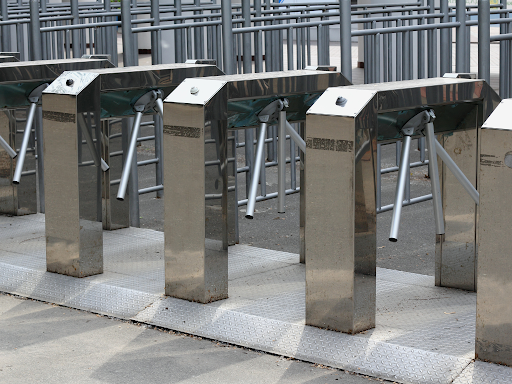
A full height turnstile is a floor-to-ceiling barrier with a rotating enclosure that allows single person access while blocking casual climb over, crawl under, and side bypass. Enforce’s live category page describes it as a high security access control gate designed to completely block unauthorised pedestrian entry, with strong suitability for perimeter protection and unmanned access points. That matters because this product category solves a different problem from a flap barrier or speed gate. It is designed to deter, contain, and regulate entry where a site cannot rely on visual supervision alone.
This is why full-height turnstiles are common at industrial compounds, utility zones, worker entry points, schools, stadium back of house areas, transport depots, and institutional sites where perimeter control matters more than a polished arrival experience. A speed gate is often selected for a staffed lobby. A full height turnstile is selected when the access line itself must do more of the security work.
The difference is practical, not cosmetic. A speed gate controls flow with sensors and glass barriers. A flap gate controls flow with faster lane logic in a front facing environment. A full height turnstile creates a cage like passage that forces one person through one controlled rotation. If the site is exposed, unsupervised, or open after hours, that physical format changes the risk profile immediately.
High security sites need perimeter control that does not depend on constant staff presence
The strongest use case for a full-height turnstile solution is a site where pedestrian entry must stay controlled even when no receptionist or guard is standing beside the lane. That includes service yards, warehouse compounds, industrial loading perimeters, school side entrances, infrastructure zones, worker accommodation access points, and facilities with restricted internal courtyards. Enforce’s product description explicitly frames full height turnstiles around maximum physical security, perimeter protection, and unmanned access points.
A flap gate or speed gate can still be secure when properly integrated with credentials and supervision. The problem is that both are more exposed to tailgating, jumping, forced lane sharing, and misuse after hours if the surrounding environment is too open. In a corporate lobby, staff presence and camera coverage often close that gap. At an outdoor entry line beside a fence, they usually do not.
That is why site context matters more than model prestige. For a high-security turnstile Singapore project, the real question is not whether a speed gate looks newer. The real question is whether the entry line must behave like a controlled perimeter device.
Flap and speed gates belong to a different operating environment
Flap and speed gates are generally better suited to buildings where controlled access must coexist with faster pedestrian movement, cleaner aesthetics, and a more welcoming front of house experience. Enforce positions luxury speed gates around premium office buildings, corporate headquarters, airports, and high security facilities where aesthetics and performance matter together. Its broader turnstile guidance also presents speed gates and tripod systems as common choices for busy managed environments.
That distinction is important because buyers often compare products without comparing operating conditions. A speed gate performs well when users are credentialed, traffic is steady, and the site has staff oversight or reception logic. A flap turnstile also works well when the brief is controlled passage with a more compact lane design. Neither is usually the best answer for a fence line entry into an industrial yard or a remote entrance that stays active outside office hours.
This is also why building owners should not buy by showroom impression. A gate that feels premium in a sales presentation may be the wrong tool for a perimeter with higher misuse risk, shift traffic, and limited supervision.
Single-person access is the core security advantage
Full height turnstiles are valuable because the barrier height and rotating chamber make single person access easier to enforce physically. That is different from systems that depend more heavily on sensors to identify piggybacking or tailgating.
For an industrial turnstile gate Singapore installation, this matters in very ordinary situations. Shift workers arrive in groups. Contractors enter at less predictable times. Delivery staff and visitors may approach from different directions. Some users carry bags or equipment. When the site relies only on a lower barrier gate, abuse is easier. When the access path is fully enclosed, misuse becomes much harder.
This does not mean full-height turnstiles eliminate every security issue. They still need proper credential control, safe release logic, and correct lane planning. What they do provide is a higher deterrence level before software and supervision even come into play.
Outdoor entry control changes the selection criteria
Outdoor entry control is one of the clearest reasons to choose full height over flap or speed gates. Weather exposure, fencing interfaces, uneven pedestrian arrival patterns, and reduced staff oversight all push the decision toward a more physically secure barrier.
A speed gate installed at an exposed perimeter usually demands more protection, more supervision, and a cleaner operating environment than many industrial or institutional sites can provide. A flap gate may look compact on plan, but it is still a lower barrier format. A full height unit is simply better aligned with perimeter fencing, after hours operation, and a site where the secure boundary is supposed to be obvious.
That is also where internal planning needs to widen beyond the turnstile itself. The site may need CCTV coverage, intercom support, card or biometric credentials, and a locked or monitored adjacent gate for accessible passage and goods movement.
Accessibility and egress planning still apply
A full-height turnstile may be the right security choice, but it cannot be planned in isolation. Singapore’s Code on Accessibility in the Built Environment 2025 states that accessibility and usability should be integrated into the overall design from the start, and the Code applies to new buildings as well as existing buildings undergoing addition and alteration works. That means a site using a full-height turnstile still needs to consider accessible routes, usable circulation, and how users who cannot pass through the turnstile will enter safely.
Fire safety and egress are just as important. SCDF’s advisory on installation of gates and turnstiles in buildings states that gates and turnstiles along egress paths affect the means of escape and are subject to approval requirements. That is especially relevant when a building owner treats the turnstile as a security upgrade without considering emergency release, adjacent escape routes, or how the secure boundary behaves during alarms and power events.
The practical rule is simple. A full height turnstile should be paired with a planned accessible gate path and a compliant emergency release strategy. If those are missing, the specification is incomplete.
Industrial and institutional projects benefit most from higher deterrence
The best fit for full height turnstiles is usually found in projects where deterrence matters as much as controlled entry records.
Industrial sites use them to separate staff compounds from vehicle yards, restrict workshop access, and harden perimeter points that stay active beyond office hours. Institutional sites use them where public facing access must remain separate from controlled service or staff routes. Education and sports venues use them where crowd control and single person passage matter more than a premium lobby feel.
By contrast, a commercial office lobby usually benefits more from lower friction, better visual openness, and faster flow. That is why speed gates remain the stronger option there. Buyers should not confuse “more secure looking” with “better matched.” The right choice is tied to the entry environment and how much physical deterrence the line needs to provide on its own.
Contractor capability matters more on high deterrence projects
A full-height turnstile installation is not only a product supply decision. It touches anchoring, fence interface, gate alignment, credential integration, weather exposure, circulation planning, and sometimes fire safety coordination. That raises the importance of choosing the right installer.
Enforce’s automatic gate contractor Singapore article makes a relevant point for this category: an automation specialist and a general contractor do not approach system integration the same way. For a secure perimeter entry gate Singapore project, that difference can show up in poor alignment, weak wiring protection, badly planned release logic, or a gate that technically works but does not serve the site properly.
Installation safety also matters while the site is live. MOM states that the Workplace Safety and Health Act requires stakeholders to take reasonably practicable steps for the safety and health of workers and others affected by work. On sites where a turnstile is installed near active routes, loading areas, or occupied facilities, that duty is not abstract. It shapes how the work is staged, isolated, and handed over.
A practical selection framework keeps the decision clear
A full-height turnstile is usually the right answer when most of these conditions are true:
- The site needs strong perimeter control rather than front-of-house presentation
- The entry point may be unmanned for part of the day
- Single-person access has to be enforced physically
- Outdoor or semi-outdoor conditions make a lower barrier format less suitable
- The secure boundary must be visually obvious to users
A flap or speed gate is usually the better answer when these conditions dominate:
- The site is a lobby or managed internal entry point
- Fast throughput and user experience matter more than hard perimeter deterrence
- The access line has staff oversight, reception support, or stronger interior supervision
- A more open visual design is part of the building brief
This is where product selection gets easier. A full-height turnstile is not a prestige upgrade over a speed gate. It is a different class of pedestrian security gate for a different risk environment.
Conclusion
Full-height turnstiles make sense when a site needs hard perimeter control, single-person access, and a barrier that still does its job when nobody is standing next to it. Flap and speed gates remain strong choices for managed lobbies and lower-friction internal access lines.
If your site involves outdoor entry control, industrial traffic, or an exposed perimeter, talk to Enforce about a layout and system recommendation based on real operating risk, not product appearance.
FAQs About Full-Height Turnstile Singapore
What is a full-height turnstile used for in Singapore?
A full-height turnstile is used for high-security pedestrian entry at industrial, institutional, and perimeter-controlled sites. It creates a floor-to-ceiling barrier that supports single-person access and stronger deterrence than lower barrier gates.
Is a full-height turnstile better than a speed gate?
It is better only when the site needs stronger physical deterrence, unmanned perimeter control, or outdoor entry hardening. A speed gate is usually better for offices and managed lobbies where flow and user experience matter more.
Can full-height turnstiles be used outdoors?
Yes. They are often chosen for outdoor or semi-outdoor perimeter entry because the format is more compatible with fencing, remote access points, and after-hours control than flap or speed gates.
Do full-height turnstiles need accessible alternatives?
Yes. BCA accessibility requirements still apply, so sites normally need an adjacent accessible gate path or another compliant entry route for users who cannot pass through the turnstile.
Do full-height turnstiles need emergency release planning?
Yes. SCDF states that gates and turnstiles along egress paths affect means of escape, so emergency release and fire safety planning must be addressed during design and approval.