

Turnstile Singapore: All 7 Types and How to Choose
A turnstile Singapore project usually fails when the building picks the wrong type for its traffic. Throughput, security, and aesthetics are not the same conversation. This blog will walk you through the seven turnstile types on the Singapore market, how each one works, and how to match a unit to your building’s actual entry profile.
What a turnstile is doing at your building’s entrance
Every product in the turnstile gate control system category in Singapore does the same fundamental job: read a credential, release a single-person barrier, and reset before the next person can enter. The barrier itself can be a rotating tripod arm, a glass flap, a swinging wing, a vertical drop arm, a sliding panel, or a full-height cage. The mechanism varies. The job does not.
The buying decision turns on four variables. Throughput per minute, lane width, security level (specifically, how hard the unit makes tailgating), and how the unit fails during a fire alarm. Get those four right and the rest of the spec is detail.
The seven turnstile types you will see in Singapore
Each type sits at a different point on the throughput-versus-security curve. Some are fast and easy to defeat. Others are slow and almost impossible to bypass.
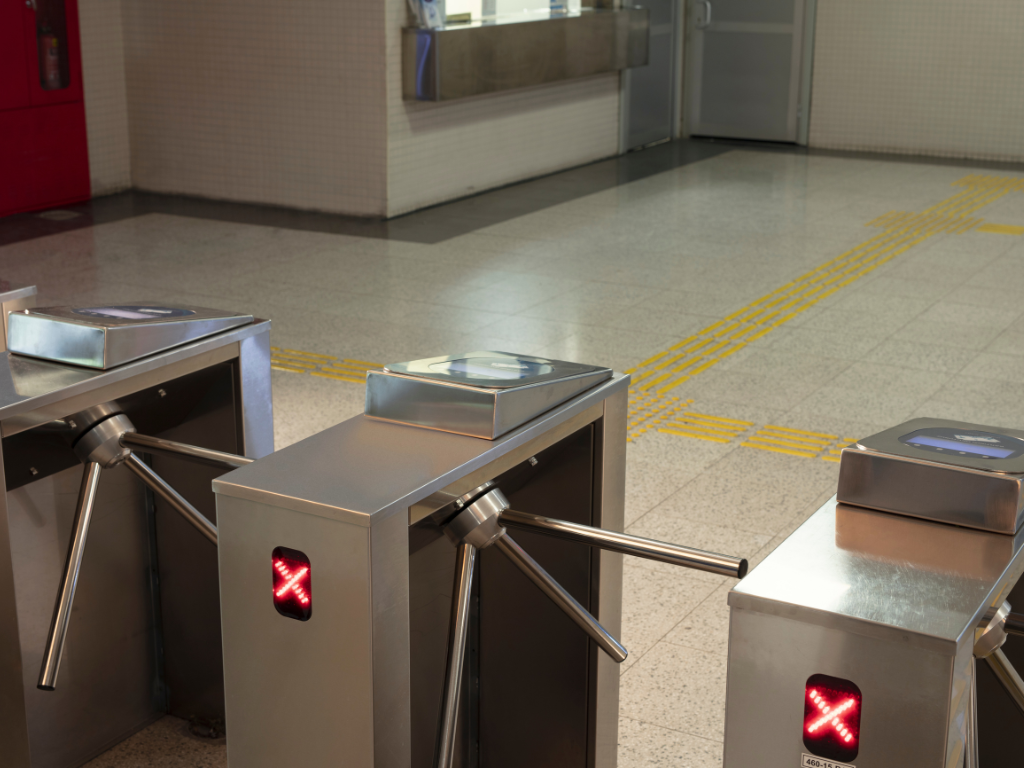
Tripod turnstile
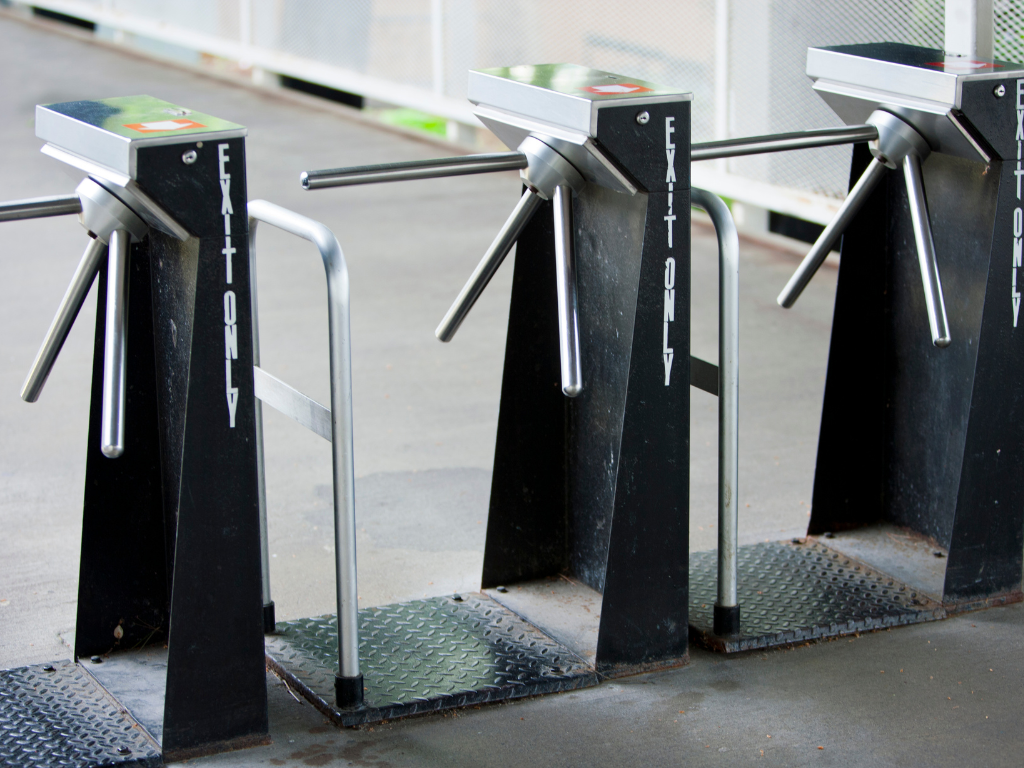
The tripod turnstile is the cheapest and most common turnstile in Singapore commercial use. Three horizontal arms rotate 120 degrees on a central post when a credential is accepted, letting one person through. Throughput sits at roughly 25 to 30 persons per minute. You see them at gym entrances, factory pedestrian gates, university buildings, and HDB construction site checkpoints. The strength of a tripod turnstile in Singapore is the price-to-deterrent ratio. The weakness is that anyone reasonably fit can climb over the arms or duck under, so a tripod is a deterrent rather than a hard barrier.
Drop-arm turnstile
A drop-arm turnstile uses a horizontal arm that drops vertically into the housing when triggered. The arm clears the lane completely, then rises back up after the person passes. Throughput is similar to a tripod (around 25 to 30 persons per minute), and lane width is wider, which makes the drop-arm a better fit when a lane needs to handle small luggage or a delivery trolley occasionally. Hotels and serviced apartments use them at side entrances. The drop-arm avoids the visual aggression of a rotating tripod, which matters in a hospitality setting.
Flap turnstile
The flap turnstile is the workhorse of Singapore office towers. Two retractable acrylic or glass wings part when a credential is read, allowing one person through, then close behind them. Throughput reaches 30 to 40 persons per minute, which is why CBD office lobbies almost always choose flap turnstiles over tripods at the morning rush. Sensors inside the lane detect tailgating attempts and trigger an alarm. A flap unit costs three to five times what a tripod costs, but the throughput and the cleaner aesthetic justify it for any high-rise lobby.
Swing turnstile
A swing turnstile (sometimes called a swing barrier or swing wing) uses a single longer wing that swings out of the lane to allow passage. The wing is usually 600mm to 900mm wide, which makes the swing the natural choice for an accessibility-compliant lane. A typical Singapore office lobby with three flap lanes will pair them with one wider swing lane for wheelchair users, parents with strollers, and visitors carrying boxes. Throughput is lower than a flap (around 20 to 25 persons per minute) because the longer wing takes more time to retract.
Slide-up turnstile
The slide-up turnstile is the rarest of the seven in Singapore. The barrier is a glass or acrylic panel that slides vertically upward into a housing above the lane. The mechanism keeps the barrier out of horizontal travel space, which is useful in narrow lanes where a flap or swing wing would catch on a wall. Slide-up units appear in some upscale residential lobbies and a small number of premium retail entrances, but they are a niche product. The mechanism is more complex, the maintenance is heavier, and the throughput is similar to a flap.
Luxury speed gate
A luxury speed gate is a flap turnstile with the design budget turned up. Heavier brushed steel housings, frameless glass wings, and tighter sensor logic that distinguishes between a child being carried and a tailgater. Throughput matches a standard flap (30 to 40 persons per minute), but the per-unit cost is roughly double. Banks, family offices, and Grade-A office towers in Marina Bay use speed gates because the lobby reads as serious from the moment a visitor walks in. The functional difference from a flap is small. The visual difference is large.
Full-height turnstile
A full-height turnstile is a vertical cage with rotating bars that allow only one person through per credential read. Height is typically 2,000mm to 2,400mm, which makes climbing over genuinely difficult. Throughput drops to 15 to 20 persons per minute, which is why you only see them at sites where security trumps speed. Logistics yards, MRT depot perimeters, prison and detention facilities, water treatment plants, and outdoor power substation gates rely on full-height turnstiles because the cage geometry is the only one of the seven that meaningfully prevents an unauthorised person from forcing entry.
How to choose the right turnstile for your building
The choice is not “which is best.” It is “which trade-off matches your building.”
Match throughput to peak demand, not average
The number that matters is morning rush throughput, not daily average. A 50-storey office tower with 3,000 occupants might see 1,800 people enter between 8:30 and 9:15. That is 40 persons per minute through the lobby, which means three flap lanes (at 30 to 40 persons per minute each) is the floor, not the ceiling. Skip this calculation and you create a queue at the lobby that residents and tenants will complain about for years.
Width and accessibility
A standard turnstile lane is 550mm to 600mm wide, which is too narrow for a wheelchair, a stroller, or a person carrying a large box. The Building and Construction Authority’s Code on Accessibility in the Built Environment requires accessible routes to provide a minimum clear width of 900mm. In practice, that means at least one wider lane in any turnstile bank, usually a swing turnstile sized at 900mm. Specifying this at design stage is far cheaper than retrofitting later.
Fail-safe versus fail-secure during a fire alarm
This is where most procurement teams trip up. A turnstile must drop its barriers and allow free egress when the fire alarm panel triggers. The arms or wings of any powered pedestrian turnstile must move to the fail-safe position automatically. Fail-secure is the wrong setting for a public egress route. The integration with the fire alarm panel needs to be tested at commissioning, not assumed. The principles in the UK Health and Safety Executive’s powered-gates safety guidance apply equally to powered pedestrian turnstiles.
Indoor versus outdoor (IP rating)
Most turnstiles are designed for indoor lobby use and carry IP rating of IP41 or IP54, which is fine for a covered entrance but not for an unsheltered yard gate. For outdoor logistics or perimeter applications, only the full-height turnstile and a small number of weatherised tripod and drop-arm models carry the IP65 rating that survives a Singapore monsoon. Buying an indoor flap turnstile and putting it outside under a porch is the most common way I have seen a building burn through its capex on this category.
Integration with access control and CCTV
A turnstile is one node in the building’s wider access control architecture. The credential reader, the door controller, the CCTV system, and the visitor management software all need to speak to the turnstile cleanly. A common Singapore stack pairs turnstiles with Soyal or ZKTeco access control, and the integration question is whether the turnstile’s I/O matches what the controller expects. Skip this conversation at procurement and the integration becomes a six-week rework project after install.
Common turnstile procurement mistakes in Singapore
Three patterns show up repeatedly when MCSTs and developers tender for turnstile projects.
The first is choosing aesthetics over throughput. A beautiful luxury speed gate is the wrong answer for a lobby that needs four lanes when the budget only covers two. The second is ignoring the maintenance contract. A turnstile is a precision mechanism with optical sensors, motors, and gearboxes, and skipping a proper after-sales service plan means a unit that limps through year three. The third is bundling the turnstile and access control software with two different vendors and assuming they will integrate. They will not, until someone is paid to make them.
Conclusion
Pick the type that matches your throughput, accessibility, fire-egress, and weather profile. The seven turnstile types on the Singapore market each solve a specific entry problem, and the right pick is rarely the one with the cleanest brochure. A site visit and a peak-hour throughput count beat any manufacturer pitch.
Speak to the Enforce team for a site survey on your office tower, factory, condo lobby, or perimeter gate, and get a turnstile specification matched to your real entry profile.
Frequently asked questions
What is the most common turnstile in Singapore offices?
The flap turnstile dominates Singapore office lobbies because it offers throughput of 30 to 40 persons per minute, integrates cleanly with credential readers like Soyal and ZKTeco, and looks at home in a Grade-A office. Tripod turnstiles still dominate factory and gym entrances where price matters more than throughput.
How wide does a turnstile lane need to be for wheelchair access?
The Building and Construction Authority’s Code on Accessibility requires accessible routes to provide a minimum clear width of 900mm. In practice, that means including at least one wider swing turnstile lane in any turnstile bank. A standard 550mm to 600mm lane is too narrow for a wheelchair or a stroller, regardless of turnstile type.
Do turnstiles need to be tied into the fire alarm?
Yes. Any powered turnstile in a public egress route must be configured fail-safe, meaning the barriers drop and the lane opens automatically when the fire alarm panel triggers. The integration with the fire alarm system must be tested at commissioning and recorded on the handover certificate, not assumed from a brochure setting.
How long does a turnstile last in Singapore conditions?
A flap or speed gate in an indoor lobby with twice-yearly preventive maintenance typically runs 8 to 10 years before significant refurbishment. Tripod turnstiles in less demanding environments often run 10 to 12 years. Outdoor full-height turnstiles depend heavily on coating quality and IP rating, with IP65 units running 10 years and lower-rated units half that.
Can different turnstile types share the same access control credential?
Yes. The credential lives in the access control system, not the turnstile. A standard ZKTeco or Soyal card or fob can trigger a tripod, flap, swing, speed gate, or full-height turnstile in the same building, provided each unit’s reader and controller are wired into the same access control backend. This is one of the most common integration failures when vendors are split.