

Swing Turnstile Singapore: Wide-Lane Access Guide
A swing turnstile Singapore project usually starts with one specific problem: a standard 550mm flap lane will not let a wheelchair, a luggage trolley, or a director with a coffee tray through. This blog will walk you through when a swing turnstile is the right answer and how to specify the wide lane correctly.
What a swing turnstile actually is
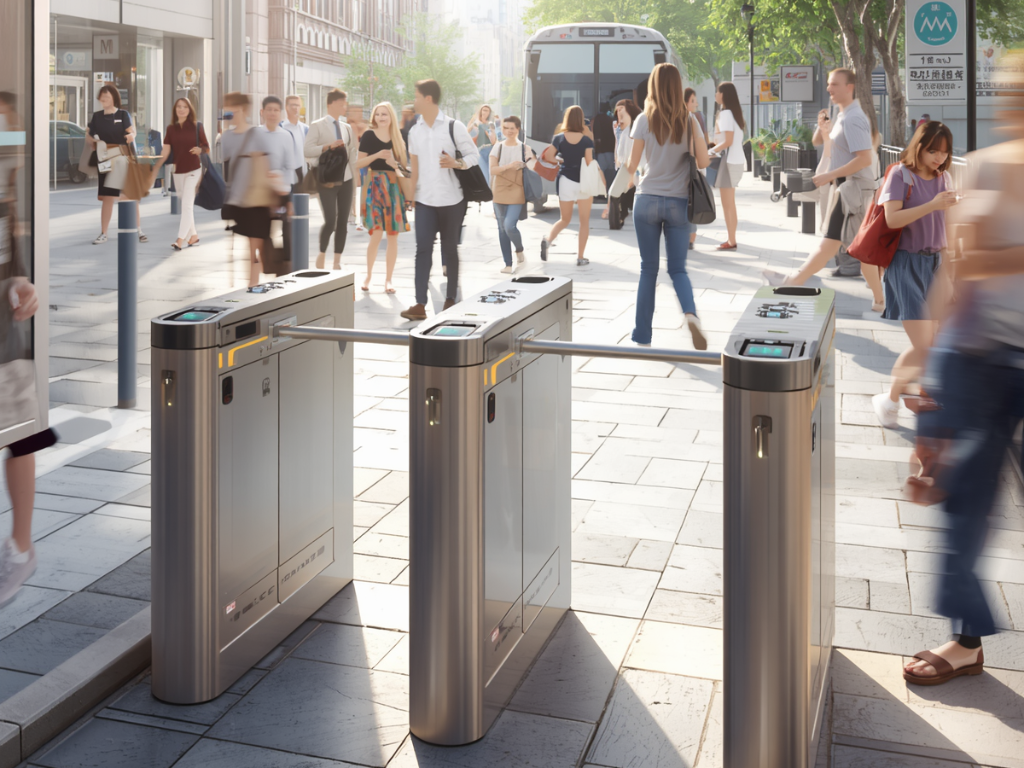
In the Singapore turnstile gate control system range, the swing turnstile sits between the standard flap and the full-height cage in throughput, and at the top of the range in lane width. The unit uses a single longer wing (or paired wings on each side of the lane) that swings out on credential read, lets one person through, and swings back. The wing is typically tempered glass or acrylic with a stainless steel or brushed-aluminium frame, driven by a low-voltage motorized swing arm inside the housing.
The defining attribute is wing length. A flap turnstile uses 300mm to 350mm retractable wings inside a 550mm to 600mm lane. A swing turnstile uses a 600mm to 1,000mm swinging wing inside a 900mm to 1,200mm lane. That extra width is the entire reason the product exists.
Why a wide-lane turnstile actually matters in Singapore
Three pressures push Singapore developments toward swing turnstiles, and any one of them on its own is enough to justify the choice.
Accessibility compliance under the BCA code
The Building and Construction Authority’s Code on Accessibility in the Built Environment requires accessible routes to provide a minimum clear width of 900mm. A standard flap or tripod lane at 550mm cannot meet this. Where a turnstile bank is the only entry path, at least one lane must satisfy the accessibility minimum, and that lane is almost always a swing turnstile.
International tenants sometimes also reference the United States ADA Section 404 standard for accessible doors and gateways, which sets a similar 32-inch (812mm) clear-width minimum. The BCA’s 900mm is the more conservative figure. Specifying a 900mm swing lane satisfies both at once.
Trolleys, strollers, and large items
Hotels, hospitals, mixed-use lobbies, and serviced offices see daily traffic that a flap lane cannot handle. A standard housekeeping trolley measures around 520mm wide. Add the operator’s hand on the handle and the realistic clearance needed is 750mm. Strollers run 600mm to 750mm wide. Office goods carts are typically 600mm. Trying to push any of these through a 550mm flap is the friction that drives security teams to wedge the lane open, which defeats the whole point of having a turnstile.
A 1,000mm swing lane handles all of the above and a wheelchair user with a small accompanying bag.
VIP flow and lobby aesthetics
A glass-wing swing turnstile in a Grade-A office or a private banking lobby reads as serious infrastructure rather than a barrier. The visual cue matters when the building wants to control entry without making visitors feel processed. The same logic applies at hotel back-of-house gates, executive floor entries, and family office reception areas, where a flap looks transactional and a swing wing looks intentional.
How a swing turnstile differs from the rest of the turnstile family
The seven turnstile types on the market each solve a different version of the same problem. The longer “all 7 types” comparison sits in the turnstile types and selection guide for Singapore buildings, but the swing’s place in the family is worth flagging directly.
A tripod is cheaper, narrower, and more visually aggressive. Throughput is similar (20 to 25 persons per minute for a swing versus 25 to 30 for a tripod), but a tripod cannot pass a wheelchair regardless of credential. A flap is faster (30 to 40 persons per minute) but narrower; the wings are too short to clear the swing’s accessible width. A full-height cage is more secure but has no accessibility lane option at all and makes wheelchair access architecturally impossible. The luxury speed gate uses the same flap geometry as a standard flap, just with better materials. None of the other types solves the wide-lane problem the swing turnstile is built for.
The trade-off is throughput. A swing wing has more inertia than a flap wing, so the open-and-close cycle takes a fraction of a second longer. Across a busy morning that translates to slightly slower flow per lane. The right answer is to pair lanes: three or four flap lanes for routine commuter traffic, plus one swing lane for accessibility and exceptions.
How to specify a swing turnstile correctly
Three decisions drive whether the unit performs as planned.
Lane width and wing geometry
The lane width is the clear dimension between the two housings. For accessibility, 900mm is the floor and 1,000mm is the practical default. Going to 1,200mm is sensible only when forklift traffic, large luggage, or hospital beds need to pass, because the wing has to grow proportionally and the open-cycle time grows with it. The wing length should be 50mm to 100mm shorter than the lane width to provide swing clearance, and the wing height should be at least 900mm to discourage hopping over.
Two configurations exist. A single-wing swing has one wing on one housing that swings to the opposite housing. A bi-directional double-wing swing has a wing on each housing that meet in the middle. The double-wing version costs more, but the visual symmetry suits a premium lobby and the failure modes are gentler (one wing failing still gives partial control while service is arranged).
Direction logic and anti-tailgating
The control board has to know which direction someone is approaching from. Sensors inside the lane detect motion direction, the controller releases the wing in the matching direction, and a second sensor confirms passage before the wing closes. Without proper direction logic, an inbound credential can release the wing for an outbound walker and create a tailgating gap. Specifying paired sensors at both ends of the lane is non-negotiable, regardless of how clean the vendor’s brochure looks.
The same direction logic supports anti-passback rules from the access control side. The controller knows the same card cannot enter twice without exiting, which matters at large estates where a single card otherwise lets multiple people through across consecutive read events.
Fail-safe and motorized swing arm safety
The motorized swing arm has to fail-safe during a fire alarm, meaning the wing moves to the open position and stays there until the alarm is cleared. The fire alarm panel sends a relay signal to the controller, and the controller drops the wing’s holding torque. The principles are documented in the UK Health and Safety Executive’s powered-gates safety guidance, which Singapore installers reference for the contact-force and reversing behaviour the wing should exhibit if it meets a person mid-swing.
Two practical checks at commissioning: trigger the fire alarm relay and verify the wing stays open, and place an obstacle in the wing’s path during a close cycle and verify the wing reverses without contact damage. Both should be recorded on the handover certificate.
Where swing turnstiles work best in Singapore buildings
Five settings make swing turnstiles the right call rather than a default.
The first is any building required to comply with BCA accessibility provisions, which covers virtually every new commercial development in Singapore.
The second is hospital and clinic entrances, where wheelchairs, gurneys, and medication trolleys are constant traffic. A swing lane sized at 1,200mm with a quiet motor and a longer dwell time after credential read is the standard spec.
The third is hotel staff entrances and back-of-house. Housekeeping trolleys, room service carts, and laundry bins all require width that a flap cannot deliver.
The fourth is Grade-A office lobbies pairing a swing lane with three or four flap lanes. The flaps handle the morning rush; the swing handles wheelchair users, contractors with toolkits, and visitors with luggage.
The fifth is family offices, private banks, and discrete commercial reception areas where the visual reads matter as much as the security function. The frameless glass wing on a luxury swing turnstile is part of the lobby’s first impression.
Common procurement mistakes
The most expensive swing turnstile mistake is treating it as a standalone purchase. The lane has to integrate with the rest of the building’s access control, the credential reader has to match the existing card stock, and the controller needs to be wired into the same backend the gantry barrier and lift access already use. A typical Singapore commercial stack pairs the swing with Soyal or ZKTeco access control, and any swing turnstile bid that does not name the existing access control system in its scope is incomplete.
The second mistake is buying a wing too short. A wing matched to a 900mm lane that the building later decides to widen to 1,000mm leaves a 50mm side gap that a slim person can squeeze through. The wing length has to be specified after the lane width, not before.
The third mistake is skipping the maintenance contract. Motorized swing arms are precision mechanisms with a hinge bearing, a motor, and a control board, all of which wear. A reputable after-sales service plan should cover hinge lubrication, motor torque check, photocell alignment, and wing-edge protector inspection at twice-yearly intervals.
Conclusion
A swing turnstile is the answer when lane width is non-negotiable: wheelchairs, trolleys, large items, or a lobby that has to read as premium rather than transactional. Spec the lane at 900mm minimum, the wing at the right length for the lane, the direction logic correctly, and the fire-safe behaviour proven at commissioning, and the unit becomes invisible the way good infrastructure should.
Speak to the Enforce team for a site survey on your office lobby, hotel entry, or hospital gate, and get a swing turnstile specification matched to the actual users who need to walk through.
Frequently asked questions
How wide should a swing turnstile lane be in Singapore?
900mm is the minimum clear width to meet the BCA Code on Accessibility, and 1,000mm is the practical default for most commercial lobbies. 1,200mm makes sense only for hospital, hotel back-of-house, or industrial settings where larger trolleys, gurneys, or beds need to pass. The wing length is then sized 50mm to 100mm shorter than the lane width.
What is the throughput of a swing turnstile compared to a flap?
A swing turnstile handles 20 to 25 persons per minute, compared with 30 to 40 persons per minute for a flap turnstile. The slower cycle reflects the longer wing’s inertia. The right architecture in a busy lobby pairs three or four flap lanes for commuter traffic with one swing lane for accessibility and exception traffic.
Does a swing turnstile pass PDPA review for face recognition?
Yes, on the same terms as any other turnstile type. The PDPC’s Guide on the Responsible Use of Biometric Data in Security Applications applies regardless of mechanism. The data flow, template storage, retention period, and PDPA notice are the controls that matter, not the wing geometry. Specify these in the integration scope before commissioning.
Can a swing turnstile be used outdoors at a property’s perimeter?
Most swing turnstiles are designed for indoor lobbies and carry an IP41 to IP54 rating, which is fine under cover but not for unsheltered installation. Outdoor swing turnstile variants exist with IP65 housings and weatherised motors, typically at a 30 to 40 percent price premium. For perimeter use, a full-height turnstile is usually the better fit.
What happens to a swing turnstile during a fire alarm?
The fire alarm panel sends a signal to the access control controller, which drops the holding torque on the swing arm. The wing moves to the fully open position and stays there until the alarm is reset. This integration must be tested at commissioning with the actual fire panel relay, not assumed from a brochure setting, and the test result should appear on the handover certificate.