

Speed Gate vs Tripod Turnstile Singapore
Planning a automatic gate installation and access solution often leads to one practical comparison: speed gate vs tripod turnstile Singapore. Both control pedestrian entry, but they solve different problems. This blog will walk you through which system fits your building’s security level, traffic flow, user profile, and operating environment best.
The difference starts with how each system controls passage
A tripod turnstile uses three rotating arms to regulate one-person passage through a compact waist-height barrier. Enforce describes it as one of the most common and cost-effective turnstile types for crowd control and basic entry regulation. A luxury speed gate is positioned very differently. Enforce presents it as a high-end pedestrian access solution built for fast, secure, and visually cleaner flow in premium commercial environments.
That distinction matters because the hardware design shapes the user experience from the first tap of a card or QR code. A tripod turnstile physically slows the user and creates a stronger sense of deterrence through its rotating arm barrier. A speed gate relies on sensor logic, glass barriers, and controlled lane opening to deliver credentialed entry with less friction. In a premium office lobby, that difference is obvious. In a factory entrance or back-of-house access point, it may matter far less.
In practice, buyers are not choosing between two equivalent products with different styling. They are choosing between two operating models. One is compact, tougher-looking, and budget-conscious. The other is faster, more presentable, and more dependent on proper integration and lane planning.
Speed gates suit buildings where flow and presentation matter every day
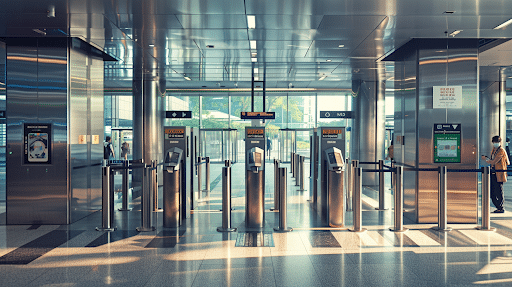
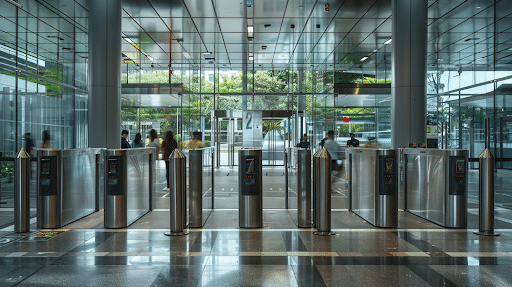
A speed gate fits best when the entrance is part of the building’s front-of-house experience. Office towers, corporate headquarters, business parks, commercial lobbies, and premium mixed-use developments usually care about both security and arrival quality. That is exactly the space where speed gates perform well.
The barrier is typically glass, the lane feels open, and the entry cycle is quicker for cardholders. Users do not need to push through a rotating arm. That reduces hesitation during peak arrival windows and makes the entrance feel less mechanical. Where the building already uses access control systems, a speed gate usually makes more sense when the goal is to connect credentials, visitor approvals, and reception workflow into one cleaner entry process.
The commercial case is strong when you want manpower reduction at the lobby line without making the entrance look defensive. Security still matters, but the system is expected to do more than block people. It should guide traffic, maintain sightlines, and support the building’s image.
Tripod turnstiles fit sites that prioritise control, durability, and budget discipline
A tripod turnstile remains a strong choice when the building needs straightforward control rather than premium presentation. Factories, warehouses, worker dormitory entrances, service corridors, plant access points, construction-related compounds, and secondary staff entrances often fall into this category.
The key strength is not elegance. It is simplicity. A tripod unit creates a clear one-person passage with a visible waist-height barrier. That physical resistance is useful in places where the priority is basic deterrence, controlled entry counts, and durable daily use.
For a factory entrance turnstile singapore requirement, tripod systems often fit better because the operating environment is less sensitive to lobby aesthetics and more sensitive to ruggedness, repetitive use, and cost control. If users arrive in workwear, carry small items, or move through an industrial entry point where polished front-of-house design is not the brief, a tripod turnstile can be the more sensible specification.
This is where many comparisons go off track. Buyers assume a speed gate is automatically the superior upgrade. It is not. If the entrance is purely functional, the tripod turnstile may give you the right deterrence level with less capital cost and a simpler maintenance profile.
Traffic flow changes the decision more than product brochures do
Throughput is one of the most important differences between a speed gate and a tripod turnstile. A speed gate is generally better at handling fast pedestrian flow because the user presents a credential and moves through a lane without physically rotating a barrier arm. In office arrival peaks, that difference adds up quickly.
A tripod turnstile slows movement by design. That is not a flaw. It is part of how it controls one-person passage. The trade-off is that queues form more easily when a large group arrives within a short time window. In an office with heavy morning traffic, that can create friction at exactly the point where the building wants a smooth experience. In a factory or secondary entry point, that slower pace may be acceptable.
A useful way to judge this is to look at the busiest fifteen minutes of the day, not the average hour. If your building has concentrated employee arrival waves, visitor check-ins, or shift-based staff movement, the lane logic matters more than the product description. A pedestrian security gate singapore project should be specified around real traffic behaviour, not around showroom assumptions.
Security performance depends on the kind of control you need
Security is not one thing. A building may want deterrence, anti-tailgating performance, access logging, supervised entry, or a combination of all four. Speed gates and tripod turnstiles handle those needs differently.
A tripod turnstile creates direct physical interruption. One body pushes through one lane cycle. That makes it effective for visible one-person passage control. A speed gate can deliver tighter credential integration and better high-volume movement, but it depends more on sensor tuning, lane supervision, and anti-tailgating logic. In a higher-end commercial environment, that can be the better answer. In a basic access checkpoint, the tripod’s more obvious physical barrier may be enough.
The right question is not which system is “more secure” in the abstract. The right question is what type of misuse you need to reduce. Unauthorised casual entry at a staff access point is a different problem from managing tenant and visitor movement in a Grade A office lobby.
User experience affects compliance, queueing, and reception workload
User experience sounds soft until the entrance starts backing up.
In an office entrance turnstile singapore context, poor user flow creates real cost. Staff bunch up at readers. Visitors step into the wrong lane. Reception gets pulled into repetitive wayfinding. Security officers end up fixing movement problems that the system should have prevented.
Speed gates usually win on user experience because the lane feels intuitive, open, and less physically awkward. That matters for executives, clients, and visitors, but it also matters for ordinary staff who use the system twice a day, every day. A poor entry experience repeated hundreds of times per week becomes an operations issue, not a design issue.
Tripod turnstiles can still work well when users are familiar with the system and the entry brief is simple. They just do not create the same front-of-house experience, and they are less forgiving when large volumes move through in short bursts.
Compliance and safe circulation still need attention
Any pedestrian entry system in Singapore has to be planned with circulation and safety in mind. BCA’s Code on Accessibility in the Built Environment applies to new works and alteration works, and it reinforces the need to think properly about accessible routes and usable circulation rather than treat them as afterthoughts.
That matters in this comparison because some entrances need a wider accessible lane, clearer approach zones, or better separation between main flow and exception flow. A speed gate line is often easier to plan into a premium lobby with one wider lane and adjacent reception oversight. A tripod arrangement can work too, but the passage format is less flexible for front-of-house circulation quality.
Electrical and workplace safety also matter during installation and operation. EMA advises consumers to engage licensed electrical workers for electrical works, and MOM’s Workplace Safety and Health framework sets out duties to take reasonably practicable steps to ensure workplace safety. Those points matter more for commercial and industrial sites where the entrance system is part of a live operating environment.
Maintenance and long-term cost do not behave the same way
A tripod turnstile is usually simpler mechanically. That tends to support lower replacement cost and more straightforward upkeep, especially where the site accepts a more utilitarian appearance. A speed gate has more front-of-house value, but it also depends more heavily on sensors, barrier logic, and clean lane calibration.
This does not mean tripod turnstiles are always cheaper over time or that speed gates are inherently expensive to maintain. It means the cost pattern is different. With a speed gate, poor tuning or weak servicing shows up as false alarms, awkward lane behaviour, or disrupted flow. With a tripod turnstile, problems are more likely to appear as wear, arm resistance, access control mismatch, or user frustration under heavy peak volume.
The best fit changes by building type
Office lobbies and commercial reception zones
A speed gate is usually the better fit when the entrance must balance security, traffic flow, reception visibility, and lobby aesthetics. It supports faster credentialed entry and makes more sense when the entry point forms part of the client or tenant experience.
Factories, warehouses, and worker access points
A tripod turnstile is often the better fit when the environment is functional, the budget is tighter, and the main requirement is basic one-person passage with visible deterrence.
High-traffic buildings with a mixed user base
This is where the decision needs more care. If the building handles employees, visitors, contractors, and deliveries through the same frontage, speed gates are often stronger because they support better user experience and smoother credential flow. If the access point is secondary, more controlled, or less presentation-sensitive, tripod turnstiles may still be the better value.
A practical stance for Singapore buyers
For most office and commercial lobby projects in Singapore, speed gates are the better long-term choice because they handle throughput better, reduce friction for credentialed users, and support a stronger front-of-house environment.
For factories, secondary staff entrances, and cost-sensitive pedestrian checkpoints, tripod turnstiles still make a lot of sense. They are not outdated. They are just solving a different problem.
The mistake is choosing by appearance alone. Building owners should choose by deterrence level, throughput pressure, user profile, and how much the entrance experience matters to daily operations.
Conclusion
Speed gates and tripod turnstiles both control entry, but they belong in different operating environments. The better option depends on whether your site values faster flow and lobby quality or basic one-person passage and tougher budget control.
If you are comparing systems for a real project, speak to Enforce about the site layout, user traffic, credential setup, and access risk first. That is how you get the right answer for the building, not just the neatest answer on paper.
FAQs About Speed Gate vs Tripod Turnstile Singapore
Is a speed gate more secure than a tripod turnstile?
Not automatically. A speed gate can offer stronger credential integration and better high-volume control, while a tripod turnstile gives more obvious physical one-person passage control. The better choice depends on the building’s security objective.
Which is better for an office entrance in Singapore?
For most office lobbies, a speed gate is the better fit because it supports faster throughput, better user experience, and a cleaner arrival environment. Tripod turnstiles suit more functional staff access points.
Which system is better for a factory entrance turnstile Singapore setup?
A tripod turnstile is often more suitable for factory or warehouse entry because it delivers straightforward pedestrian control, visible deterrence, and a simpler hardware profile.
Do speed gates need access control integration?
Yes. Speed gates perform best when they are part of a wider access control workflow involving cards, QR credentials, or visitor management. Otherwise, the lane loses much of its operational value.
Do both systems need accessibility and safety planning?
Yes. BCA accessibility requirements and safe circulation planning still matter for both systems, especially in commercial buildings and alteration works.