

Operable Wall Panels Singapore: Core, Finish & Seals
Operable wall panels in Singapore look identical on a showroom floor, yet the core, seals, and finish decide whether one holds STC 50 or leaks at STC 35. Mordor Intelligence puts glass panels near 37 percent of the market in 2025. This blog walks you through panel core, finishes, and seal design, so you can read a panel spec behind the operable and movable wall range.
What is an operable wall panel made of?
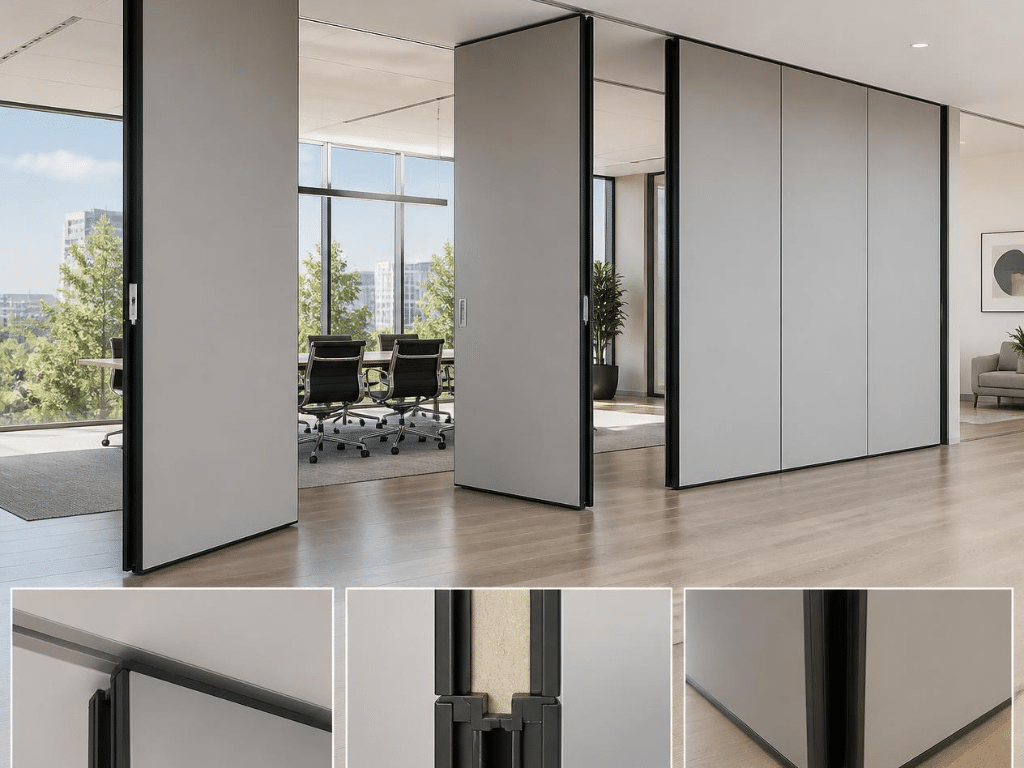
An operable wall panel is a steel-framed leaf built from a welded frame, a face skin, an internal core, and edge seals, all sized to hang from an overhead track. The frame carries the load and the seals, the core sets the acoustic mass, and the finish is the only part most people ever see.
The construction is more like a door than a wall. A typical panel uses 18-gauge formed steel framing with overlapped and welded corners for rigidity, and a continuous steel face sheet welded to the frame, with the vertical edges formed in steel to protect the skin. Inside sits the core that determines how much sound the panel blocks. Panels are nominally 76mm (3 inches) thick in standard 1,220mm (48 inch) widths, and the top channel is reinforced where the suspension trolleys attach. The result is a rigid, repeatable leaf that seals to its neighbours and to the floor and ceiling.
What core materials are used in operable wall panels?
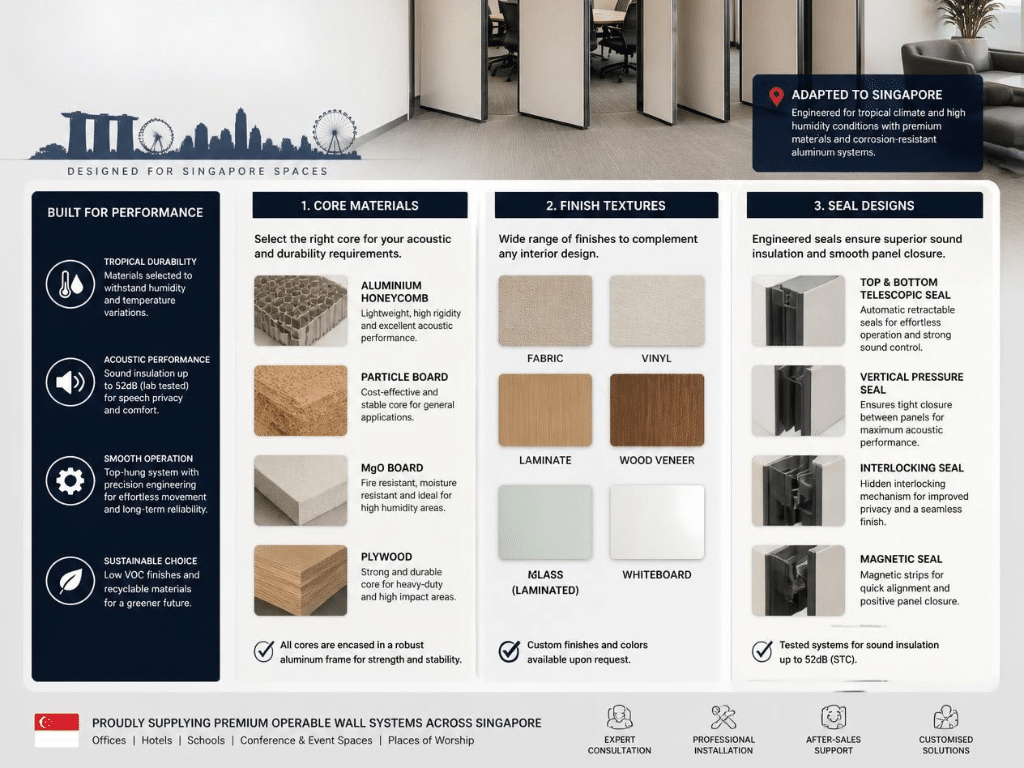
Operable wall panel cores fall into two families: lightweight honeycomb and dense acoustic infill. Honeycomb cores keep the panel light and cheap, while mineral and high-mass cores add the weight that blocks sound.
The choice is an acoustic and structural trade-off. A lightweight impact-resistant honeycomb core, as used in an all-steel panel such as the Panelfold 840, keeps hanging weight near 25.6 kg per square metre but caps the rating around STC 33. A denser mineral or gypsum-based core raises the mass and pushes the rating toward STC 50 and above, at the cost of a heavier panel and a higher-rated track. The cleaner approach for a function room or a boardroom is to specify the core to the acoustic target first, then confirm the track and structure can carry the weight, because a heavy high-STC panel on an under-rated track is a false economy. Where this breaks down is a cheap honeycomb panel sold into a space that needed real separation.
How does the panel core affect the acoustic rating (STC)?
The core drives the acoustic rating directly, because sound blocking follows mass, and a denser core blocks more sound. A honeycomb steel panel sits around STC 33, while a dense-core acoustic panel reaches STC 50 to 56.
Mass is most of the story, but not all of it. Two panels of the same thickness can differ by 15 STC points purely on core density and internal damping, which is why thickness alone tells you little. The industry-leading single-panel systems, such as Modernfold’s Acousti-Seal Encore, reach STC 56 through a dense core paired with automatic seals. Laboratory ratings are tested under ASTM E90 and classified under ASTM E413, and Moderco, an operable wall manufacturer, cautions specifiers against “simply looking at the STC number and not delving further” into the test detail. A panel rated STC 50 in a lab still needs its seals and installation to deliver in the room, which is where the specification for acoustic operable wall systems earns its keep.
What finishes can operable wall panels have?
Operable wall panels accept a wide range of finishes, from hard-wearing laminate to acoustic fabric, vinyl, timber veneer, steel, and writable markerboard. The finish is chosen last because it rides on whichever core meets the acoustic target.
Each finish trades durability against appearance and function. High-pressure laminate is the workhorse for a school hall or a function room, resisting knocks and cleaning easily, while reinforced vinyl with a woven backing, specified by weight from around 595 grams per lineal yard, is a common durable wrap. Acoustic fabric lifts sound absorption and looks refined in a boardroom, at a higher cost and with more care over its life. A writable markerboard finish turns a panel into a working whiteboard for a training room, and timber veneer or steel serves premium and industrial interiors. The same logic that guides a choice between glass and timber partition finishes applies here: match the finish to the traffic and the room, not to the sample that looks best on a desk.
How do operable wall panel seals work?
Panel seals close the gaps at the top, bottom, and between panels, and they matter as much as the core for real acoustic performance. A panel with a great core and poor seals leaks sound at every edge.
The seal system works on three edges. Horizontal top seals press against the track soffit, either as a continuous contact vinyl bulb or as a retractable seal that extends when the panel is positioned. Horizontal bottom seals are the automatic drop type, and a system like Modernfold’s SureSet provides a nominal 51mm operating clearance that drops into place with an operating range of plus 13mm to minus 38mm, without tools or cranks. Between panels, vertical interlocking seals close the joint. A quality panel drops its bottom seal automatically as it seats, so the operator does not crank each panel by hand, which is the difference between a wall that gets sealed properly every time and one that does not.
What are edge profiles and panel-to-panel joints?
Edge profiles are the interlocking vertical edges that lock one panel to the next and seal the joint against sound. The better systems use roll-formed steel astragals with a tongue-and-groove configuration, not plastic or aluminium.
The joint is where acoustic walls quietly fail. A vertical interlocking sound seal between panels uses steel astragals with a reversible tongue-and-groove edge, often in a double row with an acoustical labyrinth that lengthens the sound path. Rigid plastic or aluminium astragals are not acceptable in a serious acoustic spec, because they distort and leak over thousands of cycles. The panels align and pull together at each joint, and the final closure panel expands horizontally to lock the run tight. Insist on steel astragals in the specification, since the panel joint is the seam most likely to betray a wall rated well on paper.
How thick and heavy are operable wall panels?
Operable wall panels are nominally 76mm thick in 1,220mm standard widths, and weight ranges from about 25.6 kg per square metre for a light honeycomb panel to considerably more for a dense acoustic one. Thickness is fairly standard; weight is where the systems diverge.
Weight is the number that reaches the structure. A lightweight all-steel honeycomb panel hangs at around 25.6 kg per square metre at STC 33, while a high-STC acoustic panel carries much more mass to block sound, which sets the required track rating and the structural fixing overhead. Panel height then multiplies the load, since a taller panel of the same construction weighs proportionally more. This is why the track and the soffit fixing are engineered to the panel weight, not chosen from a catalogue, and why confirming panel weight per square metre belongs in every spec submittal alongside the width and height.
How does panel construction affect durability and maintenance?
Panel construction decides how well the wall survives daily use, and a welded steel frame with a hard finish outlasts a lightweight panel with a delicate wrap. The frame takes the abuse, the finish takes the wear, and the seals take the cycles.
Durability tracks the build quality. A welded 18-gauge steel frame resists the racking that loosens joints over years of operation, and a laminate or heavy vinyl finish shrugs off the trolley carts and chairs that scuff a function room wall. Seals are the wear item, since drop seals and astragal edges compress on every cycle and eventually need adjustment or replacement to hold their rating. For buildings needing extra protection, a fire-rated panel such as Modernfold’s Legacy Fire-Rated carries a one-hour rating tested at Underwriters Laboratories. Mordor Intelligence puts movable partitions on a 7.82 percent annual growth rate through 2031, which is drawing in suppliers of uneven build quality and makes construction detail worth checking. A maintenance plan that checks seal compression and track alignment keeps an operable wall performing, which is part of the value found across the benefits of operable walls over a fixed partition that cannot move at all.
How do you specify operable wall panels for a Singapore project?
Specify panels by four attributes: core and acoustic rating, finish, seal type, and weight per square metre. A spec that names all four lets you compare suppliers on engineering rather than on a finish sample.
State the STC target so the core is sized correctly, and name the finish against the room’s traffic and function. Require automatic drop bottom seals and steel astragal edges rather than manual seals and plastic joints. Confirm the panel weight per square metre so the track and soffit fixing are engineered to carry it. IMARC Group values the global movable walls market at 4.5 billion US dollars in 2024, and at that scale panel quality varies widely, so specify to engineering rather than to a finish sample. A provider offering a full supply and installation service can match the panel, the track, and the structural fixing under one design and one warranty. When your requirements are set, arrange a panel consultation so the specification is built to your room and its acoustic target.
Conclusion
Operable wall panels earn their rating on three things a brochure rarely shows: a core sized to the acoustic target, seals that drop and interlock automatically, and steel edge profiles that hold the joint tight over years of use. The finish is the easy choice; the core, the seals, and the weight are the ones that decide whether the wall works. Specify those, and the panel performs long after the sample has faded from memory.
Enforce Automatic Global supplies, installs, and maintains operable and movable wall panels for hotels, schools, and commercial interiors across Singapore. Arrange a panel consultation to set your acoustic target, finish, and seal specification, then receive panels engineered to your opening rather than a standard kit.
Frequently asked questions
What is the standard thickness of an operable wall panel?
Operable wall panels are nominally 76mm (3 inches) thick in standard 1,220mm (48 inch) widths, a dimension consistent across major systems like Modernfold Acousti-Seal. Thickness stays fairly constant while the core density changes, so two 76mm panels can differ by 15 STC points depending on whether the core is honeycomb or dense acoustic infill.
Can operable wall panels have a writable whiteboard surface?
Yes. A markerboard or writable finish turns an operable wall panel into a working whiteboard, which suits training rooms and classrooms that divide a hall. The writable surface is one finish option among laminate, fabric, vinyl, and veneer, and it rides on the same steel-framed panel core, so the acoustic rating is unaffected by the finish choice.
How much does an operable wall panel weigh?
A lightweight all-steel honeycomb panel weighs around 25.6 kg per square metre at STC 33, while dense-core acoustic panels rated STC 50 and above weigh considerably more. Weight per square metre sets the required suspension track rating and structural fixing, which is why it belongs in every operable wall spec submittal alongside width and height.
Are fire-rated operable wall panels available in Singapore?
Yes. Fire-rated operable wall panels, such as Modernfold’s Legacy Fire-Rated system carrying a one-hour rating tested at Underwriters Laboratories, are available for buildings that require compartmentation across a movable opening. Confirm the fire rating against the project’s fire safety requirements, since a standard acoustic panel carries no fire rating by default.