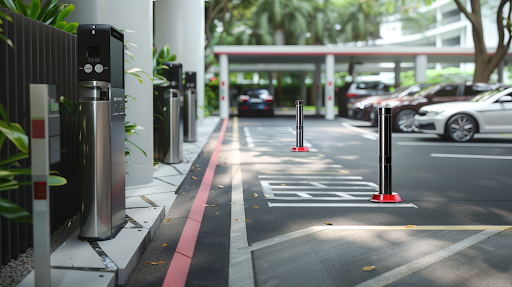


Speed Gate Singapore for Office Lobbies
Choosing a speed gate singapore system is not only about appearance. It affects traffic flow, access control, lobby operations, and daily security performance. This blog will walk you through how to choose the right system for office lobbies, commercial buildings, and high-traffic entrances.
Speed gates have a clear role in modern commercial entrances
A speed gate is a pedestrian entry control system designed for faster, more controlled passage than traditional tripod turnstiles. In Singapore, it is typically used in premium office buildings, corporate headquarters, airports, and high-security facilities where owners want both access control and a cleaner front-of-house presentation. Enforce’s live product category describes luxury speed gates as a high-end solution for fast, secure, and stylish pedestrian flow in precisely these settings.
That matters because a speed gate is not just a gate. In a real building, it sits inside a larger operating environment that includes access credentials, reception workflow, visitor handling, emergency release logic, circulation space, and maintenance support. If a building already runs on access control systems, the speed gate should be selected as part of that system architecture, not as a decorative add-on at the lobby line.
This is where many commercial projects go wrong. The buying team focuses on glass panels, cabinet finish, or opening speed, then discovers later that the lane configuration is awkward, the reader position slows people down, or the building staff have no clean way to manage exceptions. A good entrance system should reduce friction, not move it from one point in the journey to another.

Office lobbies need speed gates that balance control and presentation
In an office lobby, the gate line is part security checkpoint, part brand environment. It is the first physical system staff, visitors, and clients interact with. That changes how the equipment should be chosen.
A glass barrier gate is usually a better fit than a more industrial turnstile when the building wants open sightlines, a cleaner arrival experience, and a more premium entrance design. The visual difference matters, but the operational difference matters more. Staff should be able to present a card, phone, or approved credential and move through without hesitation. Visitors should be able to understand where to wait and where to go. Reception should be able to intervene without stepping into a messy queue.
This is why lane spacing, pedestal position, barrier height, and reader placement should be decided with the lobby layout in mind. A speed gate that looks polished in a catalogue can still perform badly if it is installed in the wrong line of movement.
For broader entrance planning, some buyers also compare how adjacent systems handle traffic and design constraints. Enforce’s automatic door installation cost guide makes the same practical point from another angle: the right entrance automation decision depends on traffic flow, operational need, and compliance context, not just hardware choice.

Commercial buildings need a gate system that can handle mixed user profiles
Single-tenant offices are usually more predictable. Mixed-use and multi-tenant buildings are not.
A commercial building may need to manage employees, tenants, visitors, contractors, technicians, and delivery personnel through the same entrance zone. In that environment, a pedestrian access control system in Singapore has to do more than open quickly. It has to support credential logic, keep movement organised, and allow building staff to deal with exceptions without creating a bottleneck.
That means the selection process should account for real user behaviour. Do contractors need escorted access? Does reception issue QR-based visitor approvals? Does the landlord require different access rules by tenant or by time window? Are deliveries channelled through the same frontage or a different path? Those are operating questions, but they should shape the hardware choice from the start.
Where the entrance profile is more security-led, it also makes sense to compare the speed gate against the broader turnstile gate control system range rather than assume one type suits every project. Enforce’s live category structure separates luxury speed gates, tripod turnstiles, swing turnstiles, flap barriers, slide-up turnstiles, and full-height turnstiles because each serves a different access-control purpose.
Throughput depends on lane planning more than brochure claims
Pedestrian throughput is one of the most misunderstood parts of gate selection. Buyers often ask how fast a lane opens and closes. That is only one part of the answer.
Real throughput depends on how many people arrive in the same time window, how quickly the credential reads, how well the user understands the process, how much stacking space exists before the lane, and how easily people can disperse after they pass through. A lane with fast mechanics can still underperform if the approach is cramped or the reader position causes hesitation.
This becomes obvious during the morning peak. If the lobby receives a concentrated arrival wave between 8.30 am and 9.15 am, the entrance has to process people smoothly without forcing security staff to manually manage the queue. In practice, two well-planned lanes can outperform three badly arranged lanes.
Lane width matters here as well. Wider passage may be necessary for users carrying bags, small trolleys, or equipment, and it becomes even more important where the route must support accessibility. Singapore’s Code on Accessibility in the Built Environment 2025 applies to new buildings and existing buildings undergoing addition and alteration works, and it frames accessibility as part of overall building usability, not a last-minute adjustment.
The practical lesson is simple. Decide the accessible route first. Then decide the gate line. Projects that reverse that order usually end up with awkward circulation, pinch points near reception, or late redesign.
Tailgating control should match the building’s actual risk profile
Tailgating control sounds like a technical feature, but it is really a risk-management decision.
Some office lobbies need basic deterrence and visual control. Others need stricter anti-tailgating performance because of tenant sensitivity, confidential operations, or a higher exposure to unauthorised access. A system selected for a finance office, controlled tenant floor, or data-sensitive workplace should not be specified the same way as a lower-risk commercial entrance.
This is where overspecification and underspecification both create problems. If the sensing logic is too weak, the gate line becomes more theatre than control. If it is too aggressive or poorly calibrated, false alarms and awkward stops will frustrate legitimate users and create friction at the exact point where the building wants smooth movement.
A useful buying approach is to define the building’s real operating risk first, then match the lane behaviour to that risk. The right answer is rarely the most expensive model on paper. It is the one whose detection logic, lane width, and supervision model suit the building’s actual usage.
Credential integration shapes the day-to-day success of the system
A speed gate that does not integrate cleanly with the building’s credentials will create manual work every day.
That integration may involve cards, mobile credentials, QR-based visitor passes, or a broader smart access control system workflow. What matters is not only whether the gate can technically connect to a reader. What matters is whether the building can run one coherent access process instead of a patchwork of workarounds.
This is also where data handling enters the discussion. If the system captures or processes personal information through visitor records, employee identifiers, QR registrations, or biometric workflows, the project should be reviewed in light of Singapore’s Personal Data Protection Act. PDPC has also stated that private organisations should cease using full or partial NRIC numbers for authentication by 31 December 2026. That is directly relevant for buildings or vendors still relying on older identity practices in access workflows.
The commercial implication is straightforward. If you are installing a new gate line in 2026, it makes little sense to build it around outdated authentication habits.
Emergency egress and compliance cannot be left to the end of the project
A speed gate is installed for controlled entry, but it still sits inside a building that must be safe during an alarm, evacuation, power issue, or system fault. That means emergency release behaviour should be part of the selection discussion from the start.
Singapore’s SCDF has published guidance that gates and turnstiles installed along egress paths affect means of escape and are subject to fire safety considerations. SCDF’s advisory on installation of gates and turnstiles in buildings states this directly, and its code on gate-type emergency exits at fare control lines reinforces the broader point that access systems must not compromise safe exit movement.
For commercial buyers, the lesson is practical. Ask how the gate behaves during deactivation, alarm events, and power interruption. Ask whether adjacent lanes remain operational during a lane fault. Ask how emergency opening is coordinated with the building system. Those are not edge-case questions. They are part of a serious gate specification.
Maintenance access affects cost, downtime, and long-term reliability
Maintenance access rarely gets enough attention during procurement. It should.
A busy office lobby can put thousands of cycles through a lane in a single day. If core components are difficult to reach, routine maintenance takes longer, fault isolation becomes harder, and simple service tasks start affecting the building’s operations. That is why cabinet access, controller reachability, sensor servicing, and the ability to isolate one lane without shutting down the whole line should be reviewed before purchase.
A gate that is difficult to service is not a cheaper system. It is a delayed cost.
The right specification depends on building type and operating pattern
For a single-tenant corporate HQ, the priority is usually a polished lobby appearance, smooth credential presentation, controlled visitor flow, and moderate to strong anti-tailgating performance.
For a multi-tenant commercial building, the priority shifts toward flexible credential logic, clearer exception handling, and stronger coordination between gate line, reception, and visitor management.
For a high-traffic frontage, lane capacity, approach space, post-entry dispersal, and service redundancy become more important than cosmetic upgrades.
That is why a speed gate should never be specified as a generic “premium entrance solution.” It needs to be matched to building profile, user behaviour, risk level, and traffic pattern. Buyers who treat all four as one decision usually end up with a neater answer on paper than in operation.
Conclusion
A good speed gate system does more than secure an entrance. It supports lobby flow, aligns with access control, respects compliance requirements, and remains serviceable after handover. For most Singapore office and commercial projects, the strongest buying decisions start with lane planning, integration, egress behaviour, and maintenance access.
If you are evaluating a new automatic gate installation and access solution for a commercial property, Enforce can help assess the site based on real operating needs, not just catalogue features.
FAQs About Speed Gate Singapore
What is the difference between a speed gate and a normal turnstile?
A speed gate is designed for faster, smoother pedestrian movement and a cleaner front-of-house look. A standard turnstile, such as a tripod unit, is often more utilitarian and better suited to lower-cost or back-of-house control points.
Is a speed gate suitable for all office lobbies?
No. It suits lobbies that need controlled entry, stronger presentation, and steady traffic handling. In lower-traffic or more industrial settings, another turnstile type may be more practical.
Can a speed gate integrate with access cards and visitor systems?
Yes, provided the gate is specified as part of the wider access control setup. Integration quality matters more than the gate body itself because daily operations depend on one clean credential workflow.
Do speed gates need to meet accessibility and fire safety considerations?
Yes. BCA accessibility requirements and SCDF egress considerations both matter when gates are placed along circulation and exit paths in commercial buildings.
Is PDPA relevant to a speed gate project?
Yes, especially if the system handles visitor identity, staff credentials, or biometric records. PDPC’s 2026 guidance on NRIC authentication is particularly relevant for access workflows that still rely on outdated identity practices.